Meditation XVI
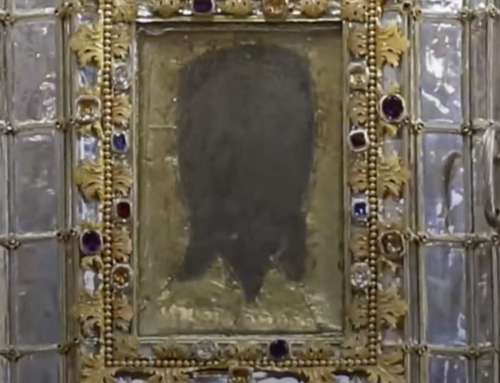
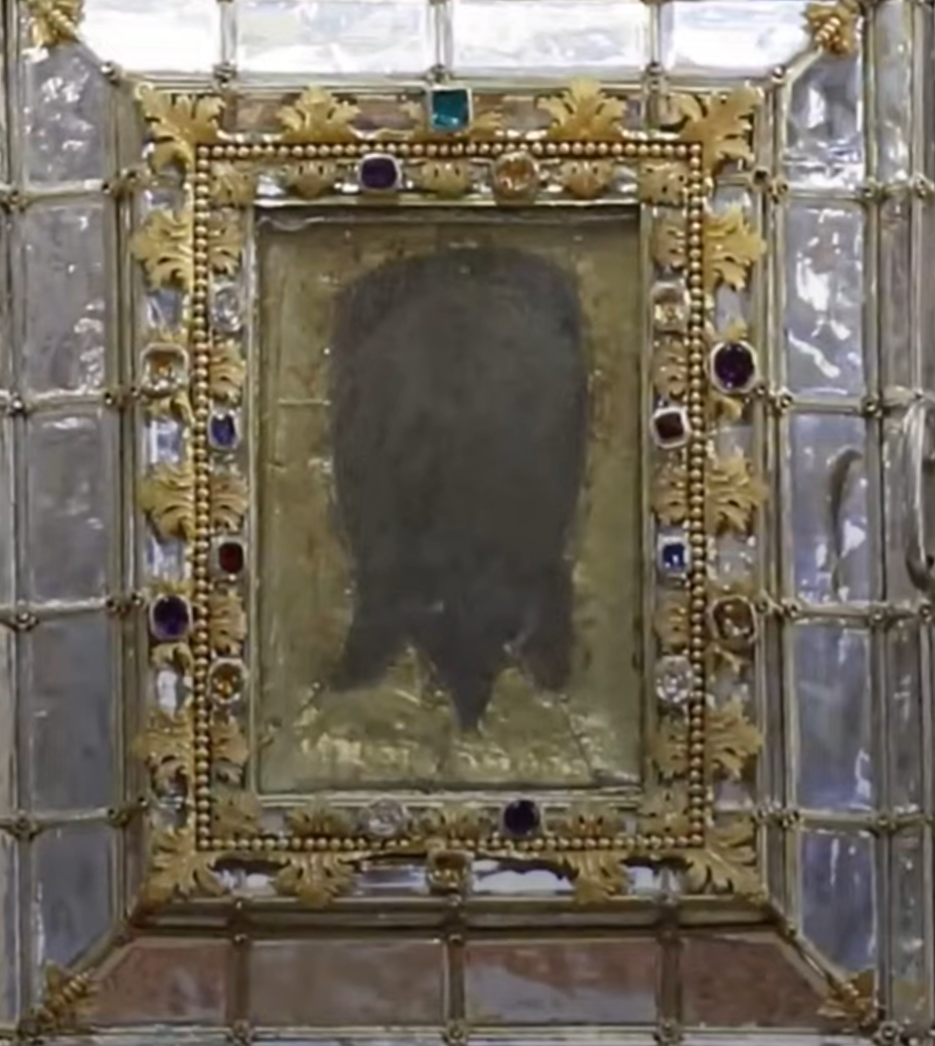
THE HOLY FACE IN THE GROTTO OF THE AGONY.
Oh adorable Face, bowed down to the ground in the garden of Olives and bearing the shame of our sins, have pity on us.
The hour of the Passion of the divine Master has struck. It is in the grotto of the garden of Olives that we are about to assist at the voluntary sufferings of the Holy Face. “Sit here,” said Jesus to his disciples, “till I go yonder and pray(1). Remain here if you have not courage to follow me further; but watch and pray, for the spirit is ready, but the flesh is weak. My soul is heavy even unto death,” he soon afterwards adds. Then, entering into the garden of the Agony, he bows down his Face to the ground. Let us follow in the train of the angels who accompany him there. Let us contemplate his sufferings, let us meditate upon them with real compunction.
1st POINT. — THE PRAYER OF JESUS.
According to an ancient tradition, this grotto, where we are meeting together in spirit, served as a refuge for our first parents after their expulsion from the terrestrial Paradise, even as Golgotha was the place of the sepulcher of Adam. It is there that Jesus prays and that he weeps in order to expiate the sins of the world, which appear to him in their infinite forms and in all their hideousness. He is on his knees, and his eyes, at the aspect of this horrible vision, close with grief and shame. They cannot bear the sight, and are sorrowfully bowed down to the ground; his heart, on the contrary, rises to God his Father, and from his agonized lips escapes the cry prompted by nature— “Father, if it be possible, let this cup pass from me. Nevertheless not my will, but thine be done.” And, saying these words, he fell with his Face to the ground.
Contemplate, oh my soul, the Face of Jesus, pale and disfigured by the sufferings of his agony. It is bathed in a cold sweat, and this sweat is the divine blood which will soon flow down in floods at the Praetorium and on Calvary. Jesus has put his heart in the wine press of his love; he cannot keep back the generous wine of his blood which issues from all the pores of his sacred body. His adorable Face is more especially inundated with it. His noble and majestic brow permits these divine sweats which veil his eyes to pour down in abundance, they saturate his hair and his beard and run down to the ground to render it fruitful. What sorrow, what fear, what terror he experiences at the sight of the sins, which he is about to expiate by so many ignominies and so many sufferings!
2nd POINT.— THE CONSOLING ANGEL
Wherefore, oh Jesus, seeing thou wert able to redeem the world by simple act of submission to the offended Majesty of thy Father, didst thou will thus to choose the very extreme of suffering? And wherefore, when carrying to thy lips the cup of bitterness, didst thou all at once experience the horror of thy agony? Jesus willed to suffer thus, answers a saintly Father, to show that he was really man, and to teach us also to suffer with him. How terrible a mystery is suffering, and yet what is more common? Suffering is necessary, and every man who refuses suffering refuses the palm of victory and the crown of glory. But courage, oh my soul. He who created thee is aware of thy weakness. Human nature in Christ accepted the succor of the consoling angel to soften his agony. He who himself experienced it will himself come to thy aid. Jesus will be thy good consoling angel. Let then the moral suffering whether of the heart or mind, or the physical suffering of the body come upon thee, and thou wilt say, with the Master — “Oh my Father, if it be possible, let this cup pass from me.” And when the angel shall have revealed his presence at thy side, thou wilt add immediately— “Nevertheless the will be done, and not mine.” God will proportion the consolation to the trial, he will not permit thee to be tempted above what thou art able to bear.
SPIRITUAL BOUQUET.
Procidit in faciem suam, orans et dicens: Pater mi, si possibile est, transeat a me calix iste; verumtamen non sicut ego volo, sed sicut tu
And he fell upon his Face, praying and saying— “My Father, if it be possible, let this chalice pass from me; nevertheless not as I will, but as thou wilt.” (Mathew, xxvi, 39.)
DEATH OF HENRIETTA.
The only daughter of M. Dupont had remained during several years under the care of Mme de Lignac. To the charms of an angelic piety, the young girl added some of the rarest natural gifts. She was just finishing her education when an epidemic, suddenly breaking out in the school, forced the Ursulines to send their pupils to their several homes. Henrietta was delighted that her holidays should take place so much sooner than usual. She little thought that they would end for her in the grave.
During the days of her illness, which were days filled with anguish for her excellent father, the virtue of M. Dupont, which had already attained so great a degree of perfection, rose to a height of heroism which made a lively and lasting impression on all who knew him.
“After the sick child had received the last sacraments,” writes a holy priest who was an intimate friend of M. Dupont, and who had not lost sigh of him during the whole course of his bitter trial(2), “her father recited the prayers of the dying… He was holding the hand of his daughter in his, and with a sublime expression of faith or his countenance, he said— ‘Depart Christian soul, depart, depart! remain no longer on this earth, where God is sinned against, depart! Death is life, the world is death. Go, my daughter, you are on the point of seeing God. Tell him all we are feeling, all we are suffering at this moment… Tell him that our only desire is that he should be satisfied with us in this trial… I suffer, it is true, my heart is torn. But, my daughter, they are the sufferings which attend a birth. I am giving a heavenly birth to you to-day. It is true that on earth we are the image of God, but it is a rude image hardly discernible. It is only in heaven that God finishes and perfects us. Depart, my daughter, and do not forget my commissions… I am still your father, and, in the name of my authority over you, I command you to say nothing to God until you have fulfilled them all.’”
M. Dupont, ever since the beginning of his daughter’s illness, had not failed to solicit the prayers of his neighbors, the pious Carmelites of Tours. Sister Saint-Pierre, with whom he had already been in communication, had prayed fervently, but had several times expressed her conviction that the young girl would not recover. God had willed to impose this hard sacrifice upon his servant, to raise him more quickly to holiness and to make him the instrument of his works of reparation through the Holy Face.
Down to the last moment, the child was perfectly conscious. Her father, who had remained on his knees overwhelmed by grief, suddenly rose, and again taking her hand, said to her— “Oh my daughter, you will not leave me. We shall not be separated. God is everywhere. You will be in his presence in Heaven, and you will see him. I here below will also be with him, and, through him, I shall be with you… Two walls separate us at this moment. Yours will soon fall; mine will also one day fall; we shall then be once more united, and we shall be together always.”
Then, when the dying girl had breathed her last sigh, M. Dupont, turning towards Dr Bretonneau, who was standing by her bed, said to him with a heavenly expression of face— “Doctor, my child sees God!” And then, in a transport worthy of a saint, he recited, others say he intoned the Magnificat.
This was really the ideal of a Christian.
INVOCATION.
Oh God, who didst prove the faith of Abraham by the sacrifice of his only child, and who didst fill thy servant with the same spirit, increase in me this faith, and grant me the grace of perfect submission to thy adorable will, whatever may be the trials by which it may please thee to lead us to holiness.
(1) Matth. xxvi. 35-46.
(2) M. I’abbé Regnard.