His Vocation—His Relations with Sister Saint-Pierre—La Salette.
Without having the character and mission of a priest, Mr. Dupont exercised the apostleship by his letters, conversations, and charitable intercourse with others. Several of his friends were astonished that he remained a secular without elevating himself to a more evangelical and perfect state. A holy missionary of America, who was well acquainted with him, and with whom he kept up an active correspondence, judging by his letters inflamed with divine love that he might yet devote himself to the function of the priesthood, and become an apostle of the new world, proposed it to him. Mr. Dupont refused humbly and frankly. He did not consider himself worthy of the vocation to the missionary life; he admires it in those who have received it; he envies them; but our Lord has not said to him: “Sequere me!” “Follow me.” “Besides,” he adds, “it is not necessary to expatriate oneself in order to find souls to save. He, Who alone gives vocations knows where to send his workmen. What concerns us, is to beg our dear Lord to send laborers to the harvest of souls in France, that the reign of God may be established, and that France may be blessed with sons ready to march to the conquest of the pagan world beyond the sea.” He will not then be of the number of those conquerors whom he admires; he is not called to the apostleship of the priesthood; but another vocation is assigned him. Whilst remaining at Tours, in the bosom of his family and in the secular state, he will become one of those “laborers” in the Lord’s vineyard whom he asks for France; it is in France, in his own country, that he will contribute, in his way, to extend the “reign of God,” of which he so ardently desires the increase.
The apostolate which Mr. Dupont was destined to exercise in our midst was that of reparation. Without knowing it, without even suspecting it, he was already, as if instinctively, preparing for it in prayer. Not satisfied by uniting with the Church in the recitation of the breviary, he associated himself with holy souls in imploring the salvation of France and in acts of reparation for the scandals which were committed.
Among these scandals, one particularly afflicted him. It was that of blasphemy. Perhaps in our days the habit of gross blasphemy, which consists in continually pronouncing with irreverence the adorable and holy name of God, has somewhat diminished, at least in the higher classes of society. But it was different at the period of Mr. Dupont’s life of which we are now writing. After the revolution of 1793, this ignoble and horrible habit pervaded all ranks and even tainted the conversation of literary men. It was not uncommon to hear very small children uttering frightful oaths and blasphemies, even in the presence of their parents. It was allowable in certain salons in which was assembled a revolutionary, Voltarian, and impious society. This will furnish an explanation of the holy audacity displayed by Mr. Dupont in his efforts to combat this habit. Whenever a word which directly attacked the Divine Majesty fell upon his ear, he was moved by a virtuous indignation. He was restrained neither by personal considerations nor by human respect. Zeal for the outraged glory of God urged him to acts which none other would have dared to permit himself, but to which the efficacy of his prayers, and the benediction of heaven always attached a special grace of reparation, and, not unfrequently, a striking conversion.
Once, when travelling, he took his seat beside the driver who uttered a blasphemous expression. Mr. Dupont instantly dealt him a heavy blow. Surprised and indignant, the driver stops his horses and demands an explanation of the insult offered him. “Unhappy man,” replied Mr. Dupont, “it is you who have insulted me. You have outraged my Father! Who gives you the right to insult my Father in this manner?” “Your Father,” said the blasphemer, astounded as much by the remark as by the blow. “Yes,” continued Mr. Dupont, “God is my Father and your Father; why do you outrage Him?” And then with the eloquence of his heart and the vivacity of his faith, he endeavored to make him comprehend how unworthy it was of a Christian to blaspheme the thrice holy God. The poor man, confused and ashamed, alleged as his excuse, his deplorable habit and promised to amend. By the time they had reached the end of the journey, they were good friends. Mr. Dupont, on parting, presented him a five-franc piece, and invited him to visit him at Tours. He had the gratification of learning later from the driver himself that he had corrected his bad habit and was leading a Christian life.
On another occasion, when he was going in a diligence from Saint-Malo to Rennes, the postilion scarcely spoke without an oath. Notwithstanding the presence of two or three travelling agents, at each oath, Mr. Dupont repeated aloud a Gloria Patri in reparation. At last, unable to endure it longer, he caught the postilion by the arm and said to him: “Friend, cease, I beg you, to blaspheme the holy name of God. Each time you wish to swear, give me a blow instead; that would please me much better.” We may judge of the impression made upon his auditors by the words of a man whose only thought was the glory of God. A good religious, who was once in the coupé of a vehicle with him, relates that he paid the driver so much a league for refraining from blasphemy. As this practice was habitual with him, we shall know, only at the day of judgment, how many oaths he prevented.
When passing through the streets of a city he never failed to reprove blasphemers, although he was often repaid by insult and contempt. Once, however, he met an unfortunate man who was uttering terrible oaths. Mr. Dupont stopped and begged him earnestly either to be silent or give him a blow. “Why should I strike you, sir?” asked the man in astonishment. “Because it would be far less painful to me to receive a blow from you, than to hear you outrage the holy name of God.” Impressed by his words, the blasphemer begged his pardon and promised amendment.
His zeal on this point suggested to him minute precautions which would hardly have occurred to another. One of his friends writes: ” I was walking, on one occasion, with Mr. Dupont. He saw lying on the pavement a small stone; he picked it up and placed it against the wall, remarking as he did so: “Whenever we find a stone lying in the way on a street or road, we should always remove it, because it might cause a man or beast to stumble, and besides the injury it would do to them, the man might be irritated and tempted to blaspheme the holy name of God.”
His devotion to St. Louis, king of France, arose partly from the idea of reparation, as he particularly honored in the prince the zeal of his justice in punishing and reforming blasphemers, and he prepared himself for the annual celebration of his feast by special prayers, called “The Forty Days of St. Louis.”
This union of prayers, sent to Tours during the the course of the year 1843, was distributed to a few pious souls, and among others to Mr. Dupont, who accepted it with delight, and observed the practices enjoined. It commenced on the 16th of July, festival of Our Lady of Mount Carmel, and terminated on the 25th of August, feast of St. Louis. A copy of the prayers was not sent the Carmelites, and they had absolutely no knowledge of the devotion. It is important to remark this fact, because on the day following the feast of St. Louis, August 26, there occurred at the Carmelite Convent, a remarkable, supernatural event, which was to be the commencement and origin of Mr. Dupont’s grand mission of reparation.
There was among the Carmelites a young religious, a native of Brittany, whom St. Martin seemed to have conducted to Tours by a special protection. She was a simple workwoman of Rennes, possessed of few natural endowments, but favored by God and enriched with the gifts of grace. Her name in religion was Marie de Saint-Pierre. Her amiable disposition and her sweet cordiality equaled the fervor of her piety and her simplicity. God did not long delay to manifest His designs over her. On the morning of the 26th of August, 1843, she sought the Rev. Mother Prioress after Mass, and throwing herself at her feet, said to her: “Our Lord has just commanded me to say, and induce others to say as often as possible, the following invocation respecting the great crime of blasphemy. May the most holy, most sacred, most adorable name of God be praised, blessed, loved, adored, and glorified in heaven, on earth, and in hell, by all the creatures of God, and by the Sacred Heart of our Lord and Savior Jesus Christ, in the most holy Sacrament of the Altar.’”
Now it happened that the 25th, the eve of this ineffable communication, was the last day of the forty days’ devotion to St. Louis, of which we spoke above, and which terminated by the aspiration: May Thy name, O Lord, be always and everywhere known and blessed! It did not seem at all improbable, that the “union of prayers,” which had not been made at Carmel, but in many cities and by a large number of pious persons, had hastened the establishment of the work of reparation.
This communication was the prelude of a series of graces granted to the humble religious, having, for their object, the establishment of a confraternity destined to repair the crimes of blasphemy and the profanation of Sunday. The Sister had proved the truth of her mission by circumstances esteemed miraculous. Permission in the first instance was given to have printed a small pamphlet containing the prayers sent from Poitiers, under the title of Association for the Extinction of Blasphemy; at the head was a picture of St. Louis in prayer, and underneath, the aspiration: May the name of the Lord be blessed! These were republished at Tours with the approbation of the Archbishop, Monseigneur Morlot. As the publication involved communication with persons outside the Monastery, and as Superiors, through prudential motives did not wish to appear in the affair, Mr. Dupont was selected to attend to the necessary arrangements. Monseigneur Morlot approved the choice, and wrote himself to Mr. Dupont upon the subject.
He permitted an act of reparation to the holy name of God to be added to the prayers of the Association. The associates were to pledge themselves never to utter a blasphemy, to exert the authority they had over others to prevent blasphemy, to make reparation, by a vocal or mental aspiration, for the blasphemies they might hear. In this we have the germ of the work of reparation.
The servant of God sincerely rejoiced at the encouragement thus extended by the pious Archbishop. On one of these pamphlets he wrote: Signatum est super nos lumen vultus tui, Domine, dedisti laetitiam in corde meo. The light of Thy countenance, O Lord, is signed upon us: Thou hast given gladness to my heart — and he added below: St. Veronica, pray for us. The devotion to the Holy Face commences to dawn.
Mr. Dupont became avowedly the distributor — according to his own expression — the peddler of the pamphlet of St. Louis. He conceived, at the same time, the idea of composing a Little Office in honor of the holy name of God. With this intention, he first collected all the texts referring to the divine name, which are scattered through different parts of the Scriptures. A selection of beautiful prayers analogous to the texts, enriched the collection as so many precious stones. Having completed this portion of the work, he chose from these passages of the Old and New Testament, a certain number which he arranged in the form of Psalms, lessons, chapters and versicles, presenting as a whole, a harmonious liturgical prayer appropriate to his design of reparation. As was his custom, he subjected his work to competent judges.
The Little Office of the Holy Name of God was issued with the approbation of Monseigneur Morlot. Each hour is preceded by a short explanation. The Latin text is followed by a French translation, carefully prepared by Mr. Dupont, who, to secure its correctness, consulted the most learned ecclesiastics. The little book was published by M. Marne, in the same volume with another entitled: Association of Prayers against Blasphemy, Imprecations and Profanation of Sunday and Holy Days. This latter work contains the statutes of the association of reparation, reflections on blasphemy and the profanation of Sunday, acts of reparation, aspirations and prayers. Thus arranged, the book was widely circulated, and prepared the faithful for another more important work which, in the designs of Providence, was about to be established.
This was the work of reparation urged by Sister Saint-Pierre. Three years had already passed since the pious Carmelite demanded it in the name of God. She declared that the exterior emblem would be the outraged Face of Christ; and acting on this idea, she had composed the Litany of the Holy Face and other analogous prayers. After many and various trials, intended to test the reality of the communications she professed to have received, her superiors acknowledged them to be truly from the Holy Spirit, and they were desirous of carrying the project into execution; but none of them would venture to take the initiative. At last they arranged a pamphlet which contained the substance of the divine communications, and which was called: “Abridgement of the Facts Concerning the Work for the Reparation of Blasphemy.” This pamphlet, intended for circulation among a few Carmelite houses and a small number of pious souls, was submitted in manuscript to the Archbishop, and was approved by him. Mr. Dupont, again placing his services at the disposal of the Community, distributed these pamphlets among his friends.
One of these fell into the hands of Mr. Lebrument, a fervent Christian of Rouen. To assure himself of the reality of the facts related in it, he determined to make a visit to Tours. Convinced of their truth by the information furnished him in that city, he did not hesitate to interest himself actively in the success of the work, being resolved to forward it whenever Providence should throw the occasion in his way. An opportunity soon offered.
Passing through Paris on his return to Rouen, he met at the hotel a priest of his acquaintance, M. l’Abbé Favrel, vicar-general of the diocese of Langres, who informed him that his bishop, Monseigneur Parisis, was at the same hotel, and invited him to pay his respects to the illustrious prelate, which he did that very day. During the conversation, the pious layman spoke of his visit to Touraine, related what he had learned from Mr. Dupont, and dwelt upon the necessity of the work of reparation. The Bishop of Langres was struck by what he heard. He admitted that, for some time, he had cherished the wish of establishing a similar confraternity in his diocese. He wrote immediately upon the subject to the Archbishop of Tours, who, as a measure of precaution, on account of the revelations made to the Carmelite sister, upon which he was unwilling to pronounce authoritatively at that time, left the initiative to Monseigneur Parisis. Thus empowered to act, his lordship of Langres, by an episcopal decree dated June 28, 1847, erected the confraternity in reparation of blasphemy and profanation of Sunday in a parochial church of Saint-Dizier, dedicated to St. Martin, and he deputed to Rome M. l’Abbé Marche, curate of that parish, to solicit in favor of the association the title of archconfraternity and special indulgences. Pius IX, who had been elevated to the chair of St. Peter two years previously, welcomed with a kind of enthusiasm the petition of the Bishop of Langres, and made, on that occasion, the remark which has been so frequently repeated: “Reparation is a work destined to save society.” He granted the indulgences which had been asked, elevated the Association of Reparation of Saint-Dizier to the dignity of an archconfraternity, and inscribed his own name the first on the list of associates, a wonderful privilege, which was the seed of many benedictions.
The idea of repairing blasphemy and the profanation of Sunday, hitherto entertained in the secrecy of their hearts by a few pious souls, now became general. Parishes and individuals were registered by thousands, and the revelation made to the humble Carmelite and, through her, communicated to the Church, was the source whence has sprung all the works of reparation of our day.
In consequence of the facts above related, Mr. Dupont had frequent interviews with Sister Saint-Pierre. The fervent layman followed with ever increasing interest the action of God on this privileged soul. His candid and simple faith led him to unite cheerfully with the Sister in her cherished devotions, particularly in that to the Infant Jesus. Whilst the Carmelites remained near the Cathedral, awaiting the completion of their new monastery which was being erected in the street of the Ursulines, Sister Saint-Pierre filled the office of portress, and Mr. Dupont went frequently to receive her commissions and to recommend himself to her prayers. She presented him little cases containing the Gospel which is read on the Feast of the Circumcision, in which is mentioned the name given the child Jesus. The pious Sister, to honor the divine Infant, had made numerous copies of this short Gospel and had enclosed them in little cases prepared for the purpose. Mr. Dupont assisted the Sister both in copying and distributing the Gospels. They were generally named “the short Gospel of Sister Saint-Pierre.” They were sent to persons who were ill, and remarkable cures, as well as great conversions, were obtained by those who wore them.
The Carmelite religious expressed the highest veneration for the servant of God. She took an interest in all that concerned him. As the time approached when Henrietta was to make her first communion, her father was extremely solicitous that she should be properly prepared for so holy an action. The Sister wrote to him: “I gladly accede to your request to address to the divine Infant Jesus for your daughter the touching prayer you have sent us, that this divine Infant may so dispose her young heart, that she may receive Him with perfect dispositions.” The prayer referred to is one addressed to the Infant Jesus, copied by Mr. Dupont, on the back of a little picture blessed by Gregory XVI, and sent from Rome by Madame Barat, in 1843. The Infant Jesus is represented seated amid lilies, holding a dove in his hand, and beneath is the inscription: “The Lord Jesus received in Holy Communion by a pure soul.” The pious Carmelite continues: “I am unworthy to offer your petitions to the Infant God; but I will beg Mary and Joseph to present my prayer, and to offer this dear child to the holy child Jesus, that the day of her first communion may be as the day of her betrothal with the heavenly and divine Spouse.”
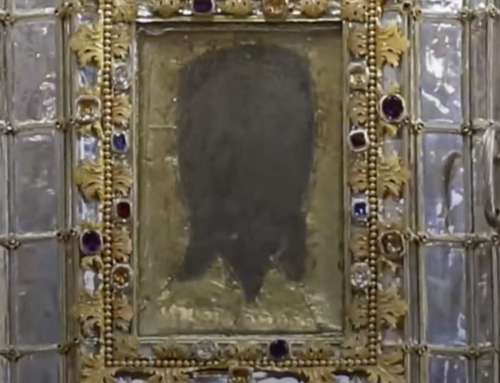
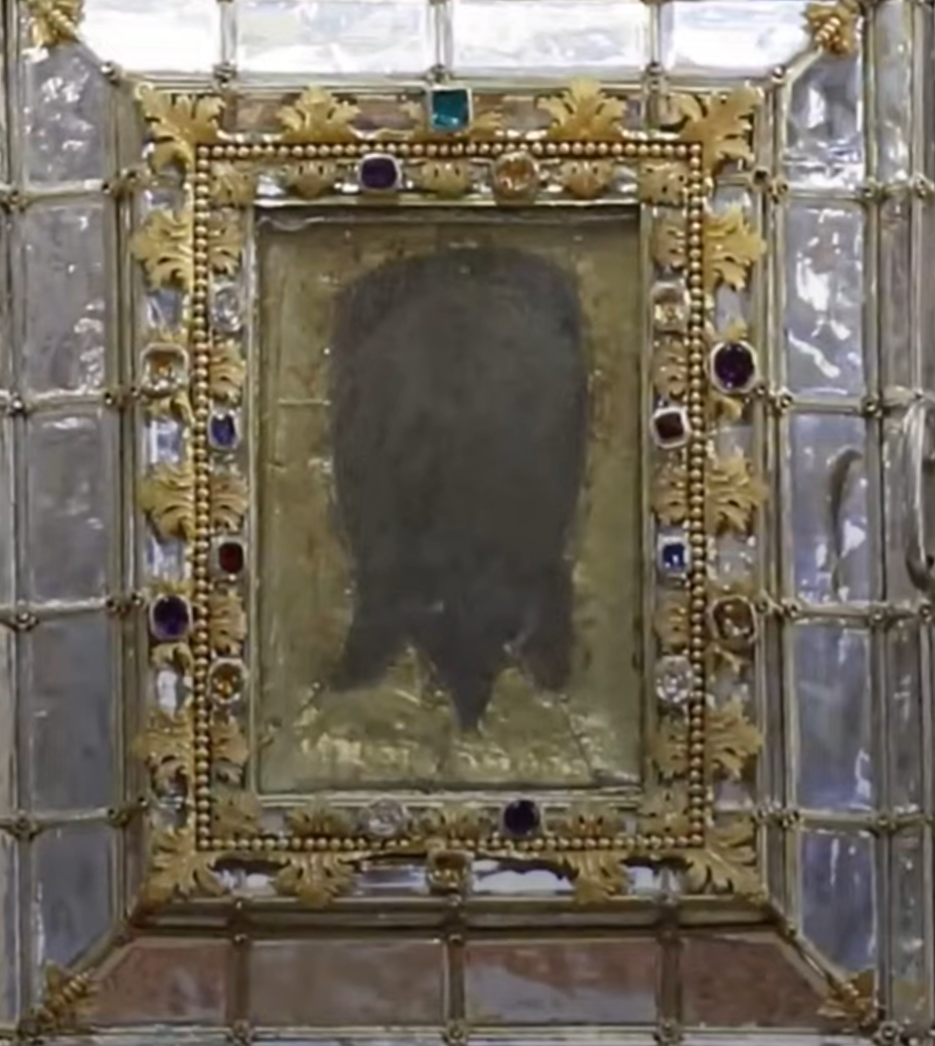
We see that Mr. Dupont’s association with the Carmelites was familiar and intimate. When the Community removed from Bauchereau street to the street of the Ursulines, Mr. Dupont, with the devoted kindness of a friend and benefactor, transacted all exterior affairs for them; he even became, so to say, their servant, going and coming from one house to the other, carrying in his hands statues and other articles liable to be broken. His house was the depot, during that time, for all articles belonging to the service of the chapel; the sacred vessels and the precious reliquaries of the Convent remained sometime in his room, and, by a remarkable coincidence, rested in the very spot which is now occupied by the picture of the Holy Face.
In the meantime, Sister Saint-Pierre continued to beg of God by fervent prayer to accomplish, through the instrumentality of others, the designs which He had revealed to her; for she, a poor religious, could do nothing, and she wished to remain unknown in her obscurity. There soon occurred in France a miraculous event of the utmost importance to reparation; an event which appeared to Mr. Dupont to be intimately connected with the divine manifestations vouchsafed the Carmelite religious.
He writes of it in the following manner:
“In 1846, early in September, I went, on the day preceding my departure with my family to Saint-Servan, to receive from the Prioress of the Carmelites, any commissions she might have for Saint-Malo, where she had relatives. During the conversation, we spoke of Sister Marie de Saint-Pierre. I had a pencil in my hand and I wrote at once what the Reverend Mother communicated to me. ‘The Sister has just told me that our Lord said to her: ‘My Mother has spoken to men of my anger. She desires to appease it; she has shown Me her breasts and said to me: Behold the breasts which nourished you; permit them to pour out benedictions upon my other children; then full of mercy to man, she descended to earth: have confidence in her.” I placed these lines in my prayer book,” continues Mr. Dupont. “The words were mysterious, apparently linking the past with the present and the future. I did not attempt to fathom their meaning; I rested content in the somewhat vague conviction I had previously formed that the Sister was favored with confidential communications from our Lord. My conviction became stronger, when I received on the 22nd of October of the same year, a copy of the first letter written by the curate of Corps, relative to the apparition of the Blessed Virgin at La Salette on the 19th of September.” Mr. Dupont considered the apparition as a confirmation of the words of Sister Saint-Pierre, which seemed to foretell it. He immediately for warded to the curate of Corps, a copy of the notes he had taken in the parlor of the Carmelites.’ The curate replied: “I believed in the apparition from the first; I am now doubly convinced of its reality.”
Mr. Dupont believed also. He was not in the least astonished when he heard an account of the apparition of the Blessed Virgin at La Salette; he admired the connection existing between that event and the communication vouchsafed to Sister Saint-Pierre. “How touching it is,” he said, “to behold our August Mother confiding the sorrow of her maternal heart to poor little children! Was it not enough that she should have been sprinkled with the blood of her Divine Son on Calvary? Must the frightful stations of the streets of Jerusalem be renewed in our days by the blasphemies of an impious generation? What will become of us, if Mary can no longer restrain the arm of Jesus?”
An account of the miraculous apparition was communicated to the Carmelites of Tours by Mr. Dupont, and it created considerable sensation among them. Like their holy friend, they regarded it as a striking confirmation of the demands made by Sister Saint-Pierre on the part of God. The mission imposed on the shepherds of the mountain was, evidently, identical with that confided to the cloistered religious. The Sister, therefore, when speaking of them, called them her two little trumpets. Hearing shortly afterwards of the erection of the archconfraternity, she exclaimed joyously: “My mission on earth is accomplished, now I shall die.” She was not mistaken. She died July 8, 1848, offering herself as a victim for the salvation of France. She was thirty-one years of age.
Mr. Dupont assisted at the funeral obsequies and accompanied her mortal remains to the cemetery. From that time, he was accustomed to pray frequently at the tomb of the venerated Sister, and he took care that it should be kept in good order. When, seven years afterwards, the cemetery was removed beyond the city limits, Mr. Dupont took advantage of the circumstance to exhume the remains and restore them to the Monastery. With pious care and religious respect, he collected the bones, and, to the great joy of the Mother Prioress and the religious, he obtained the sanction of the authorities to deposit them within the enclosure; they were placed in the chapter-hall, where they now lie. True to his characteristic faith and influenced by his belief as to the necessity of reparation, Mr. Dupont never, for an instant, doubted the miraculous apparition at La Salette. He was one of the first pilgrims to the holy mountain. He visited it in company with a venerable priest of Grenoble, from whose account we copy the following:
“We went in the month of July, 1849, the year after the apparition. We found but two cabins on the mountain. At our departure from Corbelin, we numbered five. As there was at that time no railroad running to the place, we travelled in a stagecoach; the good pilgrim took advantage of every occasion to speak of the things of God. Like St. Francis of Assisi, he made use of creatures to rise to the Creator. Prayer and aspirations seasoned his agreeable and edifying conversation. On the road we passed a castle in which a miraculous cure had been obtained by a member of the family; Mr. Dupont proposed that we should say a prayer of thanksgiving for the favor granted by God to the individual, after which he related other wonders of grace which this recalled to his mind. It would be impossible to express the pleasure we derived from his charming conversations. At Corps, we were received by the Sisters of Providence with whom the two little children of the apparition had been placed. We were permitted to see and interrogate them without restraint. They accompanied us in our ascent of the mountain, and on the very spot of the apparition the children separately gave us an account of it. At that time the stations of the Blessed Virgin were marked only by three small crosses, and the path she traversed was covered with grass.
“On the mountain, Mr. Dupont edified the pilgrims by his humility and faith. How often he kissed the ground hallowed by the footsteps of the Blessed Virgin! He followed, on his knees, the path she had traversed; he plucked a few blades of grass and gathered some little stones as a souvenir of the spot, and drank of the water of the fountain.” How precious, but how short were the moments we passed on the mountain! We descended like the Apostles from Tabor, and the good brother said to me: ‘Write in the note-book: The pilgrim who has travelled a hundred and eighty leagues says: I will return!’ Writing afterwards to the good pilgrim at Tours, I reminded him of his promise; but he replied that he was the pilgrim obliged to remain in one place and the servant of the Holy Face, that his time was no longer his own.
“Mr. Dupont, during the pilgrimage, was the hero of our companies. He edified, he astonished by his Christian conversation; he was regarded as an apostle. When we were visiting the Sisters at Corenc, the Superioress assembled the community in their conference-hall, and the holy man, for nearly two hours, edified, charmed his auditors. Thence we went to the Grande-Chartreuse. The woods, the rocks, the grottos, but more than all, the penitential life of the Angels of the Solitude spoke to the heart of the pious pilgrim, who saw them for the first time.’”
We can readily imagine from the above unaffected narrative the edification given by Mr. Dupont during this journey. His amiable qualities and his eminent virtues were evident to all who were thrown in his society. Mr. Orcel, Superior of the grand seminary of Grenoble, frequently inquired for that good Christian of the first century. The curate of Corbelin wrote of him: “Since the Sunday when he served my Mass, I have felt increased devotion to the Blessed Sacrament of the altar.”
On this journey, Mr. Dupont saw the curé d’Ars. The interview between the two servants of God was remarkable: it recalls that between St. Dominic and St. Francis of Assisi. Mr. Dupont tells us that he undertook the journey for the purpose of having a conversation with Mr. Viannay, for whom he had long professed great veneration. But how could he succeed in addressing him when a crowd of people, arranged in double rows, were already there, and were crowding upon his path as he left the church. Suddenly the curé d’Ars perceives the holy man of Tours, with whom he was not acquainted, whom he had never seen. He stops, goes up to him, fixes upon him his eyes beaming with kindness; then smiling, he joins his hands, and glancing upward, he says: “O my dear friend, how sweet it will be to us to find ourselves in heaven singing the praises of our God!” “I needed nothing more,” added Mr. Dupont gaily; “I withdrew contented, preserving in my heart the words of the holy Curé”
His first care, after his return from this pilgrimage, was to establish at Tours a sanctuary as a center of the devotion to Our Lady of La Salette. The simple chapel of the Monastery of the Purification seemed to him suited to the purpose. He was particularly interested in the community. His confessor and friend, the canon Pasquier, had founded it, with the intention of repairing the outrages committed against the Divine Majesty by those who profane the Sunday, and also to labor for their conversion by works of expiation and by prayer. The intention was pleasing to the servant of God. He had already aided the recent foundation by abundant alms; ties of friendship united him to the Superioress. At his suggestion and by his advice, she petitioned the ecclesiastical authorities to place the humble sanctuary under the invocation of Our Lady of Salette. As there was question of rebuilding it, Mr. Dupont presented a large sum, to facilitate the purchase of the ground and the enlarging of the building. When, in 1856, the whole was completed, he placed in the sanctuary, beside the altar, a picture of the apparition, which for the first time was exposed to the public veneration of the faithful.
Such is the commencement of the devotion to Our Lady of Salette among the people of Tours, and the origin of the novenas which are annually made previous to the 19th of September. In order to give permanency to this movement, the servant of Mary considered an association necessary. After conferring on the subject with ecclesiastics on whose judgment he relied, he decided to request the Archbishop, Monseigneur Guibert, to erect a confraternity. He returned a favorable answer to the petition, and by a decree of the 19th of September, 1857, he erected in the chapel of the Purification the Confraternity of Our Lady of Reconciliation, which was afterwards affiliated to the archconfraternity of the same name established on the holy mountain.
The chapel of the Purification, next to that of the Carmelites, was the one most frequently visited by Mr. Dupont. He often heard Mass and received Holy Communion there; he never failed to be present on any special feasts of the Monastery; he interested himself in a paternal manner in all the necessities of the house. For example, not long after the chapel was built, the stone cross surmounting it, fell upon the roof. Mr. Dupont, on visiting the Community, noticed it. He sent immediately for a mason, ordered a similar cross, upon which he directed the Heart of Jesus to be cut; the whole was executed at his expense.
The devotion to Our Lady of Reconciliation led to intimate and friendly relations between himself and the religious of the Purification which lasted as long as his life. “A few weeks before his death,” writes the Superioress, “he sent us a bottle of the miraculous water which he had brought with him from the holy mountain. The date is written with his own hand, and, although so many years have passed since it was drawn from the fountain, the water is perfectly clear and pure.”
During his whole life, even when he was the most absorbed by the worship of the Holy Face, Mr. Dupont preserved a particular devotion to Our Lady of Salette. To his eyes, there was such a relation between the Face of Jesus covered with sweat, spittle and blood, and that of the Virgin of Dolors inundated by tears, that for him the two devotions were but one. “Our Lady of Salette,” he would say, “seems to have united them by bearing a crucifix on her breast.”