His Works of Charity — His Conversations.
The servant of God, next to assiduous visits to the churches in which our Lord dwells, and to the sanctuaries where the saints are honored, had nothing more at heart than visiting the suffering poor. The conference of St. Vincent de Paul had just been established at Tours, and Mr. Dupont immediately requested to be admitted as a member.
He became, from the first, associated with the honorable and virtuous men of the city, and soon acquired a marked influence over them. The modesty of his demeanor won the sympathy of his fellow members, quite as much as the fame of his virtues and the example of his piety. To those who knew him well, who caught a glimpse of the celestial light which illumined his soul, and who knew in what magnificent charities he expended his income, and often a portion of his principal, it was a strange and edifying sight to behold him come every week to the conference, asking a small alms of a few pounds of bread, which he scrupulously offered in the name of all to some poor family. He gave an account of his visit, and with exquisite delicacy, replied to all the questions put to him. He rarely volunteered to speak; and if he wished to make a suggestion, he first consulted the President or some member of the Board. He put himself forward as little as possible.
He particularly delighted in these reunions, because he met there such society as he preferred — Christians reputed pious and fervent, or whom he strove to render such. Without any assumption on his part, he formed in the midst of the conferences of St. Vincent de Paul, a phalanx of devout men of which he was the head, and who were unconsciously influenced by the enthusiasm of his lively faith and ardent piety. When he was about to establish the nocturnal adoration, these members of the conferences formed the principal nucleus of adorers.
As to the poor he visited them much more frequently than the other members, and gave far more abundant alms than was allotted to each; and yet, at the weekly meeting, the treasurer could affirm that Mr. Dupont was present, simply by looking in his purse. How he loved the poor! With what interest he watched the result of an illness! A former President writes: “I had mentioned to him a family whom I was visiting. It was that of a tiler named Talon. The unfortunate man, having fallen from a roof, had been terribly mangled. His life was a long martyrdom; but he had become very pious and perfectly resigned. Mr. Dupont went to see him from time to time, encouraged and consoled him. One morning we met at the Cathedral, and he said to me with a countenance radiant with joy: Talon is dead! I kissed his heart before the chill of death had frozen it.’ The sight of a Christian death delighted him.”
Visiting the poor, and pious conversations with his fellow members, attracted Mr. Dupont to the conferences of St. Vincent de Paul. But the official part of the meetings, the formal assemblies, reports and settling of accounts were distasteful to him. He willingly left this to others, and would never consent to accept any office. He chose rather the practice of good works.
The conference of Tours had under its direction, at that time, says one of the presidents, a number of different kinds of works, such as the superintendence of apprentices, instruction of soldiers and classes of adults. Mr. Dupont comprehended their importance and was deeply interested in them. For a long time he devoted a portion of his evenings to the class of adults, which was assembled three times a week. One hundred and fifty workmen of various trades and ages received lessons in reading, writing, grammar and arithmetic. Mr. Dupont never absented himself; from seven to nine o’clock he was at his post, ready to receive all who presented themselves, but choosing for his own pupils the most ignorant, those who did not even know their letters. When, through his exertions, they had commenced to spell, he advanced them to the class of another member, by whom they were taught to read.
He never seemed so pleased as when seated on a bench, surrounded by these poor people in their working clothes, covered with dust and impregnated with the bad odors exhaled from their work and their miserable huts. He never manifested the slightest repugnance, but radiant with joy, he would frequently stop some member of the conference as he passed, and claim his admiration for the knowledge and progress of some poor man, who had, by hard labor, succeeded in spelling a word of two or three syllables. On such occasions, it was necessary to congratulate the master, to compliment and encourage the pupil. “He is improving, he is improving,” Mr. Dupont would say, “he will succeed.” Among others, there was a sort of colossus, a laboring man, quite young and very dull, who was an assiduous scholar of Mr. Dupont. During four consecutive years, Mr. Dupont devoted several hours three times a week to the task of cultivating this untutored mind. Although the perseverance of the young colossus, in his efforts to learn to read, was not crowned with success, it obtained for him something far more precious. He was as ignorant of his religion as of his letters, and if he did not learn his lessons, he learned the way to the Church; he attended Mass regularly, said his prayers and approached the sacraments. Mr. Dupont was right in saying: “He improves, he will succeed.”
His zeal was not less in the care of the soldiers than it had been for the class of adults. With them, however, his efforts were not restricted to instructions; his attention must be given also to their amusements and games. Mr. Dupont made no difficulty in taking his part in them. By his unfailing kindness, and charming simplicity in speaking of God and His wonderful works, he excited the interest of the soldiers, and his friends say that on many occasions they were not only surprised, but touched by the manner in which they listened to his pious remarks, which awoke in them the sentiments of their youthful days, and remembrances of their childhood. The man of God gave no regular discourse, nor any address which had the appearance of a discourse; the soldiers were neither formally assembled, nor seated to hear him; but a group of men would collect around him in the garden or in the recreation hall, would come and go as they liked, asking him questions, and receiving his answers with unfeigned delight.
Mr. Dupont excelled in, what we may call, this family intercourse; in such circumstances his heart expanded, was at ease, and poured itself out naturally. He had the gift of familiar conversation. His diction was easy, clear, elegant, picturesque, in good taste, and without pretension or affectation; he entirely lost sight of himself, never sought to impose his opinions, even when he clung to them energetically through conviction; but both through a motive of prudence, and an humble distrust of self, he avoided discussions or contentions, unless in cases where there was question of moral right or wrong, or of a dogma of faith; for then he did not hesitate to enter into a discussion, but always in a calm, cordial manner, never wounding any one, although, at times, he was sharp and ironical when speaking of anti-Catholic prejudices and false doctrine. His clear and solid argumentation recalled the former magistrate of the Antilles; he had reasons peculiar to himself, ingenious and just repartees, which left his adversary without reply. His honesty of purpose, his candor, his delicacy of feeling, as well as the sincerity of his opinions, were so evident, that his opponents would yield the controversy through courtesy.
The learned and celebrated Dr. Bretonneau, himself an untiring and charming conversationalist, for a long time a neighbor, and always a friend of Mr. Dupont, would endure in religious matters, his reproaches, his piquant observations, his urgent solicitations, until at last, in self-defense, he would rush from the room and take refuge in the garden.
When Béranger, the well known lyric poet, established himself at Tours towards the end of his life, and fixed his residence not far from Saint-Etienne street, Mr. Dupont, in his pious proselytism, interested himself deeply in the soul of his new neighbor. He undertook to convert him. His conversation seemed to please the Parisian poet; he only persuaded him, however, to read St. Paul’s Epistles.
Mr. Dupont was inexhaustible in his stock of religious news, pious anecdotes, and accounts of miracles. He possessed the talent of relating them in an agreeable manner, entering, sometimes into details, which were always ingenious and edifying, even when they were long and minute; he threw into them a glow of imagination and a biblical poesy, which brought vividly before the mind the persons or things he was describing; and he represented to the life, by his voice and gesture, what he was narrating.
He did much good by his conversations in families and small companies, where he was always cordially welcomed. He took pleasure in visiting at houses where he could speak freely of God; he did this with an “ineffable” charm, to use an expression which was familiar to him. But if he happened to meet company who gave another turn to the conversation, he quietly withdrew.
His friends often contended for his society. “One evening,” says one of them, “as we were leaving the conference of St. Vincent de Paul, I invited him to pass the remainder of the evening with me. Mr. de Noricourt was equally desirous of having him at his house. We agreed to toss up for him. We were on the side walk of the Rue Royale. Mr. Dupont laughed heartily, and amiably accompanied home the friend who won him.”
At his own house, he received all who called upon him, and continued the conversation as long as they chose, provided they spoke of God, or things appertaining to God. “To speak of God, or to keep silence,” was already the motto he had adopted. He did not refuse even serious controversies with Protestants or Freethinkers. On these occasions, he appeared, not only as an agreeable conversationalist, but a skillful polemic and a true Christian apologist. We give an example.
A wealthy and erudite Englishman, named William Palmer, was passing some time at Tours, and although a Protestant, often visited Mr. Dupont. They had long, amicable discussions together, particularly on the real presence in the Eucharist. This was Mr. Dupont’s favorite subject; and he returned to it the more willingly with his learned opponent, because he maintained that all true Anglicans admitted the real presence. “You are the only Englishman,” said Mr. Dupont, “whom I have heard express such an opinion. For instance, Mrs. Bruce, with whom I corresponded for a long time, did not believe in it.” Mr. Palmer insisted that the lady had been misunderstood, and he asserted positively that no member of the Anglican Church could know his Catechism and deny the real presence. What was his astonishment, when Mr. Dupont arose and handed him an Anglican work entitled Crossman’s Catechism, in which a doctrine directly contrary to the real presence is positively taught. Now this Catechism, which was a sort of theological commentary of the Anglican doctrines drawn up by Dr. Crossman, had been published with the approbation of the “Society for Promoting Christian Knowledge,” which Society includes, by right, among its members all the archbishops and bishops of the established Church, and Mr. Palmer himself. Surprised and confused, he was compelled to say: “If the Catechism of the Church of England taught that doctrine, I would not remain in her communion. But Crossman’s Catechism is not the Catechism of the Church of England!”
A few days later, Mr. Palmer received from his friend a reasonable, but singular reproach; we transcribe it in his own words from a document written by himself.
“The day following the festival of the Assumption, August 16, Mr. Dupont told me that being seated as Administrator of the Church on a bench in the nave of the Cathedral, his eye fell upon me as I passed before the altar after Vespers, and he noticed that I had not made a genuflection to the Blessed Sacrament. He could only conclude that this indicated a want of faith. ‘You say that you believe as I do in the real presence, and you did not bend your knee! Ah!’ he exclaimed, ‘you have not faith.’ To all the explanations and excuses which I offered, he persisted in repeating. ‘You did not bend your knee! You do not believe!’ He then quoted a passage from St. John Chrysostom, in which this father speaks of an old man of his acquaintance who had been favored with revelations, and who affirmed that on one occasion he had seen angels bowed before the altar, adoring God really present. And for my part, adds St. Chrysostom, I believe it. I told him I was not disposed to deny it. ‘But,’ replied Mr. Dupont, ‘you do not bend, although angels adore!’ Among other things I told him that I had not the presumption to join in religious ceremonies in Catholic Churches; for I was regarded as excommunicated, and my presence only tolerated. ‘Ah!’ he replied, ‘the laws of men are nothing in such cases. But far from believing, you call us idolators because we bend before the Host.’”
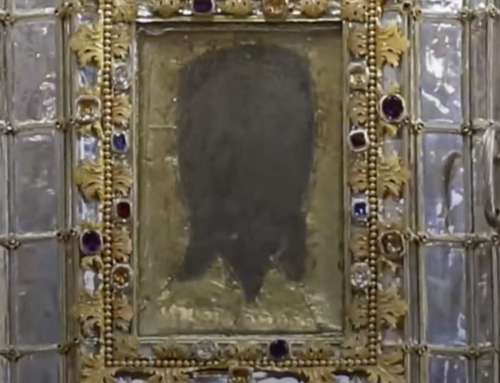
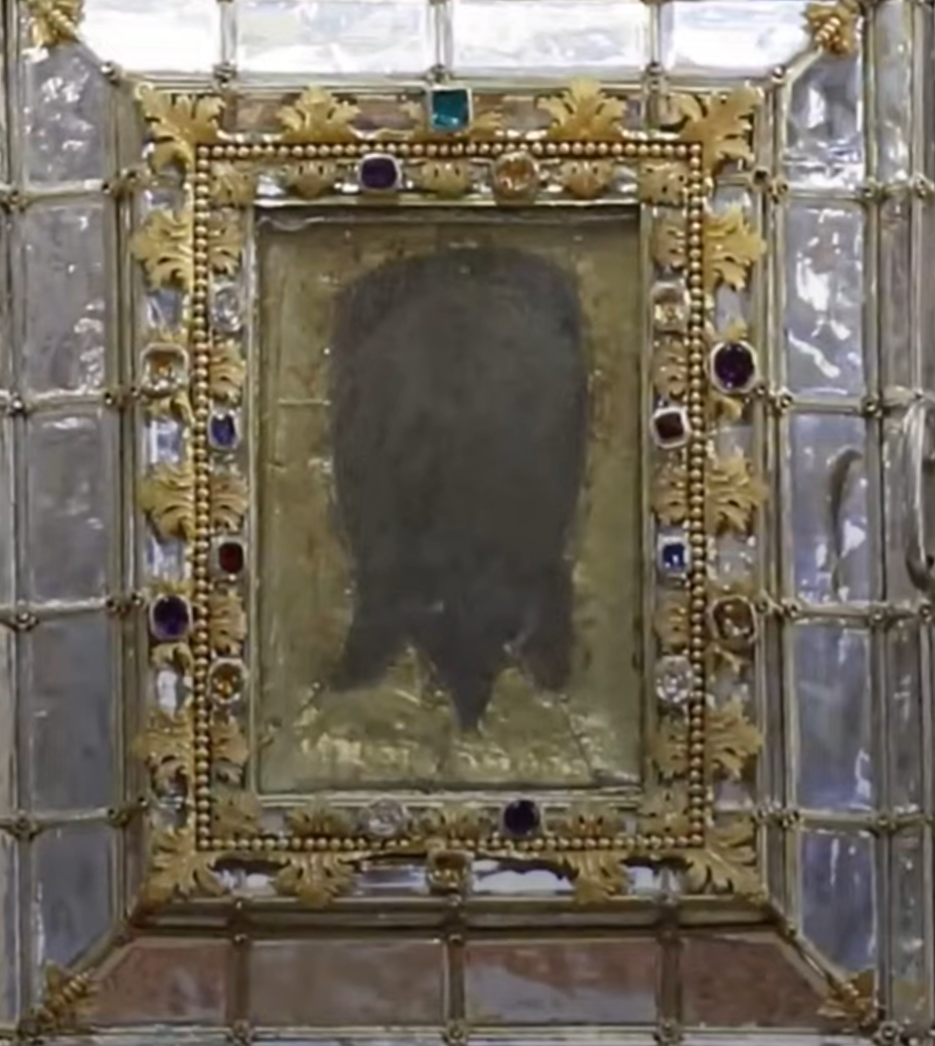
These remarks made a deep impression upon Mr. Palmer. With admirable docility, and an entire freedom from human respect, he profited by the lesson given him relative to genuflections before the Eucharist. “Not long after the above conversation,” he says, “two Anglican ministers, Fellows of Oxford, (one of them had been my professor,) making me a visit at Tours, reproached me for having knelt before the Blessed Sacrament in that very church, where I had scandalized Mr. Dupont by not making a genuflection.” Mr. Palmer was seeking the truth with sincerity: he was converted and became a zealous and fervent Catholic. Passing through Tours in 1862, he had the happiness of praying with Mr. Dupont before the Holy Face.
Mr. Dupont continued in his letters the good work he had commenced in his conversations. His correspondence, on his first arrival at Tours, was considerable; by degrees his letters were entirely on pious subjects. He wrote with facility and clearness; his style was that of good conversation; his thoughts were developed naturally and without effort; the mode of expression is often sprightly and original, enriched with quotations from Scripture, and associations of dates and circumstances furnished by his excellent memory. The number of letters he wrote was prodigious. Unfortunately, many which would have possessed a peculiar interest for us were destroyed; but those which have been preserved are charming: they reflect the qualities of his beautiful soul and loving heart; wise counsels and pious sentiments abound, and not unfrequently they are animated with a celestial enthusiasm.