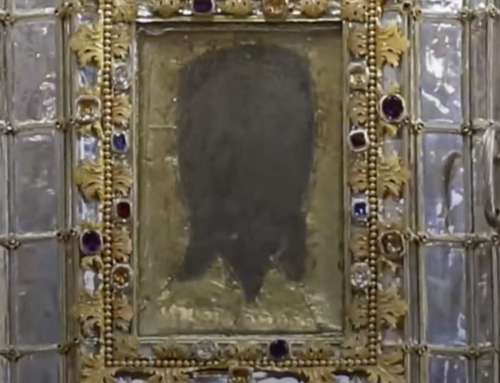
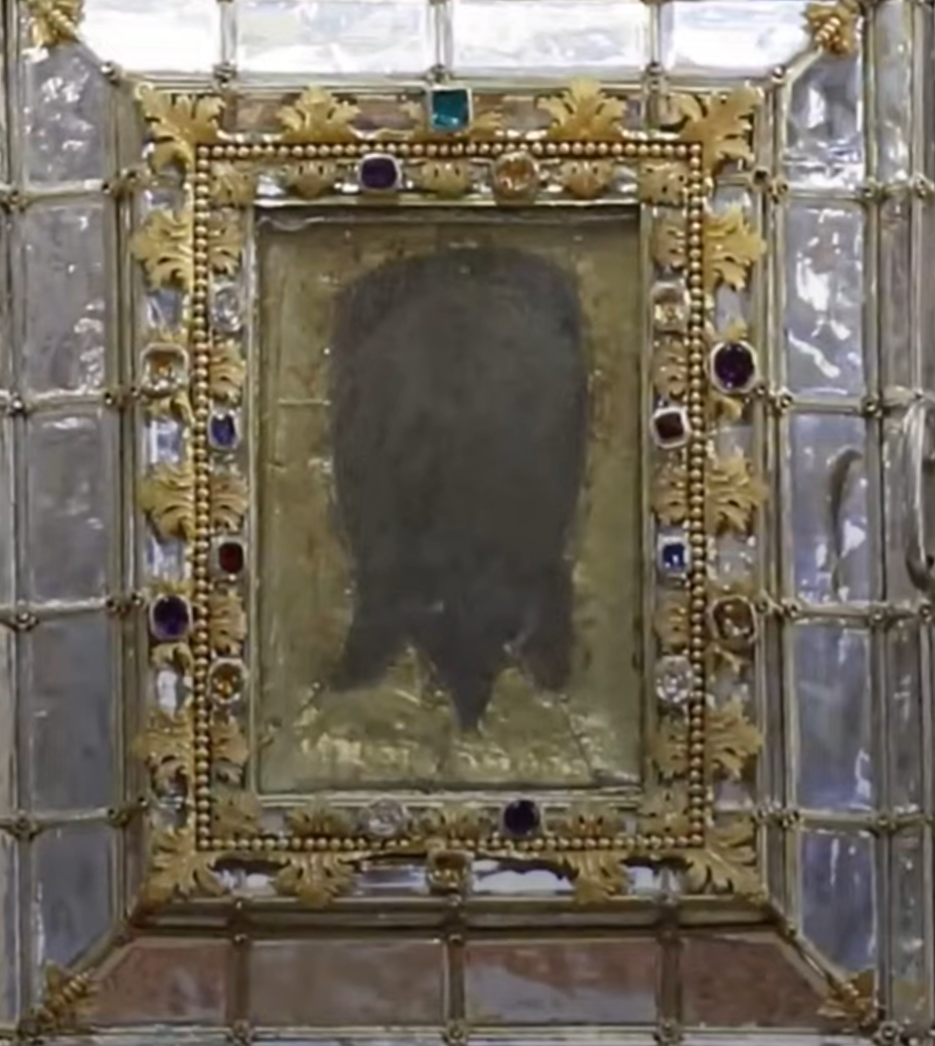
Second Period of the Devotion to the Holy Face — Certificates.
In the midst of the emotion caused by the miracles operated in Mr. Dupont’s room, what were the sentiments of the one to whom they were attributed by public opinion? It is an interesting inquiry. The answer is given by himself. “When any of those circumstances occur which are esteemed miraculous, my thoughts naturally turn to you, to Rome, and to God.” He wrote thus to the Prioress of the Benedictines of Arras, to whom, we may remember, he was indebted for his picture of the Holy Face. He adds: “That is the proper way of proceeding, is it not? And I remain in that kind of confusion which must accompany those whom the people regard as instruments” “Our Lord,” he says at another time, “blesses more and more those persons who undertake novenas in honor of the Holy Face, and desire in their hearts to repair the outrages committed against the holy name of God.” The idea of reparation! That is the dominant idea in his mind; to that he refers all the miracles of grace which are operated.
He was urged to record them, that God might be glorified. He replies as follows: “It would be extremely difficult for me, amid the multitude of my occupations, to find time to give a detailed account of the wonders daily accomplished before the Holy Face; besides, I do not think I have a mission for that. I content myself with collecting the certificates which are forwarded to me. There would be matter for a large volume, even omitting such accounts as are not sufficiently detailed. Should I, at any future time, be asked for these attestations, I shall not delay to resign them to the proper authority; on the contrary, I would give them willingly, because I should thus be relieved from the anxiety attending the safe keeping of the papers. Moreover, they would recall to memory the writings of the venerable Sister Saint-Pierre: they would give an impulse to the movement which is already inspiring thoughts tending to the work of reparation of blasphemy. It would seem that the time had come, when men should know the intentions of God, should fear the chastisements of His justice, and should take refuge in the Heart of Jesus ever open to mercy.”
Mr. Dupont awaited this moment in tranquility and peace, but he would never consent to use the press as a means of propagating the work of the Sacred Face. A friend urged him to publish a circular upon this work, that he might abridge the overwhelming correspondence to which he condemned himself, in order to give repeated explanations. “It is true,” he replied, “I am overwhelmed, but I do not think I am in a position to publish such a circular, although it would relieve me of heavy work. The public should not concern itself as to what passes here. So long as it pleases the good God to grant some little success to the work of the Holy Face, His providence will allow the ‘miserable pilgrim’ to perform his small duties.” He had no less repugnance for the publicity acquired by means of pamphlets or books. A priest of the Mission, at that time Superior of the House at Tours, related the following: “A pious layman, a distinguished savant and celebrated writer, came to see me one day, after leaving Mr. Dupont. ‘It is not fitting,’ he said, ‘that such prodigies of grace should remain unknown to the world; the glory of God and the good of religion are involved in it. There is subject matter for a beautiful book, having for its object to make known this holy man, and the work he has so zealously and so successfully embraced; I will undertake it.’ ‘Wait,’ I said to him; ‘the project, although good in itself, demands consideration; in such matters, ecclesiastical authorities must be consulted, and their approbation obtained; but it is chiefly important to know if Mr. Dupont himself would consent.’ ‘There can be no doubt of his sentiment on the subject,’ he replied, ‘as there is question of bringing before the people that which is the dearest of all things to his heart, — devotion to the Holy Face.’ I went to see the servant of God with whom I had been brought into frequent and intimate intercourse by the work of the Nocturnal Adoration.
‘I have good news for you.’ I said abruptly: ‘I know a pious and distinguished author, who proposes to write a book concerning the events which transpire here before the Holy Face.’ At these words, Mr. Dupont,— I can see him now, —throwing himself back in his chair in a manner habitual to him, folding his arms, and raising his eyes to heaven, said energetically, in a tone of displeasure, and with a dignified air that I shall never forget: ‘I declare positively that, on the very day, I hear that writer has published one word about me, I will close my house, leave Tours, and I will never return to it again.’ The decided way in which he pronounced these words, and the expression of his countenance impressed me the more, because I thought I should confer a pleasure, by informing him of a project having for its object the manifestation of the miraculous power of the Holy Face. His humility taught this grand Christian that such were not the means to glorify God. The author, on being informed of what had passed, abandoned his intention.”
On no account would Mr. Dupont have wished to attract attention to himself personally, or to lead any one to suppose that the favors obtained at his house were referable to him in the least degree. How often, when receiving in his drawing-room worthy people from the country, who, with simplicity and confidence, asked him to cure them of their maladies, has he exclaimed in a grave and severe tone: “Do you take me for a physician? I am nothing. God is good and all-powerful; kneel down and we will pray. If you have faith, you will obtain; others, worse than you, have obtained because they prayed with confidence…” At the same time, a certain expression of dissatisfaction and vexation upon his countenance, notified them that if they desired to please him, they were taking a false step by appearing to appreciate his virtues, and to rely upon the efficacy of his prayers. But he protested in vain; the miracles of the Holy Face were attributed to his intercession; and from every direction, there were sent him, under the form of attestations and certificates, letters of admiration and gratitude, in which praise of himself was mingled with the homage rendered to God.
What did he do? His course of action from the beginning was modest and prudent. Believing sincerely that he had no part in the miracles, referring all to the glory of the Holy Face, and to the work of reparation, he considered these documents as valuable evidence, as important testimony of sufficient weight to convince ecclesiastical authorities, when they should think the time had come to order an investigation. He regarded himself only as the depositary of them, not the proprietor. They were papers which Divine Providence deputed him to collect, and which were entrusted to his care. With this view, he accepted the certificates which were left with him upon the spot, after an instantaneous cure, or which were sent from a distance after a complete cure had been obtained. He verified these documents, and when occasion required, wrote brief notes upon them; he even requested them, reminding the individuals that it was their duty to render glory to God. It was not long before they lay in piles upon the shelves, and in the drawers of his desk. He cheerfully gave the most recent and most interesting to be read by his friends as a new incentive to their piety, or by strangers, to animate their faith. He would make them the subject of conversation, but quite simply, without parade or show, with an air of tranquil joy and quiet admiration; most frequently he would only point to them, indicating by a significant gesture, that they were awaiting the examination and decision of the competent authority, whenever it might be considered advisable to relieve him of the responsibility. As to taking steps for this purpose with the ecclesiastical superiors, in order to hasten the investigation, or prepare the way, none dared propose it to him, so well was it known that both by natural disposition and virtue, he was opposed to any step of the kind.
At least, would it not be advisable to arrange in a certain order this mass of papers which were sent from all parts of the country, and not leave them heaped pell-mell on his shelves? The question was asked the servant of God. Moreover, was it not necessary, at times, to give a certain form to the certificates, and draw up reports based upon the verbal depositions and written notes of the invalids and of eye-witnesses?
In consequence of his natural temperament and his constant occupations, Mr. Dupont was not the person to impose upon himself this kind of work,— a work, nevertheless, very important for the object he had in view. A friend offered to do it for him. This friend was Mr. d’Avrainville, his countryman, accustomed in the bureau of the navy department, in which he held a situation, to classify documents and write reports. He kindly offered his services to the servant of the Holy Face, to aid him in the “department of certificates,” and the offer was accepted with joy and gratitude. From time to time, Mr. d’Avrainville came from Paris to put in order the writings and to arrange “the rubbish,” as Mr. Dupont said, without adding or omitting anything, carefully preserving for these papers of every style, coming from persons of every rank, the traditional consideration with which the employees of a bureau guard the minutes confided to their care.
It was to this friend that the holy man bequeathed, by a codicil in his will, the entire collection of papers that, after his death, they might be delivered to those having jurisdiction over such matters. The trust was faithfully fulfilled. Arranged finally by other conscientious and intelligent friends, the precious documents are, at the present time, in the hands of the diocesan authority; and it is from them that we have been permitted to select the greater portion of the narratives we have given, relative to the miraculous cures which took place in Mr. Dupont’s room. We shall continue our selection from the same source, and we will now relate the principal facts of this kind, comprised in what we call the second period, from 1856 to 1860.
A child, about eleven years of age, deformed with a humpback, ill, and the back covered with blisters, was taken from the hospital to Mr. Dupont’s. After the prayers were said, he requested Madame R—–, who was present at the time, to retire with the child into the adjoining room to apply the oil. He never himself made the unctions on a female, unless it were on the forehead. Madame R—– was thus able to see the terrible affliction of the poor young girl. She had an enormous hump covered with blisters and plasters, because of a fearful ulcer, which the pious lady anointed with the oil, the best way she could, but not without repugnance. The servant of God redoubled his prayers. The unctions were repeated three times. After this, he resumed his writing, and Madame R——- began to read. During this time, the young girl walked slowly up and down the room, holding a crucifix in her hand and praying fervently. Every time she passed Mr. Dupont, who was seated at his desk, she politely bowed her head in salutation. She was a courteous, amiable, and very intelligent child. “Is it an imagination, an illusion?” said Mr. Dupont suddenly, as he raised his eyes and looked at the child; “it seems to me that the hump has disappeared. Take her,” he said to Madame R—–, “into the next room, undress her and examine the back.”
Madame R—— did as he directed, and as she opened the dress, the blisters, plasters, all the dressings of the ulcer fell to the ground. There was no hump on the back, nor the least appearance of the wound remaining; the child was no longer deformed. “Is it an illusion? Do our eyes deceive us?” said Mr. Dupont and Madame R—— to each other.
They sent for Mr. Dupont’s mother, Madame d’Arnaud, without telling her what had just happened. “Look at that poor little deformed child,” they said to her; “see, the hump on her back.” “Deformed! a hump on her back!” said Madame d’Arnaud; “what do you mean? She is no more deformed than you or I.” “She was, awhile ago,” they say to her; “but she is so no longer; our eyes do not deceive us.” Her clothing had become so large, that they were obliged to fasten it in folds, enable her to wear it.
On some occasions, prayer alone, offered by Mr. Dupont, sufficed to obtain wonderful cures. In 1856, one of his goddaughters, Mane R—-, only five months old, was ill with fever, diarrhea and vomiting. Her condition was such that they were obliged to watch her day and night; and the first inquiry made by the physician on entering the house was: “Is she alive?” At last, finding her very low, the doctor simply prescribed a mustard plaster, without anticipating any benefit from it. But, contrary to expectation, the infant passed the night without fever, diarrhea, or vomiting, and the doctor, instead of finding her dead, as he expected, noticed so great a change for the better that he pronounced her out of danger. So surprising was the improvement, that he inquired for how long a time they had applied the mustard plasters. He was told they had not been removed at all. He hastened to remove them himself, attributing the reaction to the mustard, and to the blisters which he expected to uncover; but what does he see? The limbs of the infant are not even reddened; by some unaccountable mistake, instead of using the mustard which he had ordered, the nurse had made a flaxseed poultice. There was but one explanation of the extraordinary circumstance which could be given. About the time, they applied the supposed mustard plasters, Mr. Dupont had called. He had prayed beside the child, and, upon leaving, he had said to the parents with emphasis: “Do not despair of her cure.” The physician did not hesitate to recognize a supernatural power in the sudden change. The visit and the prayer of Mr. Dupont without an unction, or other exterior sign, had obtained the cure. Impressed with the truth of this idea, the parents always preserved a reverential gratitude towards Mr. Dupont; they honored him as a saint, and the child, miraculously saved from death, is now a religious in a monastery of the Visitation.
The following anecdote was communicated to us by a Benedictine of England. Mr. Peter Swing, a student at the College of Downside, being attacked by an affection of the eyes which obliged him to suspend his studies, accompanied his family to Tours. There was no exterior evidence of defective sight. He went to the house of Mr. Dupont, who approached him, as he entered, and, to his astonishment, placing his hand upon his eyes, said: “Sir, the sight you came here to seek, will be restored to you.” The young man became deadly pale on hearing revealed to him what he had mentioned to no one. He, in reality, recovered his sight and resumed his studies at Downside, in England.
A reliable person narrates the following: “I heard from Mr. Dupont himself what I now repeat to you. I went to visit him, and I was scarcely seated when he said to me in his inimitable tone of tranquil joy; “Something singular has happened; it is a charming circumstance. A short time ago, a lady came and asked permission to pray before the Holy Face, requesting me to unite with her to obtain the conversion of her brother, an officer of high rank, at that time in garrison in a northern city. We recited some prayers, after which I spoke to her a few words of encouragement, and urged her to have confidence in the success of her petitions. I looked at her, and suddenly, an idea struck me. ‘But, Madam, there is something defective in your eyes, (she squinted); take a little oil and anoint them.’ ‘Oh! sir, that is of no consequence at my age,… and I have lived thus up to the present time,’ I insisted: ‘it is so simple and so well to ask of God even trifles.’ She consented and used the oil once; we prayed, and, after a second unction, she arose perfectly cured. We thanked God, and now she was full of confidence, sure of obtaining the desired conversion. She recommended herself to the prayers of the Adoration, and I promised to inscribe her petition upon the register. Yesterday morning, I received a letter from her. On her arrival, her brother regarded her with astonishment. ‘Ah! you have had an operation performed?’ ‘Not at all.’ She related to him what had passed; he was so impressed that he has received the sacraments.”
A priest from Normandy, the curate of an important parish, had been suffering for nine months from an extinction of voice. He was obliged always to carry about him a slate, as it was his only means of communicating with his friends. He went to Tours. Mr. Dupont anointed his throat with the oil which was burning before the Holy Face, and then began the prayers for the restoration of the invalid. Having finished the prayer, he requested him to speak. The priest replied in the lowest whisper that he dared not attempt it, because the effort to speak louder, deprived him of the power of uttering any sound whatever, and, moreover, resulted in acute pain of the throat. Mr. Dupont insisted. “You are a priest, sir, and you know better than I, who am a layman, the faith that is required, the faith that moves mountains. Try to say: Sit Nomen Domini benedictum! The good curate endeavored to articulate these words. He succeeded in making his voice heard, but it resembled that of a ventriloquist. They then said the Litany of the Holy Face and other prayers, which he was able to answer in a loud voice. The longer he continued to speak, the stronger his voice became, until, at last, it acquired its natural tone. ‘Sing the Magnificat,’ said Mr. Dupont; and immediately he sang the Magnificat in a strong and loud tone. The following Sunday, he preached at high mass, and related to his parishioners the facts above stated. He left his slate at Mr. Dupont’s, in testimony of his gratitude. For a long time, it lay on the chimney-piece of the servant of God, enclosed in a frame covered with glass. At the present moment it is among the “ex votos” in the oratory of the Sacred Face.
Besides the certificates of which we have spoken, there was another kind of ex voto not less valued by Mr. Dupont: we mean the canes and crutches left in his hands by the infirm and lame who had been healed before the Holy Face. These were collected, tied in bundles, and placed in a small cabinet which opened into the drawing-room, and which has since been styled “the miracle room,” a sort of museum, unique in its kind, presenting to the eye different objects which it is impossible to contemplate without a lively interest and intense emotion. To the pilgrim and the traveler, they offered indubitable evidence of the miraculous power exerted in that holy spot. They were of all forms, and of every quality, from the commonest stick and ordinary cane, to the pair of crutches skillfully stuffed and polished, each fashioned to suit the want of human infirmity; the greater portion of them had evidently been in long use. This strange and curious collection increased by degrees, as cures were operated and graces obtained. The account of it is simple and touching.
Almost every day, one, or several infirm persons present themselves with the hope of being healed. They are the cripple, the maimed, invalids attacked by gout, rheumatism, or paralyzed in different ways. One arrives dragging himself along painfully, leaning on crutches, or a stick; another is carried in the arms of a parent, a servant, or a friend; others are supported as they totter along. Prayers are said, and the holy oil applied to the diseased or paralyzed limbs; the prayer is heard, and faith is rewarded. The sufferer declares himself, either partially, or wholly relieved; the infirm recover their health; the lame walk; those who, a moment before, were incapable of moving, arise and move without help. To test their strength, they walk around the apartment, or, with overflowing joy, they run in the garden. Before leaving, in order to visit, by Mr. Dupont’s advice, the different churches of the city, and to deposit, for the poor, in the box of each, an offering of thanksgiving, they place in the “room of miracles” the stick or the crutches which, in future, will be useless to them. The man of God attaches to each an inscription, containing simply a name and a date. It is an additional ex voto offering, another homage rendered to the power of the Holy Face; it is a palpable proof which none can contest, which will rejoice the good, fortify the weak, and inspire others with confidence in the efficacy of prayer. Later, they will famish to diocesan authority matter for an official document which may be presented as evidence in favor of the work of reparation. They have been deposited by persons from different countries, and from all parts of France. In this manner the precious collection has been gradually formed. The facts we have thus grouped together and recorded in a general way, occurred successively, in public, in the presence of friends, strangers, pilgrims of every kind, going and coming during the whole time, all of whom could say: “I saw, I was present, I can assert.”
“I saw,” says Zépherin, the servant of Mr. Dupont, “a young girl of seventeen brought in a carriage from the depot, and carried in her father’s arms to the drawing-room. I saw her instantaneously cured; she left her crutch before the Holy Face, and returned to the cars without any support whatever.” The same servant relates many similar instances which he witnessed almost every day. He mentions, among others, a cripple, living near Tours, who was completely cured, and who left his crutch at Mr. Dupont’s.
These miracles were, of course, much spoken of by the public, and they formed an inexhaustible subject of conversation. Very many were reported by the citizens of Tours, and circulated among the people. It would be impossible to relate so large a number; we, however, give an extraordinary one, for the truth of which we can vouch.
A worthy woman, well known in her neighborhood by the name of Mother Eugene, had been for a long time confined to her bed, from which she could arise only with extreme difficulty. The parish priest, on going one day to visit her, found her almost incapable of moving herself. What was his astonishment, the following day, when he saw Mother Eugene walk rapidly towards the confessional where he was seated, and kneel, without difficulty, to make her confession, — Mother Eugene whom he had seen on the eve unable even to lift her hand! ‘How did this happen, good Mother?’ he said to her. She answered calmly: ‘Oh! sir, I went to Mr. Dupont, and I am well now.’ And then she told, as the most natural and simple thing in the world, that being urged by one of her neighbors who had been talking to her of the holy man, she arose, as best she could, aided by Mother Proust, another kind neighbor; she begged her husband for a crutch, and he borrowed one for her. She reached Mr. Dupont’s in this condition. She was anointed with the oil, and she was immediately cured. “As a proof of your cure,” said Mr. Dupont, “leave your crutch here.” She did as he directed. On her return home, she related all to her husband. “Where is the crutch?” he asked. “What have you done with it?” It was a borrowed crutch which he had promised to return. In order to leave a perpetual memorial of the miracle, the husband ordered a new crutch, took it to Mr. Dupont and withdrew the other. This crutch, inscribed with the name and date, remains among the ex votos.
All these objects were held sacred by the servant of God, it mattered not from whom they came. On receiving them, he constituted himself their depositary and guardian in the name of the Holy Face, and in the interest of reparation. These crutches, these sticks remitted to him with so much emotion, with such transports of pure joy by poor sufferers cured before his eyes, under his hand, were venerated, we might say, nursed by him, as sensible proofs of the divine goodness; he exhibited them with an air of satisfaction and triumph. He took a jealous care of their preservation, was careful in preventing the inscriptions from becoming detached. From time to time he directed the servants to dust them; once or twice a year, he sent them to the neighboring baker’s, that by being heated in an oven, they might be protected from moisture, and preserved from decay and from worms. By such precautions, he kept them always perfectly clean and sound.
During the Prussian invasion, when the ambulances established at Tours were crowded with the sick and wounded, they could think of no better way of supplying the wants of the unfortunate victims of our disasters, than by levying on the arsenal at Mr. Dupont’s. It was a sacrifice for him; he made it, however, with his habitual serenity and charity; but his cherished stock was notably diminished. Many crutches and sticks, which were borrowed from him, were never returned. It would be impossible to estimate the exact number of those precious articles which disappeared at that time. Mr. Dupont computed them at sixty or seventy. After his death, all that remained were verified, collected, and put in order by two of his friends.
These curious ex votos now number one hundred and forty-six. Nearly all of them are arranged in order in the “room of miracles,” which has become a part of the sacristy, and in the oratory on each side of the main altar, where they attract the attention of pilgrims. Those who deposited them, easily recognize them. Thus, on the 16th of November, 1876, a worthy man from Chissay, not finding us at the oratory of the Holy Face, sought us in the sacristy of the Cathedral. He was accompanied by his curate and two villagers, the elder of whom said he had been a servant of Mr. Dupont, when he was staying with Mr. de Marolles at the chateau of Chissay. The other related to us, in presence of several members of the chapter, that in 1857 his leg was in such a condition that the physicians thought of amputating it. He went to Mr. Dupont by whom he was known; he anointed his leg three times; it was instantaneously cured, and so perfectly that he was able to go, at once, to the Cathedral and several churches, to offer the prayers of thanksgiving recommended by the servant of God; he waited a fortnight, and then returned before the Holy Face, to deposit the crutch which he no longer needed. It is still marked with his name. “Oh!” he said, laughing, “I recognized it very well in the chapel; it is on the right side.”
On the 22d of November, 1878, a resident of Lignites, who had gone to Tours to celebrate the festival of St. Martin, entered, by chance, the oratory of the Holy Face; at the sight of Mr. Dupont’s room transformed into a chapel, he was touched and astonished. Meeting with a priest of the house, he narrated to him how he had been formerly cured. “On this spot,” he said, “I prayed with Mr. Dupont; here, he anointed my leg. I left my stick in testimony of my gratitude; where is it?” We examine those arranged around the altar, and then we pass into the “room of miracles;” the worthy man joyously recognizes his stick among the ex votos of this small apartment. “There it is!” he exclaims. His name and the date of his cure is inscribed upon it: January 11, 1873,— Martin Daveaux, of Ligniéres. He had not seen the house since that time; but on entering, he recognized the porch and the hall, where Mr. Dupont had kindly taken leave of him, having accompanied him to the door with his habitual politeness.
Among the crutches and canes arranged in the oratory of the Sacred Face, an old, common umbrella is noticeable. The inquiry as to the manner in which this strange ex voto obtained so honorable a place, is naturally made. It happened in the following way. Cardinal Morlot, while he was Archbishop of Tours, went to Paris at the invitation of the Saint-Saéne family, in order to bless the marriage of Mademoiselle de Saint-Saéne with Mr. de Musy. This circumstance threw him in the company of the brother of the groom, M. l’Abbé Musy, who, in consequence of an affection of the throat, had, for four years, completely lost his voice. The Cardinal invited him to go to Touraine, and told him of the miraculous cures obtained at Mr. Dupont’s. The invalid went in May, 1854, and was instantaneously cured. The whole family, moved by gratitude, desired to go to Tours, to return thanks to the Holy Face. They wished, moreover, to obtain the cure of Madame de Musy, who was so far deprived of the use of her limbs, as to walk with great difficulty and pain. Several other persons joined the party; among them, a young workwoman of Paris, who was the victim of a terrible cancer. Mr. Dupont thus received about a dozen travellers: the usual prayers were said. In a short time, Madame de Musy was able to walk, and was decidedly better. They next turned their attention to the poor girl with the cancer. Madame Viot-Otter, who happened to be there, took her to the cabinet and made the unction with the oil; she repeated it six times without effect; the patient returned after each unction to pray before the Holy Face. After the seventh unction Madame Viot entered triumphant, saying that one of the openings of the frightful wound was healed; there were three. The second was healed at the eighth unction, and the third, at the ninth. Thus completely cured, the young girl could scarcely contain herself; she seemed intoxicated with joy. The following day, she was presented to the Cardinal, who could not withhold the homage due to the power of the Holy Face. These cures were widely known and talked about generally in all circles. A Mr. Malibran, a musician, persuaded his wife, an artiste also, affected with a throat disease, causing extinction of voice which prevented the exercise of her talent, to make the pilgrimage to Tours. She obtained her cure, and her grateful husband fulfilled his promise of going thither on foot. On the way, being overtaken by rain, he bought an old umbrella from a peasant. Having returned thanks to the Holy Face, he left the umbrella among the ex votos as a souvenir of his pilgrimage.