Commencement of the Devotion to the Holy Face.
In pursuing thus far the history of Mr. Dupont, we have been forced, by the nature of the materials, to present one after the other, in so many separate chapters, the different works of piety and zeal by which the servant of God was the most constantly occupied. It may seem that his life was divided, and, as it were, distributed on many different subjects at the same time, without connection and without any precise aim. This is far from being the case. There was one special, unique object from which his mind was never diverted, — the idea of reparation. It took a firmer hold on him day by day. This grand idea is about to assume a new form, to take entire possession of him, and to make him commence, if not found, a work of salvation wonderfully adapted to the wants of the Church and of France.
We have seen the relations established between Mr. Dupont and Sister Saint-Pierre in regard to the work in reparation of blasphemy. The pious layman had been made acquainted with the revelations successively made, on this subject, to the Virgin of the Cloister. He was particularly struck by the means of reparation pointed out by Jesus Christ to his servant, namely, the worship of his dolorous Face. As this included the love of our outraged Lord, and, at the same time, an idea very dear to him, Mr. Dupont took particular interest in it, and received with avidity the least details of the revelations made to the humble religious. The latter, in obedience to Superiors, wrote, in the form of letters addressed to the Mother Prioress, the celestial communications as they were made to her. The Prioress never omitted to make them known to the man of God, who studied, them attentively, and always derived from them additional light upon the work by which he had long been piously occupied.
On the 11th of November, 1845, Sister Saint-Pierre wrote: “Our Lord transported me in spirit to the route leading to Calvary, and portrayed vividly before me the pious office rendered Him by St. Veronica, when with her veil she wiped his sacred Face, defiled with spittle, dust, sweat, and blood. Afterwards, this divine Savior gave me to understand that the impious renew at present, by their blasphemies, the outrages inflicted upon His Holy Face, and I comprehended that all these blasphemies, hurled by the impious against the Divinity, Whom they cannot reach, fall, like the spittle of the Jews, upon the Holy Face of our Lord, Who became a victim for sinners. Next our Lord taught me, that in performing exercises for the reparation of blasphemy, we render to Him the same service as that rendered Him by His pious Veronica, and that He regarded the persons who honor Him in that manner, with the same favor as he did that holy woman at the time of His passion.”
These ideas, developed by a series of revelations during several years, made a great impression upon Mr. Dupont. He saw at a glance all that was practical and opportune in the worship of the Holy Face, under this point of view. At all times, the divine Face of our Lord was undoubtedly honored by faithful and devout adorers; but that which is new in the devotion and peculiarly appropriate to the necessities of our times, is Its being made the exterior and sensible sign of works of reparation, which the whole world, and above all, France, need so much. It was this that delighted the soul of the servant of God.
He was particularly charmed by the following words: “In proportion to the care which you will take in repairing the injuries inflicted on My Face by blasphemers, I will take care of yours, disfigured by sin. I will renew upon it My image, and I will restore the beauty which was communicated to it in the waters of baptism.” “There are men on earth who can restore the health of the body, but I alone, can restore to souls the image of God. Behold then the grace I promise to all who devote themselves to offer to My adorable Face the honor and adoration which are due to It, with the intention of repairing, by this homage, the insults It receives from blasphemies.” “And our Lord pointed out to me in the apostle, St. Peter, an example of the virtue residing in His Holy Face. That apostle, by his sin, had effaced the image of God in his soul, but Jesus turned His Face towards the faithless apostle, and he became penitent: Jesus looked at Peter, and Peter wept bitterly. This adorable Face is as the seal of the Divinity, which has the power of reproducing in souls which apply to It, the image of God.”
One of the last communications made to the Carmelite is the following: “Our Lord made known to me that the impious, by their blasphemies, attack His Holy Face, and that holy souls glorify Him by the praises they render to His name and His person. There is, in effect, something mysterious on the face of a man who is contemned. Yes, I see there exists an intimate connection between his name and his face. Behold a man distinguished by his name and his merits, in the presence of his enemies. They will not raise their hands to strike him; but they overwhelm him with injuries; they insult him by opprobrious epithets, instead of using the titles of honor which are his by right. Notice the face of the man thus outraged. Might you not say that all the injurious words which proceed from the mouths of his enemies, rest upon his face and make him suffer a real torment? That face burns with shame and confusion. The opprobrium and ignominy inflicted upon it, cause more suffering than actual tortures in other parts of the body. Behold here a faint picture of the adorable Face of our Lord outraged by blasphemers and impious men. Imagine to yourself this same man in presence of his friends, who, having heard of the insults which he has received from his enemies, are eager to console him, to treat him in a manner becoming his dignity, and render homage to his great name by addressing to him honorable titles. Do you not see the face of this man reflect the happiness conferred by these praises? Glory reposes upon his brow and makes his countenance radiant. Joy sparkles in his eyes, a smile parts his lips; in a word, his faithful friends have chased away grief from that face outraged by his enemies; glory has replaced opprobrium. This is what the friends of Jesus accomplish by the work of reparation; the glory which they render to His name reposes upon His august brow, and rejoices His Holy Face.”
The conclusion drawn by the Sister from all that our Lord revealed to her, is thus summed up: “This work has two objects: the reparation of blasphemy and the reparation of the profanation of Sunday by servile works; consequently, it embraces the reparation of outrages against God, and against the sanctification of His name. Should devotion to the Holy Face be united with this work? Yes, It is its most precious ornament, since our Lord has made a present of His Holy Face to the work, that it may be the object of the devotion of the associates; they will become all-powerful with God by the offering which they will make Him of the august Face, Whose presence is so pleasing in His sight, that it infallibly appeases His anger and draws down upon poor sinners His infinite mercy. Yes, when the Eternal Father looks upon the Face of His beloved Son, which was disfigured by blows and covered with ignominy, the sight thereof moves Him to mercy. Let us endeavor to profit by so precious a gift, and let us beg our Divine Savior to hide us in the secret of His Face during the evil days.”
Mr. Dupont, who was kept informed of all that was passing, failed not to notice particularly the contents of these letters. Written by a religious, formerly a poor workwoman of Brittany, without education or instruction of any kind, he discovered in them every mark of divine inspiration, and we can readily imagine the effect they produced upon him. On the 8th of July, 1848, the pious daughter of St. Teresa had been dead three years, but the holy man of Tours continued to venerate her memory, and as far as was in his power, communicated her ideas and propagated the work of reparation. A circumstance, simple in itself, was about to give form to these sentiments, and transform them for him into a work of practical and daily devotion.
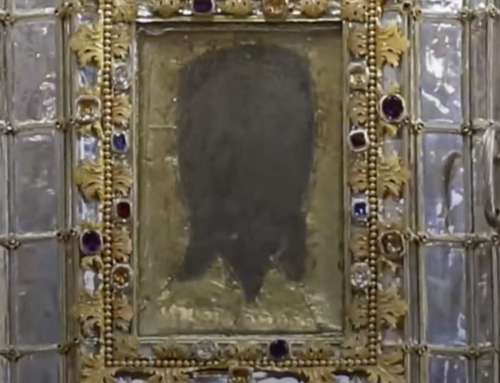
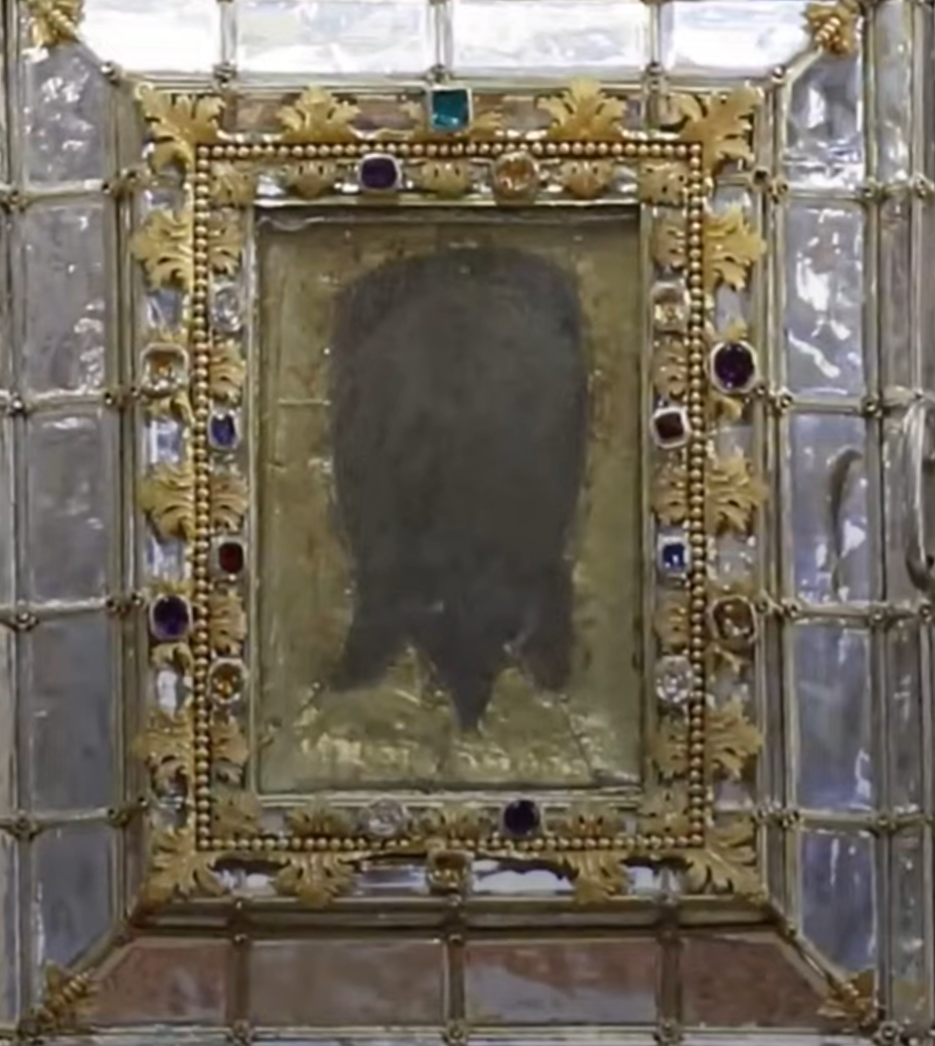
The Lent of 1851 was drawing to a close. The Prioress of the Carmelites, who knew his sentiments, thought she would confer a pleasure by sending him two engravings representing the Holy Face, copied from that impressed upon the veil of Veronica which is preserved in the Vatican. She had received them from the Prioress of the Benedictines of Arras, with whom she had corresponded for several years. These precious pictures came from Rome, and were being distributed by the zeal of the said religious, who had taken a deep interest in the revelations of Sister Saint-Pierre. Profiting by an opportunity, they had ordered from the eternal city a certain number of these pictures with certificates attached. At the request of the Prioress of the Carmelites of Tours, they sent some for different persons, and two, especially intended for Mr. Dupont. Both were forwarded to him on Palm Sunday. The following day, Monday in Holy Week, he sent them to be framed; they were returned to him on Wednesday morning. The more beautiful one, the one better framed was presented to the Work of the Nocturnal Adoration; it still hangs in the parlor of the Priests of the Mission. He kept the other, which was slightly damaged by a fold in the material which crossed the left cheek of the Holy Face; by this it can readily be distinguished from others and identified. He selected for it a simple frame of black wood.
A miracle that occurred at Rome in connection with the veil of St. Veronica at the Vatican, of which the servant of God had been informed, increased his appreciation of the precious facsimile of which he had become possessed. The following is an account of it as given by Mr. Dupont in a letter to a friend: “In the month of January, 1849, during the exile of Pius IX at Gaëta, public prayers, by order of the Holy Father, were offered in all the churches of Rome, to implore the mercy of the Omnipotent on the Pontifical States. On this occasion, they exposed in St. Peter’s the wood of the true cross and the veil of St. Veronica. On the third day of the exposition, the canons appointed to the charge of the precious relics, noticed in the Holy Face, the impression of which on the veil is so faint as to be scarcely visible, a remarkable change. Through another veil of silk which covers it, and absolutely prevents the features from being distinguished, the divine Face appeared distinctly, as if living, and illumined by a soft light; the features assumed a death-like hue, and the eyes, deep-sunken, wore an expression of great pain. The canons immediately notified the clergy of the Basilica; the people were called in. Many wept; all were impressed with a reverential awe. An apostolic notary was summoned; a certificate was drawn up attesting the fact; a copy of it was sent to the Holy Father at Gaëta. For many days this prodigy, which lasted three hours, was the sole topic of conversation at Rome. On the evening of the same day, some veils of white silk, on which is represented the Holy Face, were applied to the miraculous veil. These veils have been sent to France.”
In writing shortly after the reception of the two pictures sent from Arras, Mr. Dupont seems to insinuate that they might be from among those which touched the veil of Veronica on the very day of the miracle. It is certain, at least, that the custom of sending to France certified copies of the veil of Veronica, was introduced after the event related above, and, therefore, the one possessed by Mr. Dupont was really among those which were first forwarded from Rome. He attached a great value to it, and took particular interest in the miraculous event, which was either the immediate, or remote cause of the distribution of the pictures.
We shall now hear him relate the first use he made of the picture after it came into his possession. “I placed it,” he says, “in my room on the left side of the chimney-piece, above a small chest of drawers upon which I could conveniently put a lamp, and with it, several small pious pictures. It was Wednesday in Holy Week. I had hardly arranged the whole, when my heart was touched by a sudden emotion. ‘Can a Christian,’ I said to myself, ‘expose in his house this image of the divine Face of the Savior of men, during the great week of the Passion, without offering some exterior mark of respect, adoration, and love?’ Certainly not; this shall not be. And from this came the thought I had of burning a lamp before the Holy Face, my intention being, however, only to continue it during the remainder of Holy Week. I immediately acted upon that idea, but soon there arose another. The room was the one in which I was accustomed to receive my visitors, as well as those who came upon business; in it was my desk. I considered that every one would inquire why a lamp was lighted in the day-time. I reflected upon the answer I should give, and I was satisfied with the one which occurred to my mind. Yes, I said to myself, that is the very one. I will answer, as follows, whoever may ask me why I burn a light in the day-time: ‘I do so, in order to teach those who enter here, that when the business which brings them is terminated, they must either speak of God, or withdraw.’ And I concluded to write the following words on a card, which I placed on my desk, to make use of it as circumstances might require: ‘Every one is free to do as he pleases in his own house; in my house, those who come must either retire after concluding their business affairs, or speak of the things of God.’
“That day and the following passed, and no one made the inquiry I had anticipated. Some did not appear to notice the lamp; others considered it a pious idea. On Good Friday, a travelling agent forced his way into my apartment, to solicit an order for Bordeaux wine. I returned to his question the answer I had prepared, and he was so surprised that I was obliged to repeat it a second time. This gave me an opening to speak to him of religion. He remained listening to me for more than an hour, and, having entered my room careless as to religion, he left me almost converted, and taking with him some of the water from La Salette. I do not know what became of him.
“On the following day, Holy Saturday, our Lord commenced to make known his intentions. I received a visit from a very pious person, Miss X——– with whom I was acquainted, and who was suffering with her eyes; on entering my room she complained of the sharp pain in her eyes, caused by a piercing wind, which filled the air with dust. She wished to see me upon business. As I was engaged in writing, I requested her to pray before the Holy Face, whilst waiting for me a few minutes. She profited by the opportunity to ask her cure. I soon joined her, knelt by her side, and we said some prayers together. On rising I said to her: ‘Put some oil from the lamp upon your eyes.’ She dipped her finger into the oil and rubbed it on her eyes; as she turned to take a seat, she exclaimed in astonishment: ‘My eyes no longer pain me.’ When she left, she took with her a little of the oil, because she was going to Richelieu, her usual residence.”
He relates afterwards that on Tuesday of Easter Week, a young man of the city was sent to him on an errand; he had a sore leg, limped, and walked with great pain. The servant of God anointed the leg with oil from the lamp, saying a prayer to the Holy Face. The young man was immediately cured, and was able to run, with perfect ease, around the garden. “Another and very consoling event, which is not generally known in the city,” observes Mr. Dupont, when telling of the cure.
At the end of the Holy Week, he intended to extinguish the lamp. “But,” he says, “as often as I was about to remove it, my feelings were opposed to doing so, and I left it. Then came the month of Mary: I had an additional motive not to discontinue the little devotion, which I knew was not in opposition to the spirit of the Church. We next entered into the months consecrated to the Sacred Heart and the Precious Blood, and, from that time, consolation superabounded. More than twenty persons had been relieved in serious illness. The cures that had been effected, were repeated from one to another. We then began to recite before the picture the Litany of the Sacred Face, composed by the poor workwoman of Brittany, known as Sister Marie de Saint-Pierre. Prodigies were multiplied; I cannot undertake to enter into a detail of the cures obtained by the use of the oil: cancers, interior and exterior ulcers, cataracts, deafness, &c…. and many cases of them. From the 2d of December to the present time, May 3d, I have given more than eight thousand small phials of oil. Day by day the crowd increases; sometimes on Saturdays, more than three hundred, persons arrive; the other days of the week, not so many. The proof that grace is acting on souls, may be seen by the fact that all understand that the novenas of prayers and of anointing with the oil, conclude with confession and communion.” “I will conclude here the recital of facts,” says Mr. Dupont. Writing familiarly to a friend, he adds: “They have established a kind of pilgrimage to Saint-Etienne Street: Infirma mundi et ignobilia et ea quae non aunt… degit Deus. ‘God hath chosen the mean things of the world, and the things that are contemptible, and things that are not.’ I allow myself the liberty of saying to our Lord: ‘Why have you chosen the house of the poor pilgrim of Saint-Etienne Street to operate such wonders?’ Alas! so many others will say the same thing with a shrug of the shoulders.”
Before relating the result of the pilgrimages and the miracles which were performed, it will not be without interest to learn whence the idea of anointing with oil came to the servant of God.
Whilst he was engaged in his compilation of his Année de Marie, a notice was sent him of Notre Dame de l’Enfantement, which is particularly honored at Rome in the church of St. Augustine. He noticed that the oil from the lamp, which always burned before the Madonna of that church, was used for anointing the sick, and that very many persons had been recompensed for their faith by a miraculous restoration to health. The fact made an impression upon him, particularly when he reflected upon the case of one of his neighbors whose lungs were diseased. He said to himself: “Is not the Blessed Virgin as powerful in France as in Italy?” Moved by this reflection, he went at once in the rain to the extreme end of the city, to procure some oil from the lamp which he knew was lighted before Notre Dame des Miracles. He found, on entering the chapel, that the lamp was extinguished for want of oil. He gave a piece of twenty sous to purchase oil, and requested to have the lamp lighted. He took with him, on his return, a small phial of the oil, carried it to the consumptive lady who, after being anointed with it, improved rapidly. In a fortnight, she was perfectly well; and the physician, although an unbeliever, certified that her lungs were entirely healed.
This occurred in 1840. He acknowledges that his thoughts, subsequently, dwelt often upon “the practice of lighting a lamp before the images of Mary.” Now in 1851, just as he has carried into execution his pious design relative to the Holy Face, he learns that the celebrated Madonna of St. Augustine has been crowned at Rome. Rome seems, by her example, to authorize what he has done, and to serve him as a guide in the course he should pursue. The servant of God has clearly thus explained his motives, and we can but admire the ways of Providence in his regard. Every thing comes to him from Rome. The venerable picture, the object of his devotion, the idea of honoring this picture by a lamp, the practice of anointing with oil from the lamp for the cure of the infirm: these three holy things come to him directly from the eternal city, the center of light, the source of grace.
The worship of the Holy Face, which was for the future to fill up the life of Mr. Dupont, evidently associated this grand Christian with the mission of Sister Saint-Pierre. The humble Carmelite had been the first to present the adorable Face of our Lord as the exterior sign, and the special means of reparation. From the very beginning, the pious layman regarded the miraculous cures which took place in his room, as striking manifestations of the will of God in this regard.
Among those which occurred during the first year, we will relate the following, which caused a great sensation in the city. A woman from Neuillé-Pont-Pierre, who was afflicted with a cancer, went to Tours, to receive treatment at the Petit-Hôpital. She underwent a painful operation, but, not long after her return to Neuillé, the disease returned with additional violence; the wound reopened with considerable discharge, and her acute sufferings prevented her from doing any kind of work. She visited Mr. Dupont, who advised her to make, with her husband, a novena to the Holy Face. At the end of the nine days, the wound was healed, and she was entirely free from pain.
A young girl of Chinon was suffering from a cancerous tumor, as large as the head of a small child, and was lying, as the physicians declared, at the point of death. A phial of the oil having been procured for her, it was applied to the diseased part, and a novena to the Holy Face was commenced at the same time. The next morning, the physician was astonished to find his patient better; she had slept well, and the tumor had diminished in size: it continued to decrease during the succeeding days. The girl had promised a visit to the Holy Face, and as soon as she was able to be moved she went to Mr. Dupont’s. On entering his room, she was pale and suffering, the tumor being still as large as a nut. After she had been anointed with the oil, and had recited the Litany of the Holy Face, the tumor disappeared entirely, and she no longer experienced any pain. She had recovered her strength, and she walked some distance through the city before going to the railroad to return to Chinon.
The restoration of Doctor Noyer, a celebrated physician of Paris, is no less wonderful. The invalid hastily entered Mr. Dupont’s room, and presented him with a letter of introduction from one of his friends. The servant of God opened the letter in his presence and commenced to read it aloud. After awhile, he hesitates, he stops. He was informed by the physician who wrote the letter that the gentleman presenting it, was so seriously affected that he could not live more than three weeks. Seeing this hesitation, Doctor Noyer said, “Do not fear to continue, I know what has been written to you, — that there is no hope of my recovery.” “That is true,” replied Mr. Dupont; “but have you faith?” “Certainly, I have.” “Then, we will pray together.” It was with good reason that his brother-physicians had pronounced his disease incurable, and his death imminent; for, he was in an advanced stage of consumption, one lung being entirely gone. He was then on his way to Pau for the benefit of the milder climate. The two knelt in prayer; Mr. Dupont anointed his chest. The invalid, full of confidence, requested a few drops of the oil to drink: he was instantaneously cured. On his return to Paris, he kept up a correspondence with his benefactor, sent his patients to him, and, during the remainder of his life, never failed to make annually a pilgrimage of thanksgiving to Tours.
Two things contributed to increase the number of these miraculous cures in distant places; the distribution of the pictures of the Holy Face, and the presentation of small phials of the oil. It will not be out of place here to describe these two means of propagandism, which created for Mr. Dupont two real occupations in his holy life. As early as the year 1846, long before he placed the venerable picture from Rome in his drawing-room, we know he was zealous in recommending certain representations of the Holy Face, as emblems of the work of reparation. When the facsimile of the veil of Veronica came into his possession, be had a photograph taken of it immediately, and from this, he directed small engravings of the Holy Face to be struck off. These were placed at the top of small sheets of printed prayers, and distributed in every direction. He devoted himself to the work with his characteristic zeal. He wrote in 1854 that twenty-five thousand had been stamped by the lithographer. The lithographer has informed us that, since that time, the number of these engravings of the Holy Face, has amounted to hundreds of thousands. He often sent thousands in packages addressed to persons of every condition and rank.
Another occupation connected likewise with this cherished devotion, was equally delightful to him. We refer to the distribution of the phials of oil. “Would you believe,” he said in 1854, “that, by a rough calculation, more than sixty thousand phials have either been given away to persons before the Holy Face, or forwarded to a distance? The oil is sent for in every direction, and we have, daily, additional proof that the homage rendered to the Holy Face is agreeable to our Lord.” “I have received from England to-day (February 1, 1857) an account of the cure of a cancer. The individual was a Protestant lady, whose son, having entered the true Church, came to pass some time at Tours, until the anger of his father, a Protestant minister, should subside. He took with him several phials of the oil, and he now requests more to be sent to him; he relates very many graces obtained.”
The man of God made a serious occupation of the forwarding of these phials; he arranged them himself and mailed them at his own expense; when occasion required it, he sealed and tied up the package. It was a curious sight which amused his friends to behold him devoting his leisure hours to these minute arrangements. Visitors would find him seated in a corner of his drawing-room before a table, on which was a number of small bottles in rows, filling them, by means of a little funnel made for the purpose, with oil taken from the lamp of the Holy Face, preparing, and cutting the corks. The selection and quality of the corks were not in his eyes unimportant matters, as these were to protect the oil from the risk of being spilled. The packages were sent by mail, as the laws regulating the post-offices were not so rigorous as at the present time. Mr. Dupont forwarded them, in that manner, not only to all parts of France, but we may say, to all countries in the world, to Poland, England, America, and even to Calcutta, and China. His friend, Mr. d’Avrainville, who resided in Paris, furnished him with the phials and corks. Their correspondence on the subject was often witty and amusing. This friend always had on hand a provision of small phials of oil sent him by Mr. Dupont, in whose name he distributed them in different directions; his house was a kind of emporium, and both were equally anxious to keep it well-stocked. These little phials became the cause of numerous conversions and cures, which rejoiced the heart of the servant of the Holy Face.
It would be impossible to relate all the events considered miraculous, of which Mr. Dupont’s house was the scene. They would fill volumes. However, as these events are so intimately connected with him, and occupy so large a place in his life, we cannot pass them over in silence. We shall, therefore, select some of the principal ones, preserving, as nearly as possible, the words of the witnesses from whom we heard them directly, or the text of the written documents which we have in our possession. The witnesses are grave and sensible persons of undoubted veracity; the documents have all the marks of perfect authenticity.
“In 1855,” writes a priest of the Mission, “I held the office of Vicar of the Cathedral. I was in Mr. Dupont’s room when a woman, who had been lame for twenty years, and who used two crutches in walking, entered. The good old woman went into an adjoining apartment, and, having applied the oil from the lamp to her knees, returned to the drawing room, where about thirty persons were assembled. All knelt and answered aloud the Litany of the Holy Face, recited by the Superioress of the Sisters of Charity. At the conclusion of the Litany, Mr. Dupont inquired of the old woman how she was; she replied that she was a little better. ‘Have faith,’ said Mr. Dupont to her, ‘continue your prayers, and if you have confidence, you will be cured.’ His words were verified: in a quarter of an hour, the woman was perfectly well. I was present during the whole time.”
A lady, carrying in her arms a child about seven years of age, ill, and unable to walk, arrived by the railroad at Tours. She inquired of the conductor Mr. Dupont’s direction. The employees at the depot were accustomed to such inquiries, and were so kind to strangers going to Mr. Dupont’s, that often they would, themselves, act as guides to the pilgrims. And so it happened on this occasion: the conductor accompanied the lady to the house of the man of God, aiding her to carry her afflicted child. They arrive and kneel in prayer before the Holy Face. Mr. Dupont examines the child, and asks, “why he has no shoes.” The cause was too evidently the deformity and swelling of the feet. “Because he cannot put them on,” replied the mother. “Go and buy shoes for him,” said Mr. Dupont, “at such a number, such a street.” The mother obeyed and went out. In the mean time, the servant of the Holy Face anointed the feet with oil. When the mother returned with the shoes, the child could put them on without difficulty; he was cured.” We heard the circumstance from the conductor himself.
Another person vouches for the truth of the following: “I arrived, on one occasion, at the time of the usual prayers. A young man from the country came in, bringing a letter from the mayor of the commune: his right hand was as inflexible as a bar of iron; he could neither close, nor bend it; and, for two years, he had been incapacitated from doing work of any kind. Mr. Dupont, placing the hand in his and examining it, pronounced these words: ‘Oh! oh! this hand must close.’ I trembled with emotion as I thought to myself: Will it really close? Mr. Dupont directed all to kneel down, saying: ‛Come, it will be necessary to pray fervently’ We recommenced our prayers, and the anointing was repeated ten times before the favor was obtained; little by little, the hand, which was at first stiff and inflexible, was bent and finally closed. After each anointing, Mr. Dupont took the hand, placed it in his, examined it, and encouraged those present to persevere in prayer, repeating each time: ‘This hand must close ’ His words excited the confidence of all. I never saw him pray with so much fervor. When at last he saw the hand close, he sent the young man into his garden, to satisfy himself that he could work; they gave him a shovel, and he dug the earth with ease and without fatigue; he was cured. From those who witnessed this scene, there ascended a chorus of praise and unspeakable thanksgiving to the adorable Face of our Lord.”
A boy, about seven years of age, was attacked by a disease, which had already carried off several of his sisters and brothers. For three consecutive months, he had endured intense suffering; he was so weak he could not stand. His father, a man of faith, seeing the inutility of resorting longer to human remedies, carried the child to Mr. Dupont. After the recitation of the prayers and one application of the oil, the young invalid was able to stand up. After a second anointing, he began to walk, and the third restored to him the strength, agility, and appetite which he had not enjoyed for three months. He ran about swiftly, and without experiencing the least pain; he rushed into the garden, where hunger, and the mischievousness natural to his age, urged him, as he acknowledged later, to pull stealthily some fine cherries, hanging rather high on the tree, which his infirmity would have prevented him, a short time previous, from even desiring to touch. On his return to the drawing-room, he ate with appetite a large slice of bread, and he never afterwards suffered from the same disease. This child grew up, became a priest in this diocese, and, in order to render homage to the servant of God, he now publishes this wonderful instance of the divine mercy.
Mr. Baranger, dean of Ligueil, related to us the following circumstance, which attests, at the same time, a miraculous cure and the conversion of a soul. “In 1856, a stranger of fine appearance and polished manners called to see me, and inquired if I was acquainted with Mr. Dupont. ‘Certainly,’ was my answer. ‘He has converted me,’ he said, ‘and I have come to request you to hear my confession.’ He then related what had happened to him. Passing through Tours, he noticed in a street near the railroad a number of persons directing their steps to a certain house. He asked what took them thither. He was told that a gentleman, who lived there, performed miracles. On hearing this, curiosity induced him to enter with the others. It was Mr. Dupont’s house. On seeing him, the servant of God saluted him politely and said: ‘To what do I owe the pleasure of your visit?’ The traveler related to him simply what had taken place, and what he had just been told. ‘Yes, sir,’ resumed Mr. Dupont; ‘miracles have been performed here, and, by the goodness of God, they occur daily.’ Upon seeing the astonishment of the visitor, he added: ‘It is no more difficult for a Christian to obtain a miracle than to obtain a dish of peas from the shop at the corner; it suffices to ask; and, if you choose, you shall see one. Here is a woman who is nearly blind; we are going to pray for her, and I hope her sight will be restored.’
‘“I knelt,’ continued the traveler, ‘with the others who were present, and I united with them in prayer, although ten years had passed since I had made an act of religion. The eyes of the blind woman were anointed. She said that she was unable to read a single word in a book which was handed to her; but, after having been anointed several times with the oil of the Holy Face, she began to distinguish the persons in the room; by degrees, her sight became better, until, at last, she was able to read.’ Touched by what he had seen, and moved particularly by the words of Mr. Dupont, the stranger could not resist the inspiration to make his peace with God. He sought a priest to whom he made his confession with every evidence of sincere repentance. This proved to be, in his case, the commencement of a complete conversion; at least, I know that for years afterwards he frequented the sacraments.”
“A young girl of La Vendee, affected with a lachrymal fistula, had gone to Tours to consult a celebrated oculist, who judged a painful operation to be necessary. A friend took the girl to Mr. Dupont, and on her return to the oculist, he said no operation was required, as she was nearly relieved. Her complete cure was effected by the use of the oil of the Holy Face.”
A lady (1851) certifies her cure in the following words: “I had been ill for two years, during which time I was unable to speak, and I had been given up by several physicians who pronounced me incurable. I went to prostrate myself before the Holy Face, and after the application of oil to my throat and forehead, I commenced to say the Litany: at first, I could speak only in a whisper; but when I came to the Agnus Dei, I was able to say the remainder aloud. It would be impossible for me to describe my emotion; I could hardly believe in the reality of the miracle; my feelings overpowered me, and tears fell from my eyes. I sang the Magnificat in thanksgiving. My strength was immediately restored to me; the circumstance was so extraordinary that very many visited me through curiosity. The physicians themselves were compelled to acknowledge that the hand of God alone could have effected my cure.”
A mother relates in a letter to Mr. Dupont, the cure of her daughter: “My little Marie had fallen from a swing and injured herself seriously, but she contrived for two months to conceal the circumstance from me. It was only when the poor child, overcome by pain and the swelling in the left side, acknowledged to me the truth, that we comprehended the extent of the injury. The remedies applied proved ineffectual. The little sufferer continued to grow worse daily, so that, at last, she could neither take a step, nor eat a mouthful of food without real torture. The child who had, hitherto, been the personification of joy and happiness, lost all her gayety, and the color faded from her cheeks. Such was her condition, when we decided to go to Tours, for the purpose of consulting the celebrated Doctor Bretonneau. The journey was accomplished with intense pain to the poor child, who, although dying from hunger, was unable to eat. After we had waited six hours, the doctor was at leisure to see my daughter; but before pronouncing decisively upon her case, he wished to make a second examination, and appointed the following day at half-past eleven. As he had been detained, and had not come at two o’clock, I could no longer endure the sight of the sufferings of my little Marie, who was not in the least relieved by the use of morphine which had been ordered. I, therefore, took her to you, sir; you prayed and anointed her with the oil which burns before the Holy Face of our Lord. The first three unctions produced no effect; but after that, as you prayed, the pain diminished in intensity, and, in a few minutes, the child declared she no longer suffered in the least. To test the reality of what she stated, I pressed with great force upon her side; the dear child laughed and said: ‘Oh! mamma, you do not hurt me at all;’ she could not before endure the pressure of her dress. However, I was not certain that the cure was complete; for Marie had suffered so much when eating, that I wished to make the trial at once of her condition in that respect. You had the kindness to send for bread and preserves; she ate with the avidity of a child who was very hungry, but without inconvenience. From that moment, my little Marie has been entirely free from indisposition of any kind. The family, on our return, could scarcely credit the good news; her grandparents shed tears of joy and gratitude. I know young libertines and unbelievers who do not doubt the miracle, and who desire to send many invalids to you.”
Dom Guéranger had the thought one day to send a novice, who was suffering, to his holy friend, and command him to cure him. “I apply to you in behalf of our brother Boutin, who has a serious affection of the lungs: help him to obtain the favor he begs; his faith is simple; be sure to return him to me cured.” The faith of the one and the obedience of the other were recompensed. Five days afterwards, the illustrious abbot wrote: “Our brother Boutin returned cured; this appears to me evident; however, before a positive decision, we must wait until the end of the novena.” The novena being finished, he wrote: “Our brother Boutin has been entirely cured.”
The cure of Captain Claret, a relation by marriage of Mr. Dupont, was accompanied by circumstances so extraordinary that we cannot resist the desire to relate the principal facts. During the Crimean war in 1853, Captain Claret was second in command on board the frigate Jéna, stationed at the port of Toulon, and appointed to convey provisions to the army. On the 24th of June, he was seriously wounded on board his ship during some evolutions at sea. While he was engaged in superintending the tacking of the ship, his foot became entangled in a rope, he was thrown down, and, but for the prompt action of the crew, who disengaged him from his perilous situation, his leg would have been crushed. His wound was serious. The attention bestowed upon him gave every reason to anticipate a speedy recovery; but after a few days, inflammation set in, and the patient was transferred from the vessel to the hospital, where the surgeon-in-chief reported that erysipelas of the most malignant kind had been developed. The swelling was extending to the knee, and none of the remedies used, availed to check its progress. Symptoms of dysentery excited grave apprehensions lest gangrene existed in the intestines. The amputation of the limb was rendered very perilous by a burning fever. Nevertheless, several physicians were of the opinion that, although there was scarcely one chance out of a hundred that the amputation could be successfully performed, the operation should be undertaken, as it was the only hope left them of saving his life. They feared that Madame Claret, who had been summoned by telegraph from Brest, might not arrive before her husband’s death. As soon as the news of his illness reached her, she left Brest, and after many incidents on the journey, she gives the following account to her sister:
“On my arrival at Tours, I was grieved to find I could not proceed at once to Toulon, and I asked the agent at the depot if he could not remove my trunk, and allow me to go on in the next train. He consented very kindly to my request, and I thought I would pass with Léon the three hours I should be detained. (Mr. Léon Papin-Dupont, her relative.)
When I entered, I found him engaged in conversation with a Polish princess; he was astonished to see me, and asked me where I was going. I told him I was on my way to Toulon, where my husband was ill; not to inconvenience him, I went up stairs to see my aunt, but returned after awhile to Léon. We had scarcely a moment alone; four persons from Blois arrived asking for prayers. Léon told me of the miraculous cures obtained by praying before the Holy Face, and the persons present confirmed what he said. When he had anointed them with the oil which burns before the sacred picture, we all knelt down to recite the Litany of the Holy Face, and Léon said to me: ‘I am going to pray more particularly for your husband.’ I was greatly touched by what I saw, but when I heard Léon say: ‘It is possible, Antoinette, that your husband will be better from to-day; as soon as you arrive, write to me; to-morrow evening at the Nocturnal Adoration we will pray for him, and the general communion of the next day will be offered for him,…’ I experienced a confident hope of his recovery, which did not diminish during the remainder of the journey. When we were alone, he told me of several miracles. His great faith does good; when I left him, I felt better. He wanted me to remain longer, but my time was short, and I went to the depot.”
She arrived at Toulon. “There,” she says, “at the first gate of the city, a gentleman inquired if Madame Claret was in the cars: I advanced immediately, ‘Madame, your husband is much better.’ His manner told me all, and I replied: ‘Has he, then, been very ill?’ ‘Very ill, Madame, but I assure you he is much better.’ We set off together, and he related to me (this was on Friday), that he had become unexpectedly better, that there was one night which the physicians called the miraculous night; that all thought it impossible to save his leg, and indeed had little hope of his life; that as to himself upon calculating the hour of my arrival, he thought I would be in time to see my husband before he died. These details impressed me; I thought of Léon. ‘Have the kindness to tell me on what day and what night the change for the better occurred.’ ‘On Monday evening, he was slightly better, and on Tuesday, he was out of danger.’ Imagine my feelings! It was on Monday that Léon said to me: ‘Your husband will better to-day.’ I was overpowered with emotion on meeting my husband; he was frightfully changed. The priest was with him. I could restrain myself no longer, and I related all that had passed. These gentlemen are as impressed as I am, and they declare that I owe to a miracle, not only the life of my husband, but the preservation of his leg. I wrote immediately to Léon; I also told you of it; you have not answered my letter. Perhaps you are incredulous? As for myself, that is impossible.”
It was not less impossible to Captain Cléret to be incredulous. Perfectly convinced of the great miracle operated in his favor, he wished, in order to render glory to God, not only to relate in conversation to his friend the fact as here given, but also to forward to him the confidential letter we have just read.