The Holy Scriptures.
M. Dupont, even in his youth, loved the Holy Scriptures. The earliest letters we possess from his pen, contain frequent quotations from the sacred text. The facility and fitness with which he made use of them, in conversation, proved that he read the Scriptures so frequently as to have become familiar with them, and to have learned them almost by heart. We have known few ecclesiastics, even among the most erudite, who were as well versed in them as he was. He not only quoted passages from memory, but he loved to comment upon them, and this he did in a manner peculiar to himself, not by way of explanation, or interpreting as a theologian, but with an ingenuity, a charming apropos, and sometimes, with an elevation of sentiment and a broadness of view, not unworthy a Father of the Church.
In the middle of his room there stood, for his own particular use, a large desk like a church pulpit, upon which at all times lay open two folio Bibles, one in Latin, the other in French; he searched them, by turns, in order to find the exact words of a text which he wished to employ in his correspondence, conversations, or meditations. He was so perfectly familiar with the different parts of the Bible, that his finger rested immediately, and without hesitation, upon the passage he had in his mind. He explained the Old and New Testament, the one by the other. That was his method of studying the Scriptures. He rarely had recourse to commentaries, not through contempt, but from the natural turn of his mind. He compared different texts. He discovered in them relations, analogies with the events of the day, coincidences, by which his soul was moved to wonder and gladness; his conversation and letters sparkled with the beautiful thoughts, and glowed with the pious sentiments he thence derived.
A conversation with him did not long continue, before he found the opportunity of quoting a passage from the Bible. He did so, without affectation or formality, with an unction, a fervent love, which touched all who heard him. He seemed to feel, to taste the words of the text; he pronounced them with respect and devotion; he would repeat them over with an ever-increasing admiration and enthusiasm. This, above all else, impressed laymen and ladies of the world when visiting him. A word, spoken as it were by chance in conversation, would recall a text; then he would go to his desk, turn over the leaves of his Bible, and comment upon it in so interesting a manner, that one would willingly have remained for hours listening to him. A Christian mother of Tours who made the above remarks, adds: “When one of my daughters, who was still quite young, would see me about to enter Mr. Dupont’s house, she would whisper to her father: ‘Please do not go in, mamma will commence the Bible with Mr. Dupont, and they will never finish. A lady, a neighbor of the servant of God, writes of him in terms of the highest admiration: “I cannot express my regret, I may say, my remorse, for not having taken notes of all I saw and heard of Mr. Dupont. How often, on entering that room which has been the scene of so many marvelous events, I have found him standing before his Bible, and have heard from his lips remarkable interpretations of the Holy Scriptures! M. l’Abbé Boullay, a competent judge, because well-versed himself in the study of the Scriptures, said to me of Mr. Dupont: ‘He has a clearer intelligence of the Bible than any one I know.’”
Although every portion of the Bible was familiar to him, there were certain personages of the Old Testament whom he regarded in a particular light, and for whom he professed a kind of enthusiastic admiration. One of these was Nebuchadnezzar. This prince appeared to him clothed with extraordinary grandeur. He represented the abjection of man before God. After his trial, Nebuchadnezzar lifts his eyes to Heaven and cries out: “All the inhabitants of the earth are as nothing before God.” “I see him yet,” relates an eye-witness, a celebrated writer, “and he never impressed me more than on that occasion. It was after dinner. He stood before his desk; the Bible was open at the Prophecies of Daniel. He tried to read, but it was too dark. Addressing his faithful friend, he said: ‘Give me a light, d’Avrainville,’ and he read in a tone of deep humility these words of Nebuchadnezzar: ‘I lifted my eyes to Heaven and my sense was restored to me: and I blessed the Most High, and all the inhabitants of the earth are reputed as nothing before Him.’ At that moment Mr. Dupont was majestic. The words of Scripture, making evident the nothingness of man and the sovereign dominion of God, had found in him a living echo.”
Not less ardent was his predilection for Job. “Job,” he said, “may be considered as the perfect type of our Lord. He prays for his false friends who had drawn upon themselves the anger of God, and obtains their pardon. ‘Here indeed the just suffers for the unjust.’” One of his habitual visitors says: “Once when I went to see him as usual, I had hardly saluted him, when, without noticing my salutation, he apostrophized me with the words: ‘Do you ever pray to the good man, Job?’ The question appeared to me at first somewhat odd. I answered: ‘I must confess that I have never thought of him. And yet, with my violent irascible temperament, I ought to have invoked him to obtain the patience I so greatly need.’ He replied: ‘You are wrong not to invoke him. Read.’ Taking me to his Bible, he read me the following words from the Book of Job: ‘Go to my servant Job and offer for yourselves a holocaust, and my servant Job shall pray for you: his face I will accept that folly be not imputed to you.
“‘You see, my friend, that God promises to hear the prayers of Job; he has promised this to no one else in the holy books. Consequently we should pray to Job. We do not lose our time when we pray for others. It is when he prays for his friends that Job is delivered.’”
His warm heart sought to communicate the light and spiritual joy he found in the word of God. He recommended particularly the reading of the Epistles of St. Peter and St. Paul. “There is,” he said, “an ineffable sweetness in reading these Epistles, when we remember that they are addressed to each of the faithful individually. It was in reading lately the First Epistle of St. Peter, that this thought particularly impressed me. In effect, our Lord said to his apostles: ‘Teach all nations . . . and behold them writing letters for those whom they cannot reach by the spoken word.” .
An intelligent and well-educated lady, who has a particular love for the Holy Scriptures, attributes her taste for them to Mr. Dupont. “I had been living only a short time in Touraine,” she writes, “when having the misfortune to lose my husband, I determined to relinquish the worldly life I had hitherto led, and to devote myself to good works. But I was much embarrassed as to the means of carrying my resolution into effect; I was about to enter, upon an untried path, and I needed a guide. Fortunately, I heard of Mr. Dupont, and from my first interview with him, he comprehended my difficulties and my aspirations for a more perfect life, and he gave me the most salutary advice. We had exchanged only a few words, when he opened his Bible and read, in a grave and impressive manner, different passages from St. Paul upon the duties of a Christian widow, imparting great unction to the holy words. For several years, I had the happiness of frequent conversations with him, during which he would often have recourse to the Holy Scriptures. He took particular pleasure in reading to me from St. Paul, whose Epistles I have, consequently, relished exceedingly, although previously I was not familiar with them.”
Mgr. d’Outremont was once complimented upon his happy application of certain passages of Scripture, commented upon by him in the style of the homilies of the Fathers. The prelate replied: “I am indebted to Mr. Dupont for this method of interpreting the Scriptures. When I was Vicar at the Cathedral, I visited him frequently, and our conversations turned entirely upon the Bible. He inspired me with a taste for the study of the Scriptures; he was my director and my teacher. Numerous interpretations and ideas of different texts, have remained impressed upon my memory; they recur to my mind when I am preparing to speak, and I am glad to make use of them.”
In fine, the veneration of this fervent layman for the word of God, found exterior expression in an act of homage, which is one of the most remarkable of his life, and the most indicative of his character. Among the great Christians who have professed a special love of the Holy Scripture, Mr. Dupont is the first, and, to our knowledge, the only one whose devotion has gone so far, as to honor it by burning a lamp before it day and night, as before the Holy Eucharist. We see in the lives of the saints that some read the Scriptures on their knees and with uncovered heads; others carried it respectfully about their persons, whilst others placed it in cases fastened with ivory or silver clasps. We are not told that any of them conceived the thought carried into effect by Mr. Dupont. The idea of lighting a lamp before the Sacred Scriptures, is an idea of faith peculiarly his own, an idea of reparation, to expiate the crime of blasphemy so commonly committed in our days by unbelievers, impious men, and ignorant Christians, who either deny the divine origin of our holy books, or who regard them as a purely human composition. “The Holy Scripture,” he would say, “is the Face of God; before that Face, as before the Divine presence, fire should burn day and night… I see Jesus Christ entire in each word of Scripture. Jesus Christ cannot be divided.”
The period at which he realized the thought, should be recorded in his life as a memorable date. It was the 29th of March, 1865. He did it without show or parade; it was remarked only by his most intimate and most observant friends, and in a letter he refers to it with simplicity. Having occasion to write to some one that same day, he concludes with these words: “Let us repeat together this charming verse of the 118th Psalm: ‘I entreated Thy face with all my heart: have mercy on me according to Thy word. Deprecatus sum Faciem tuam in toto corde meo; miserere mei secundum eloquium tuum.’ Now, my dear friend, it is only to-day, when for the first time I placed a lamp, before the Holy Scriptures, that I noticed the appropriateness of that prayer. The lamp is on the corner of my desk, directly in front of my large Bible, and I, miserable creature, am between the two lights which burn in reparation of blasphemy.”
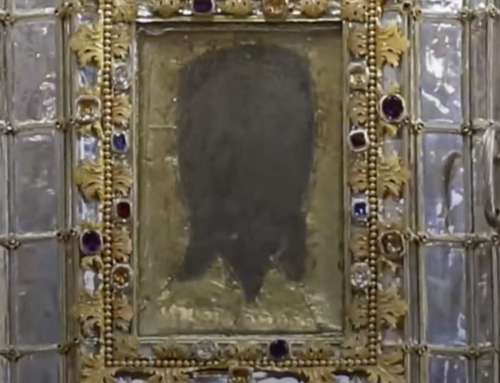
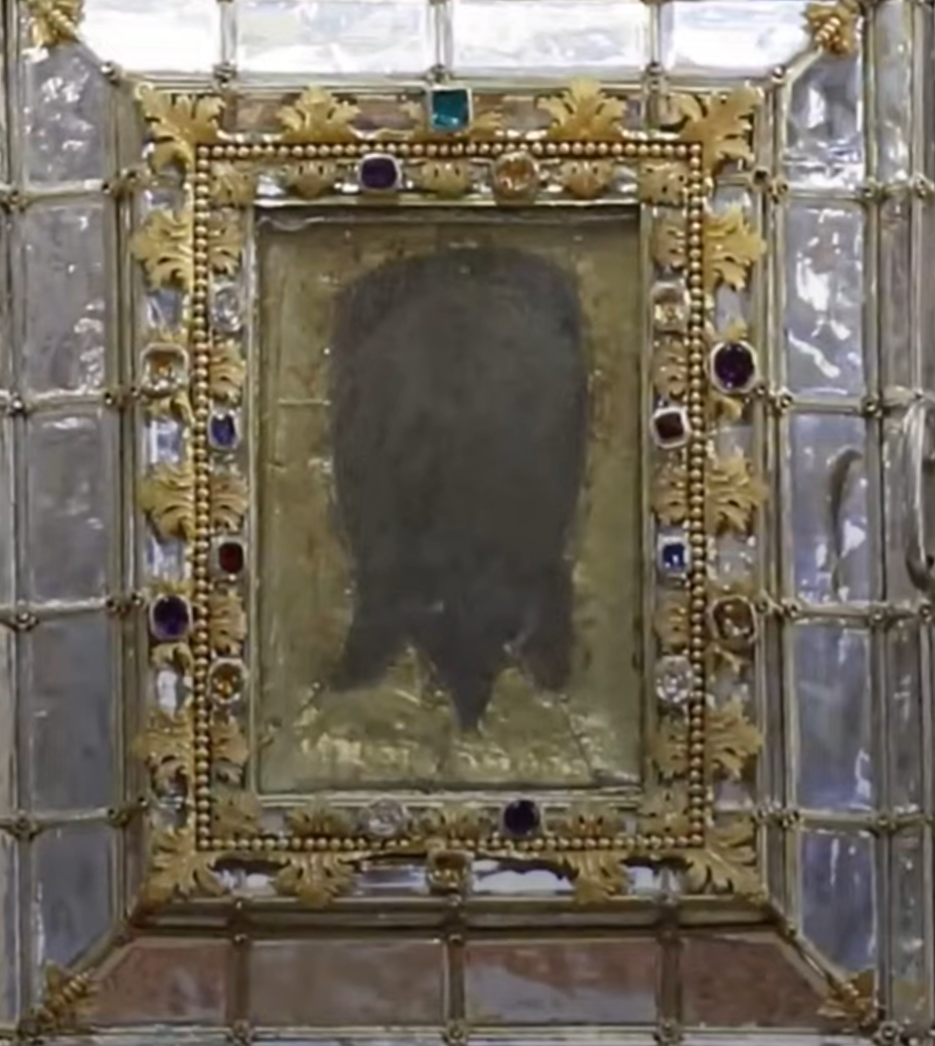
There were two lamps. One of them burned before the Holy Face, the other, before the Holy Scriptures; and the man of prayer and reparation was there, between the two, burning with love for God and his neighbor. That was the place assigned him by God, and he desired no other. He occupied the place in person as well as in spirit, seated at a square table between the two lamps, between the Holy Face and the Holy Scriptures, always, either on his knees before the Holy Face, or seated at that table. We might say that Mr. Dupont was there also, entire and without division. The Scriptures, the Holy Face, they were his life.
He provides for his Bible in his will, expressing the desire that it should still be honored by a lamp. He bequeathed it upon that condition. By a concurrence of providential circumstances, his wish has been realized far beyond his expectation. In the very room where he so long venerated it, his dear Bible, the same he used in life, is open on the same desk; a lamp still burns day and night in its honor. This lamp is the pendant of that which is lighted before the Holy Face, and, with the one which hangs before the Blessed Sacrament, it gives a peculiar aspect to this little oratory, well suited to aid the piety of fervent souls, and to dispose them to sentiments of reparation.