Meditation IV
THE FACE OF GOD AND THE PATRIARCHS
Christ, hear us.
Let us adore God saying to us by the mouth of the Holy Spirit— “Walk before me, and be perfect(1).” This counsel was indeed addressed to Abraham, but it is also addressed to all his descendants and to all Christians. Let us thank God for this lesson, and let us beg of him to recall it often to our minds, as a principle of sanctification and of salvation.
1st POINT. — THE MANIFESTATION OF GOD IN THE LAW OF FEAR.
God, in the Old Testament, as though to prepare himself for the great mystery of the Incarnation, often appeared to the patriarchs and prophets. He conversed with Abraham as a friend with a friend. The father of the Hebrew nation had even the happiness of seeing the Holy Trinity come, under the form of three angels, to sojourn under his tent. “He saw three of them, and he prostrated himself to the ground(2)”. But, with the exception of this event, it appears probable that the Patriarchs heard rather the voice of God, than that they saw him under a sensible form. — Moses, who had such frequent communication with the Lord, once asked him, in the ardor of his faith, to permit him to have the happiness of seeing his Face, and God replied— “Moses, my servant, thou knowest not what thou dost ask, for no man has been able to see the Face of God and live; but, to satisfy as far as is possible thy ardent desire, I will pass before thee; thou shalt hear me and thou shalt see me through the cloud, but thou couldst not bear to contemplate my features.” After these interviews with God, the legislator of the Hebrew people descends from the mountain shrouded in such splendor, that all Israel cries out— “Oh Moses! speak thyself to God henceforth, for if we were to dare to do so, we should die.” And during the whole remainder of his life, he preserved on his brow two beams of light impressed on it by the vision of the Face of God through the cloud.
Oh God, terrible and good, I adore law of fear, bringing man by means of the salutary terror of thy judgments to wisdom and perfection(3).
2nd POINT. — MANIFESTATION OF GOD IN THE LAW OF LOVE.
Very different is the Face of God in the law of love. It there shows itself to us full of sweetness and benignity(4). Thou comest, oh my God, to fill up the immense void in our hearts, to satisfy the most imperious needs of our souls. To see God, to possess God, the unknown, the infinite, the eternal, thou who art perfect goodness, that is indeed our most earnest desire. Happier than Abraham, happier than Moses, I can even here below see thee and converse with thee as a friend with his friend; see thee by faith, hear thee, possess thee in the Eucharist and in my inmost heart.
Nevertheless, the law is not changed; no one can see God and live; therefore, Lord, it is always through a veil that I see thee, but this veil, the eucharistic veil, is thinner and more transparent than the cloud on Sinai. My faith can pierce it, and the burning rays of thy divine Face, of thy sacred Heart, rendering this veil every moment more transparent, penetrate into the interior of my heart. I can, moreover, see thee, Lord, and possess thee, not merely for a fleeting moment like Moses and Abraham, but every day of my life and of my exile, according to thy adorable word— “He that eateth my flesh and drinketh my blood, hath everlasting life; and I will raise him up in the last day(5).”
Oh my God, may I possess thee, may I love thee upon earth, in order that I may deserve to go and possess and love thee hereafter in heaven!
SPIRITUAL BOUQUET.
May I expire, parched with an ardent thirst to see the desirable Face of Our Lord Jesus Christ. (Exclamation of St Edme. Last words of M. Dupont.)
HONORS RENDERED TO THE HOLY FACE IN THE AGES OF FAITH
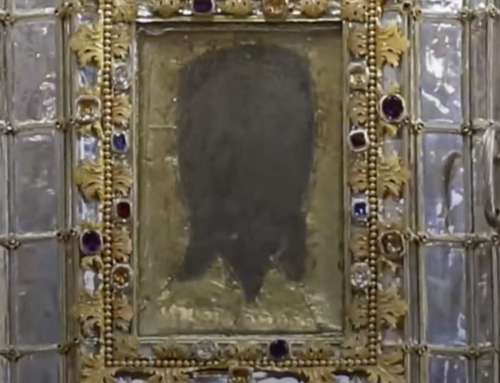
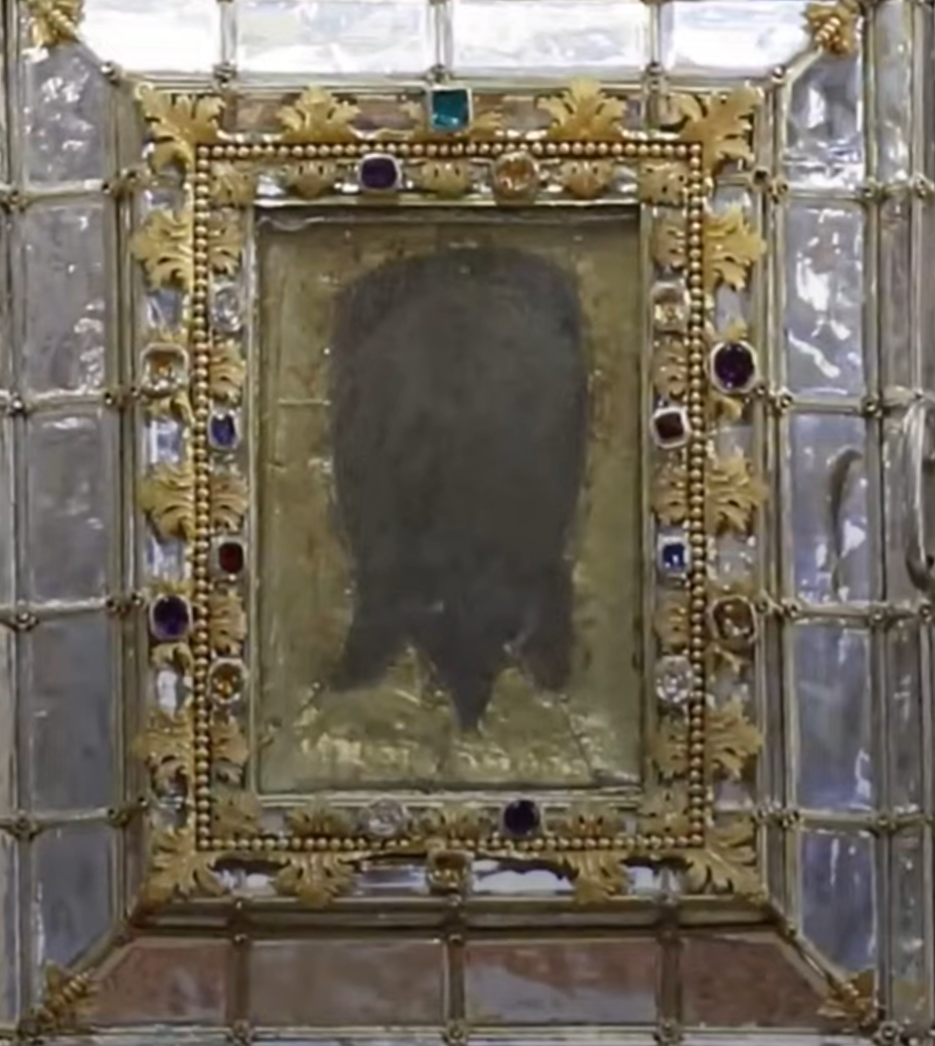
In remembrance of the sojourn of the Holy Face at Saint Mary of the Martyrs, the coffer in which it was enclosed is preserved in that church. The urn which contained this coffer, and of which only fragments remain, is placed upon the table of the altar of the Crucifix, in a hollow of the wall, and bears the following inscription— “Coffer in which, during a hundred years, this church was illuminated by the holy veil, brought from Palestine to Rome by St Veronica.” This coffer had ten locks, the keys of which were confided to the chiefs of the ten ancient rioni, or Roman regions, so that the holy relic was in this manner confided to the care of the whole city, and could not be exposed, except in presence of all its representatives.
When it was transferred to the hospital of Holy Spirit, it was placed in a closet, entirely lined with marble and iron, and locked with six keys, which were confided to six Roman families. At that time, the Holy Face was shown only once a year, and the six gentlemen selected to be its guardians, and who were exempt from the payment of all taxes, were obliged to be present on the occasion, accompanied, each of them, by twenty armed persons in order to surround the relic. In 1208, Innocent III, instituted a procession which was wont to take place the first Sunday after the octave of the Epiphany, and in which the Holy Face was carried solemnly from the Vatican basilica to the church of the Holy Spirit, followed by the cardinals and the Pope, who addressed a sermon to the people and gave three deniers to each of a thousand poor foreigners, and three hundred to the said hospital.
At this epoch, medals were struck bearing a representation of the Holy Face and of the keys of St Peter. These medals were called Veronicas, and the pilgrims who visited the tombs of the holy Apostles wore them with great devotion. The effigy of the Holy Face was even impressed upon the pontifical money.
Such was the veneration professed for the holy effigy. Pope Innocent Ed. himself composed prayers in its honor, and ordered them to be recited before the veil of St Veronica, attaching to them certain indulgences.
INVOCATION.
Oh adorable Face, which was offered upon the cross like a precious coin for the ransom of the world, permit me to offer thee to the eternal Father, that I may obtain thereby the graces of which I have need to pay the ransom for my sins, and to procure me an entrance into thy eternal kingdom.
(1) Ambula coram me et esto perfectus. (Gen. xvii.)
(2) Apparuerunt ei tres viri stantes prope eum; adoravit in terram. (Gen. xviii, 2.)
(3) Principium sapientiae timor Domini. (Prov. ix.)
(4) Apparuit benignitas et humanitas Salvatoris nostri Dei. (Tit. iii)
(5) Qui manducat meam carnem et bibit meum sanguinem, habet vitam ce ternam… In me manet, et ego in illo. (Joan, vi, 55-57.)