Meditation XIX
THE HOLY FACE BEFORE THE HIGH PRIESTS.
Oh adorable Face, which was humiliated for us before the tribunals at Jerusalem, have pity on us.
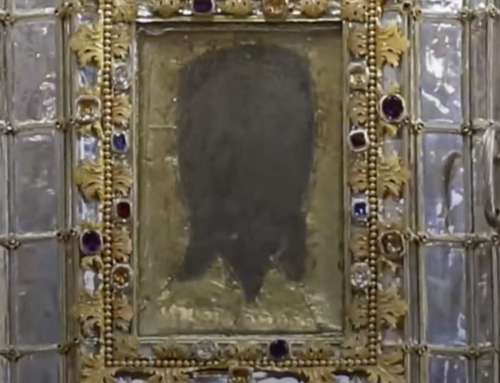
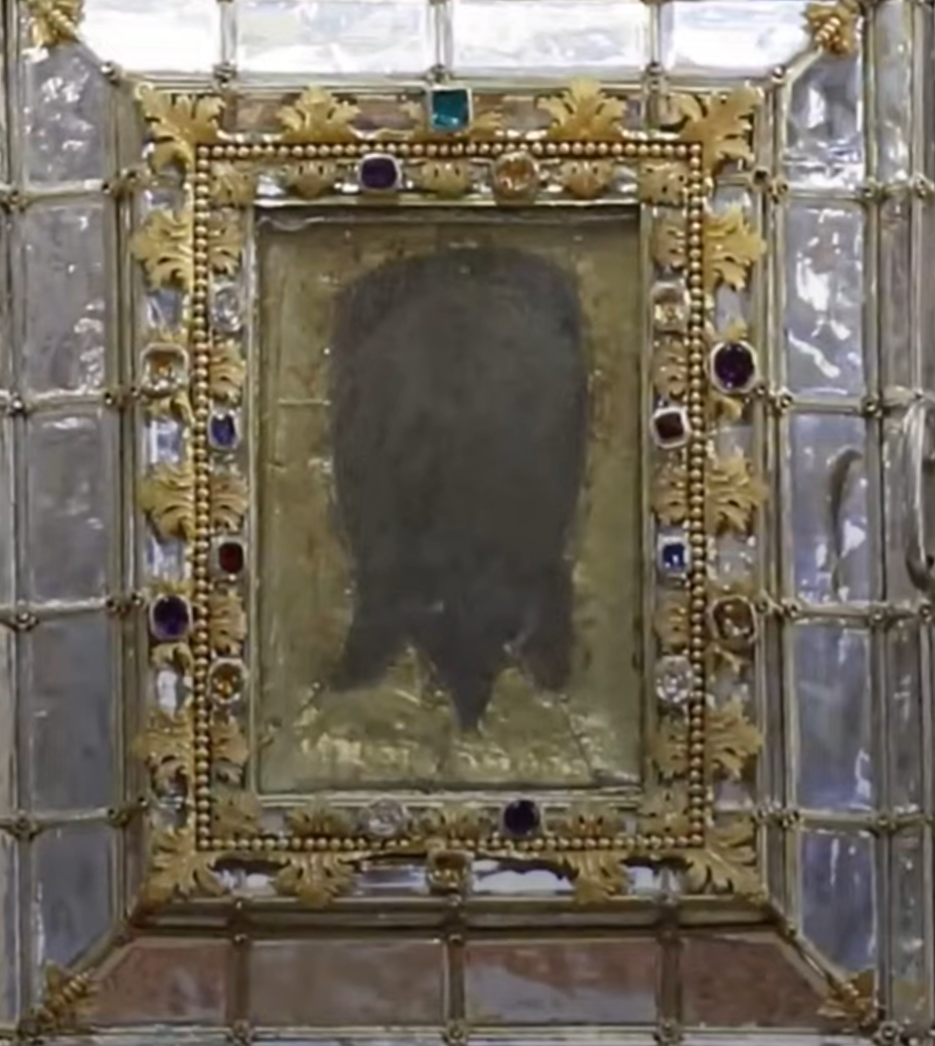
Let us follow Jesus along the path leading to Calvary. We are going to contemplate the Holy Face saturated with ignominies and outrages in presence, first of Anna, and then of Caiaphas; and everywhere we shall admire its sweetness, its serenity, its radiant and divine majesty.
1st POINT. — THE OUTRAGES INFLICTED UPON THE HOLY FACE.
The Pontiff questions Jesus respecting his doctrine and his disciples.
And the divine mouth which had made the mountains and the plains of Judea resound with the words of eternal life, which the people received with avidity, speaks once more. Let us listen to its answers — “I have spoken openly to the world, I have always taught in the synagogue and in the Temple, whither the Jews always resort, and in secret I have spoken nothing. Why askest thou me? Ask them who have heard me! Behold they know what things I have said(1).” Such is the answer full of wisdom which issues from the lips of the Savior. And what was the recompense? When he had said these things, one of the servants standing by gave Jesus a blow. “Why was I not there with my Franks!” exclaimed the young king Clovis on hearing this passage read for the first time. Oh Jesus, why was I not also there, with my love, to efface the infamous mark produced by the blow given to thee by the servant.
From Anna let us pass to Caiaphas. Calumnies and blasphemies are accumulated upon the Savior. “He has said— I can destroy the temple of Jehovah, and raise it up again in three days.” Jesus kept silence. The high priest is angered at him and cries out— “In the name of the living God, I adjure thee to tell us if thou art the Christ.” — “Thou hast said it,” answered Jesus, “and one day thou shalt see the Son of Man seated at the right hand of the Father and coming in the clouds of heaven.”
Let us admire the sweetness, the serenity, the wisdom of the divine words of Jesus. Oh adorable Face, teach me to practice the same virtues in the midst of the trials and difficulties of life.
2nd POINT. — THE ANSWERS MADE BY THE DISCIPLES OF JESUS.
Anna and Caiaphas belong to all ages; there have always been obscure persecutors and also persecutors clothed with purple and seated upon thrones of pride and cruelty. There were martyrs during three centuries, and there will be still. At the present day there are many enemies of the Christian name. With what do they reproach thy Church, oh my God, its doctrine and its disciples? It can, like its divine Founder, reply— “I have always taught in public. Question those who have listened to me; they will tell you the truths I have proclaimed the virtues I have taught them to practice.” And in return for this answer, the Spouse of Christ will like him, receive the blow of the servant.
But behold Caiaphas in his turn approaches. No accusation founded upon truth can be discovered to bring against her. Calumnies must therefore be invented— “Art thou divine? Is thy Christ God?”— “Thou hast said it, and a day will come when the outraged Spouse will come at the right hand of her Beloved to judge the persecutors and the executioners.” Priests of Jesus Christ, faithful to Holy Church, offer your cheek, for you also have dared to sneak the truth to the powerful of this world. Prepare yourselves then for blows. But rejoice that you participate in the ignominies of your Savior; is it not a glory to do so? It is a glory which I long for, oh my God, that I may one day be associated with your immortal triumphs.
SPIRITUAL BOUQUET
Unus assistens ministrorum dedit alapam Jesu.
One of the servants standing by gave Jesus a blow. (John, xviii, 22.)
PROCESS FOR THE CANONIZATION OF M. DUPONT.
The history of the Saints does not end with their lives; the day of their death is called by the Church dies natalis, “the day of birth.”
The veneration felt for him who was called the Holy man of Tours continued after his death. Mgr. Colet, not content with having declared the pious servant of the Holy Face to have died in the odor of sanctity, made no delay in commencing a process of examination into his virtues and the miracles attributed to him. M. l’abbé Janvier, who was made postulator of the process, addressed a petition to the Archbishop, praying that it would please him, for the greater glory of God, who shows himself to be admirable in his Saints, to make use of his authority as ordinary, by authorizing the process of enquiry into the reputation for sanctity, the virtues, and the miracles of the servant of God, according to the tenor of the ancient and modern decrees of the sacred Congregation of Rites.
In answer to this petition, the Archbishop of Tours instituted an ecclesiastical tribunal, composed of a postulator, of three judges, of a promoter of the faith, of two notaries, etc.
The duty of the postulator is to convoke the meetings of the tribunal, to cite the witnesses who have been acquainted with the servant of God, to gather together and to administer the sums required for the expenses of the process.
The president of the tribunal, who is the Bishop himself, is ordinarily replaced by one of his Vicars general. He has two auxiliary judges.
The duty incumbent on the promoter of the faith is most important. He has to see that all is performed according to the formalities prescribed by the sacred Congregation of Rites; he has himself to interrogate the witnesses and to dictate their answers to the notaries. He must also draw up the list of questions which must be carefully placed under seal.
The notaries draw up the citations and register the oaths and the answers of the witnesses, called upon to give their testimony.
The witnesses are presented either by the postulator, or else, ex officio to the fiscal promoter.
The following is the formula of the oath which they are obliged to take.
“I the undersigned, touching the holy Gospels of God, placed before me, swear and promise to speak the truth both with regard to the interrogatories and to the articles on which I shall be examined in the cause of beatification and of canonization of the servant of God, Leon Dupont, and I swear and promise religiously to keep secret and not reveal to any one whatever the nature of the interrogatories, or the answers and depositions which I shall make to these same interrogatories and articles, and not to speak of them to any one, exclusive of your Lordships, the judge and his auxiliaries, the fiscal procurator and the notary deputed to carry on the process, under pain of perjury and of excommunication thereby incurred, from which I cannot be relieved except by the Sovereign Pontiff, exclusive even of the grand Penitentiary, unless it be at the point of death. And this I promise and swear, so help me God and his holy Gospels.”
The tribunal, having finished questioning the witnesses, reads the record over again, a copy of it is then preserved amongst the archives of the Archbishopric, and another copy is sent to Rome.
We will terminate this notice by some details respecting what has been done for the process of M. Dupont.
The preliminary examination by the ordinary was begun on the 2nd October 1883. It was ended on the 6th June 1888. Five hundred sittings have been held. About sixty witnesses have been questioned.
It was on Friday the 1st of June that there was held in the Oratory of the Holy Face the public sitting of the opening of the process and the release from the oath of secrecy. The postulator, having declared that he had no more witnesses to cite, demanded the cloture, which was immediately wanted by the judges and accepted by the promoter. Then the notaries brought the two volumes containing the depositions of the witnesses, and undid the band which had been placed round the questions. From that moment the law enjoining secrecy ceased to exist.
The Archbishop himself presided at the last sitting held on the 6th of June, and the process was deposited under seals in a coffer destined to be taken to the sacred Congregation of Rites, by two members of the ecclesiastical tribunal.
INVOCATION.
Oh adorable Face of Jesus, source of grace, of light and of peace, grant that we may walk with a firm step along the path of holiness, and by often contemplating thy Effigy may impress on our souls the divine resemblance to it, which thou desirest to see shining on thy Saints.
(1) John. xiii.