Meditation XVIII
THE HOLY FACE AND PETER.
Oh adorable Face, whose divine glance pierced the heart of St Peter with an arrow of grief and of love, pray for us.
IT is in company with the apostle chosen by Our Lord to be the founder of his Church upon earth, that we are about to admire the power of the eyes of Jesus. It was that which called Peter to follow Jesus, which raised him after his fall and gave him a martyr’s courage. Let us contemplate, in these different circumstances, what the Holy Face did for Peter and what Peter did for his master.
1st POINT. — VOCATION OF THE APOSTLE ST PETER.
Jesus was on the borders of the lake of Gennesaret, and Andrew, who had attached himself to him, came and said to his brothers— “We have found the Messiah.” And immediately he led him to Jesus, and Jesus, having looked at Simon— Intuitus autem eum Jesus(1), said to him at the same moment— “Thou art Simon, son of John, henceforth thou shalt be called Cephas, that is to say a stone.” Let us admire the power and the efficacy of a glance from the eyes of Jesus. He turns his Holy Face towards a poor fisherman, and he discovers in him what no one had hitherto seen: an elect soul, a future fisher of men, he who was destined to be the corner stone on which his Church was to be built. This look of Jesus so penetrated into the soul of Peter, that he immediately left his nets and his family, and followed his master.
Was it not also a glance from the eyes of the Savior which fell upon my soul, at a moment when I was perhaps very far from the heavenly fold, and which, illuminating it with a ray of grace, enabled me to understand the nothingness of things created, and the happiness of following the divine Master? Oh Lord, cause thy tender glance to shine upon me once more, and point out to me the road I must follow in order henceforth to avoid the paths of error and of vice.
2nd POINT. — FALL OF THE APOSTLE ST PETER.
“Although all shall be scandalized in thee, I will never be scandalised(2),” the apostle replied to his master on the eve of his Passion; and in punishment of his presumptuous confidence in himself, Jesus permits the words spoken by a maid servant to make his vicar deny him three times and affirm with an oath that he knew not the man. “What a lesson, oh Jesus! But see! hardly has the fall been consummated before the Savior thinks of nothing but of raising his apostle up again. He forgets his own sufferings and ignominies, and turns towards him his adorable Face; a ray of light and of love, proceeding from the eyes of the Master, penetrates into the heart of the faithless disciple, and Peter confesses his fault. Flevit amare(3), says the Gospel. “He wept bitterly,” and so bitterly, that a rivulet of ceaseless tears traced upon the face of Peter an indelible furrow.
Is not the history of thy apostle in some degree mine also? How many times have I not denied thee by sin? How many times hast thou not raised me up again by a tender glance from thy eyes! But, oh my Jesus, has my contrition resembled that of the penitent apostle? Give me his true grief for my faults, and may I learn, when contemplating thy august Face, disfigured by my sins, henceforth to live a life of reparation and love.
SPIRITUAL BOUQUET.
Conversus Dominus respexit Petrum, et, egressus foras, Petrus flevit amare.
And the Lord, turning, looked upon Peter, and Peter, going out, wept bitterly. (Luke, xxii, 61.)
THE ORATORY OF THE HOLY FACE
After the death of M. Dupont, the faithful accustomed to go and pray before the Holy Face attached a particular interest to his dwelling, where so many graces had been granted, so many extraordinary cures accomplished before their eyes, and so many good works founded.
In order that the house of the holy- man of Tours should not become private property, Mgr. Colet, who had declared in an official document that M. Dupont had “died in the odor of sanctity,” permitted the property to be bought by a community belonging to the town. A public oratory was established there on the 29th of June the feast of St Peter, the Archbishop solemnly inaugurated it and was the first to celebrate holy Mass in the chapel.
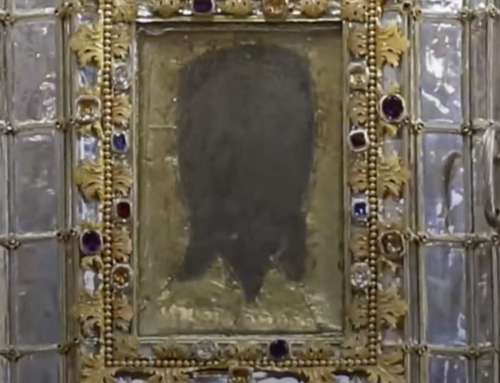
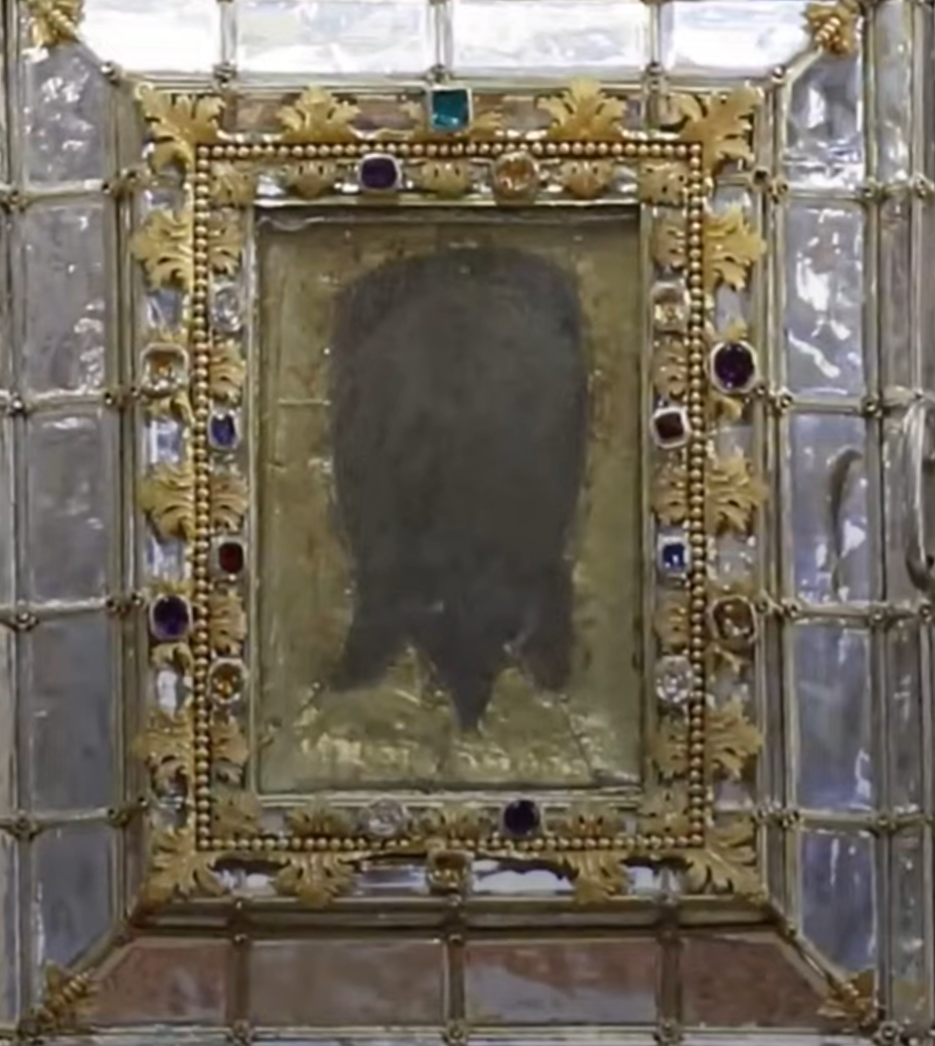
The Oratory is composed of what was formerly M. Dupont’s drawing-room, to which have been added two lateral chapels, in the Byzantine style, one of which is consecrated to Our Lady of Seven Dolors, and the other to St Peter penitent. The Effigy of the Holy Face, which remains in the place it always occupied, has been adorned with a handsome frame of gilded bronze, decorated with precious stones, the gift of the Christian mothers of Tours. The crystal lamp kindled by M. Dupont continues to burn before it. The high altar covers the marble chimney piece and the hearth stone on which M. Dupont knelt down to pray. Above this altar is placed a statue of the Ecce Homo. On the epistle side is displayed a banner of the Sacred Heart, a fac-simile of the one which led to the field of honor at Patay the heroic crusaders of Charette and Cathelineau. Near it, upon its high reading desk, is the folio bible in which M. Dupont searched for the texts on which he commented to his friends. Close beside it is a lamp which perpetually burns in honor of the word of God. The walls of the oratory, divided into panels, have pious sentences painted on them and touching inscriptions which have relation to the virtues of the servant of God, and to certain circumstances in his life. Numbers of crutches placed near the altar attest the cures obtained before the Holy Face during the life time and after the death of M. Dupont.
Cures and graces of all kinds do not, in fact, cease to be granted to the prayers of the pilgrims. The Oratory of the Holy Face has become more than ever the center of truly reparatory works. An irresistible attraction, full of unction and of suavity, attract persons to this pious sanctuary, and it would be impossible to number the souls which have felt themselves to be consoled, fortified and rendered better after having prayed and meditated for some time in a place which is still impregnated with the perfume of virtues of so great a Christian. Numerous masses are celebrated every day, and if may be truly said that prayer is uninterrupted.
INVOCATION.
Oh adorable Face of Jesus, who didst seek the solitude and the silence of the grotto of the Agony, to prepare thyself for the mysteries of thy sorrowful Passion, permit me to meditate, far from the vain rumors of the world, upon the opprobrium thou didst endure for love of me, that so I may fortify my soul for the great combat it will have to wage ere it arrives at celestial glory.
(1) Joan, I, 42.
(2) Etiamsi oportuerit me mori tecum, non te negabo. (Matth. xxvi, 33.)
(3) Matth. xxvi. 75.