The Oratory of the Holy Face — Conclusion.
After Mr. Dupont’s death, there was a natural desire to know what would become of the venerated picture of the Holy Face, which, for so many years, had been the one object of his life, and which had been honored in his home by so many miracles. The servant of God was unwilling himself to leave any direction in regard to its disposition. When making arrangements concerning his property, his confidence in God and his humble discretion had dictated to him the following words: “That I do not speak of the Holy Face in my will, is not the result of forgetfulness. I do not wish to interfere in the question which may arise, when I shall no longer be there to maintain the lamps in my oratory. God will provide according to His holy will.”
The confidence of “the good servant” was not frustrated. The “will of God” was about to manifest itself in a striking manner, and assign to this dear object an exalted destiny far beyond all human foresight. In consequence of family arrangements, the house was to be sold. This was publicly known, and great anxiety was felt lest the holy spot should fall into careless and profane hands: it was, however, soon announced that it had become the property of a religious community. The purchase had been accomplished secretly, and the Carmelites were the happy proprietors. Notwithstanding their poverty, by a concurrence of providential circumstances, these humble virgins, worthy inheritors of the grand idea of reparation which had taken its rise in their midst, had succeeded from the seclusion of their cloister in making the important acquisition. The combined influence of Sister Saint-Pierre and Mr. Dupont was manifest, and, for the future, Carmel and the Holy Face were to be inseparably united.
Great was the joy of the Carmelites, as was also that of the pious faithful of Tours, and all the friends of Mr. Dupont. The Archbishop, Monseigneur Colet, not only authorized the Reverend Mother Teresa of St. Joseph, Prioress of the Carmelites, to take this generous and bold step, but he was desirous of giving a proof of his sincere devotion to the Holy Face, and his profound veneration for the memory of the grand Christian, who had died in his archiepiscopal city, “in the odor of sanctity.” Such were the terms used by the pious prelate in the decree, by which he “converts into a chapel the oratory where the servant of God has, for so many years, kept a lamp burning night and day before the picture of the Holy Face of our Lord, and where so many marvelous events, attested by public report, occurred after unctions made with the oil from this lamp.” This posthumous eulogy of Mr. Dupont, and the indirect acknowledgment of the miraculous events of his life, were very remarkable from the pen of the successor of St Martin. His Lordship announced that he would himself bless the new sanctuary. We will give a glance at the arrangement of the holy place.
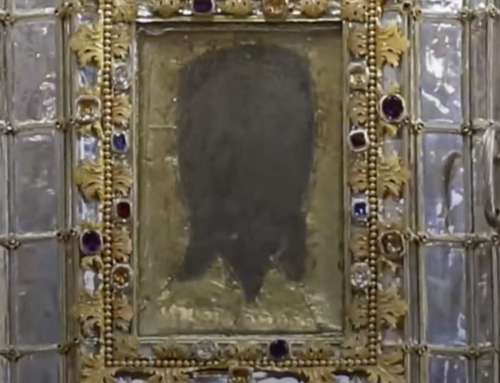
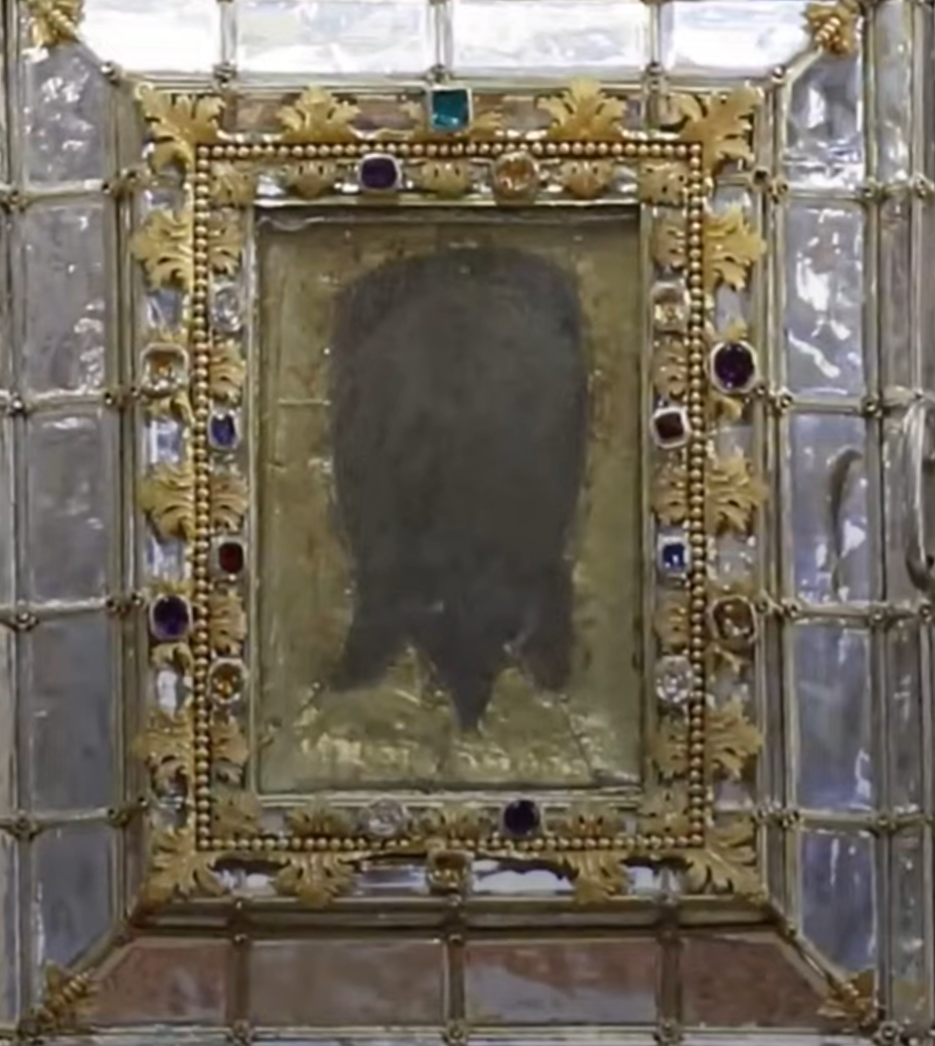
The oratory of the Holy Face is composed of the two apartments, which were formerly the small dining-room and the drawing-room of Mr. Dupont. It is a chapel of expiation, and it has been arranged in conformity with this idea, but in such a manner as, at the same time, to express to the eye of the public what it had formerly been, namely, the apartment in which the servant of the Holy Face habitually remained and prayed. The partition-wall, separating the dining-room from the drawing-room, has been removed, and in its place are now isolated pilasters connected by a balustrade; the idea was taken from the Sistine Chapel at Rome. The altar covers the marble mantel-piece, and the flagstone upon which Mr. Dupont was accustomed to kneel in the midst of the pilgrims. A statue of the Ecce Homo is placed in a niche above the tabernacle. The picture of the Holy Face, in a handsome frame, the gift of the Christian Mothers of Tours, surrounded as with a crown by numerous ex voto offerings, hangs on the right, viz., the Gospel side, in the same place as formerly, with the same lamp always burning before it. On the left, or Epistle side, is displayed the flag of the Sacred Heart, a fac simile of the glorious standard which was unfurled by the Zouaves of Charette, and which preceded them at the battle of Patay. Quite near and on the same side, open on his desk and honored, as heretofore, by a lamp ever burning, appears the Holy Bible, the very one which Mr. Dupont used. On the interior wall, in imitation of the rooms of St. Ignatius and St. Philip Neri at Rome, are painted pious sentences and touching inscriptions, recounting the virtues of the servant of God, and the principal incidents of his life.
The 29th of June, feast of St. Peter, was appointed by Monseigneur Colet for the benediction of the oratory. The prelate wished to bless it himself, and offer the first holy Mass at the new altar. The ceremony was performed with great solemnity in presence of several members of the metropolitan chapter, the curates of the city, the superiors of communities, a large number of priests and of the faithful, all rejoicing in this episcopal act, which converted into a public oratory consecrated to works of reparation, what had hitherto been, in the house of a fervent layman, only a sanctuary of private devotion. At the same time, Monseigneur Colet canonically erected there the confraternity in reparation of blasphemy and profanation of the Sunday, which, according to the rules, was affiliated to the archconfraternity of the same name at Saint-Dizier, for the establishment of which Mr. Dupont, seconding the desires of Sister Saint-Pierre, had formerly exerted himself so zealously. The Archbishop of Tours, however, using his right, and wishing to render the spirit and regulations of the said association more intimately conformable to the character and title assigned to the new oratory, introduced in the rule notable modifications relative to the particular devotions of adoration, prayer, and love with which it was intended to honor the Face of our Lord, outraged and disfigured in His Passion. He thus made it a special confraternity “in honor of the Holy Face.” He inscribed his own name the first upon the list, and appointed a priest to serve the chapel, with full power as director, to aggregate to the confraternity the faithful of both sexes.
By these different acts the devotion of reparation to the Holy Face— that cherished devotion of Mr. Dupont— assumed only three months after his death a new form, was proposed by legitimate authority to the faithful at large, and, in future, permitted to be the object of a regular and liturgical pilgrimage. Very soon one priest did not suffice for the duty. Already, the oratory was too small; the faithful, priests, religious, succeeded each other almost without intermission; some, to celebrate mass; others, to receive communion; all, to offer prayers and petition for graces. The pilgrimages to the Holy Face, which, during the latter years of the life of the servant of God, had diminished in numbers, or had even been interrupted, were resumed with such activity and fervor that a more complete organization became necessary.
The archbishop, under these circumstances, decided to establish in the house of Mr. Dupont, under the auspices of this apostle of the Holy Face so devoted to St. Martin, a society of priests especially charged to attend the oratory, and to serve the faithful who might visit it as pilgrims. He regularly appointed and named them “Priests of the Holy Face,” a title sufficiently indicating the particular mission which is confided to them,—that of promoting and extending by every means in their power, the devotion of reparation to the dolorous Face of our Lord, such as Mr. Dupont understood and practiced it for twenty-five years.
As soon as they were installed, the priests of the Holy Face had sensible evidence that the hand of God directed the current of events occurring in this holy place. Even more than during the life time of Mr. Dupont, his little oratory became the center of adoration, supplication, thanksgiving, and works of reparation. It continues to be visited without interruption by persons from all parts of France, and also from different countries. From England, Poland, America, Cochin China, applications are received for tickets of admission to the Confraternity, and petitions to participate in the prayers and merits of the work. Twice a day the pious invocations improperly called the Litany of the Holy Face(1), are recited there, and sometimes amid a considerable concourse of the faithful. Innumerable petitions, and often touching letters of thanksgiving are presented. “Ex-voto” offerings are from time to time sent as expressions of gratitude, and they are added to those which already surround the venerable picture. Pilgrimages, solemnly organized, are made to the oratory at certain times of the year.
For instance, during the last weeks of Lent, which are more particularly set apart for the commemoration of the Passion, the different parishes of the city, and the greater part of pious associations and boarding schools, are accustomed to make thither a pilgrimage of public penance and expiation. That of the men, on the evening of Good Friday, is every year attended by large numbers whose zeal and fervor give great edification: on that day, and on several extraordinary occasions, many of these men of the world, assembling by hundreds when the appeal is made to them, seem eager to prove that they have not lost the remembrance of the heroic virtues of Mr. Dupont, their fellow-citizen and their friend. The associates of the Nocturnal Adoration, inspired by the same sentiment, requested permission to establish their work in the oratory of the Holy Face: once a week on Tuesdays, there is now as there was formerly during Mr. Dupont’s time at the chapel of the Lazarists, a holy vigil from half past nine in the evening until five o’clock in the morning, before the Blessed Sacrament publicly exposed. On Wednesdays, adoration during the whole day prolongs this prayer of reparation, and thus completes a day and a night of uninterrupted adoration.
Not less striking is the irresistible attraction, an attraction full of sweetness and unction, which is felt by all souls for this holy spot. It is experienced, not only by the simple faithful of all ages and of every condition who go there to pray, but priests, and religious the most accustomed to pious emotions, assert that this little sanctuary possesses for them a charm, and imparts a peace not found elsewhere, and this they attribute to the memory of the pious layman who so long had made it his abode. There is scarcely a strange prelate, an eminent ecclesiastic, who, after visiting in our city the tomb of St. Martin, does not desire to offer a prayer in the oratory of the Holy Face. It seems as though a heavenly influence hovers over the spot, that a celestial perfume embalms and attracts souls, and that there they inhale the good odor of the virtues of Jesus Christ. All retire deeply and delightfully impressed. They echo the words of a pious prelate, Monseigneur Richard, who exclaimed on leaving it: “Oh! how devout is your little sanctuary!”
The extensive correspondence of Mr. Dupont continues, although under a different form. The priests of the Holy Face daily receive letters, in which petitions are made for divers kinds of graces. Nearly always, the name of the venerated deceased is mentioned in terms of eulogium, and his memory recalled with gratitude; the writers refer to visits made to him, cures, and other favors obtained by his prayers and the unctions with the holy oil; they evince deep emotion when narrating his kind attentions, his goodness to the sick and poor; they never weary of rehearsing the wisdom of his counsels, the charm of his virtues. In some of these letters, with a beautiful simplicity, they speak to him as though he were still alive; they beg his intercession; they ask his aid, as they would that of a saint in Heaven. They do not hesitate to call him “the saint,” “the holy man,” “the thaumaturgus,” “St. Dupont.”
Those who visited him in his last illness, retain a vivid remembrance of it. “I shall never forget,” writes one of them, Mr. Joseph Lemann, “the pressure of my hand by the dear deceased, and the look of love he raised to Heaven, when, speaking of his death, I said to him: ‘During your whole life you have adored the Holy Face; now, you have a right to the Heart.’ From the Holy Face he must, in truth, have passed to the Heart of his God. He might well be called a man of the two Testaments: of the one, through the Holy Scripture, with which he was perfectly familiar; and of the other, through the Holy Face. He had, moreover, the venerable majesty of the patriarchs, and the inexhaustible charity of the apostles. I knew he was near his end; one of his hands was entirely paralyzed; with that which he could still use, he selected two prayers, handed them to me, and expressed the wish that I should make them known, if I thought them suited to do good to souls. If I thought them worthy! They are burning darts of love. One is the sigh of his soul deprived of daily communion. The other is the sigh of his soul, which he imagined already in the other world, but deprived, for a time, of Paradise. I do not think that our good God allowed him to recite the second prayer.”
It has been necessary several times, in order not to infringe the laws of the Church, to repress the popular enthusiasm, and to put a stop to the demonstrations of veneration and honor to his memory and tomb. At least, all which the Church does not forbid is practiced; they invoke his name and pray in private at his tomb. And this spontaneous confidence in the efficacy of the prayers of the venerable deceased, and in the power of his intercession with God, is rewarded at the present moment, as it was formerly, by cures, conversions, and other favors. We have no intention of now relating these facts which form a series to themselves; perhaps the occasion may present itself at some future time. We will, however, mention some.
A paralytic of Orleans having been taken to Mr. Dupont’s grave, and having made interiorly in union with him a novena of prayers, at the same time anointing with the oil, was perfectly cured, was able to go herself to the oratory and deposit her crutches as an ex-voto offering before the picture of the Holy Face. A young person, a lunatic, having been without result under treatment at Paris, at the house of a physician who made insanity a specialty, was suddenly restored to reason during a novena of masses, prayers, and unctions offered through the intercession of Mr. Dupont. An inhabitant of Alsace was afflicted with an immense internal tumor, for which a painful and dangerous operation was judged necessary; he was anointed with the oil, invoked Mr. Dupont, and promised to make a pilgrimage to his tomb. The tumor and all pain disappeared in a few days. In the month of August, 1880, he undertook the long journey, accomplished his vow at the tomb of the servant of God, and requested a mass to be offered in thanksgiving at the altar of the Holy Face. A short time previous, a venerable lady of Rennes fulfilled a similar promise: after using the oil of the Holy Face, and invoking the name of Mr. Dupont, she recovered her sight, of which she had been nearly deprived. We could mention other instances of the same kind, which manifest the power of the servant of the Holy Face in favor of those who continue to visit his oratory with faith. The large number of plaques of marble, which already cover the walls of the lateral chapels, are unexceptionable witnesses of the truth of the statement.
Another point which we can, likewise, affirm with certainty, is the wonderful increase of the devotion to the Holy Face. Mr. Dupont’s drawing room, when converted into a chapel, became very soon too small even for the ordinary exercises of piety. It was necessary to enlarge it. This was accomplished without depriving it of the character proper to it. Two lateral chapels were added, one of which was dedicated to St. Peter penitent, and the other to our Lady of Dolors. These two little apartments, lighted from above by a dome in the oriental manner, constructed in a pure and austere style after the model of the most ancient Latin Churches of Rome, are as two precious jewels on either side of the simple sanctuary; they enable the faithful on days of large pilgrimages to make their stations more conveniently. From all directions we receive petitions for the picture of the Holy Face, which is the true representation of the veil of Veronica, and identical with that venerated by Mr. Dupont. The priests of the Holy Face obtain them from Rome, and distribute them. It would be impossible to count the number of these pictures exposed in different places, and almost always with a lamp burning before them. They are to be found in private houses and oratories, in hospitals and convents, in public chapels, in parochial churches and in Cathedrals. They were venerated, even in Mr. Dupont’s time, at the hospital of Vincennes, the Visitation of Paray-le-Monial, and the Benedictines of Arras. Now they adorn Notre Dame at raris, the Cathedral of Perpignan, the Basilica of Lourdes, and the chapel of the Sacred Heart at Montmartre.
This rapid increase, this moral progress, this unexpected expansion of a purely private devotion, which is becoming a Catholic and universal work, may well be interpreted as manifest signs of the intervention of Divine Providence. The servant of the Holy Face was unwilling to make on this point any arrangement looking to the future. He had said: “God will provide.” And we see how God has provided and He ceases not to provide.
Has this adorable Providence ulterior designs on the name of the great Christian, whose history we have just related? Shall we one day have the privilege and joy to see decreed to him the honors of canonization? It would be rashness on our part to engage in such inquiries, or anticipate in any manner the decisions of ecclesiastical authority. We must pray and hope. We can do no more: let us glorify, love, invoke, what our holy friend glorified, loved, and invoked during his life. Let us do so with the generous faith and unshaken confidence which he himself possessed. Following his example, let us be, above all, men of prayer and reparation. God raised him up, a simple layman, to manifest, in a striking manner, what can be done in our day by a Christian who is worthy of this name.
The world is apparently verging towards its decline; the Church is attacked with surpassing rage by the powers of hell; princes, governments, nations, those whose mission it is to aid and defend her, turn against her or abandon her; there is no earthly arm upon which she can lean. But the Spouse of Christ, apart from the privileges of infallibility and immortality, with which she is endowed, has within herself for the service of her children, a divine force, which no human force can overcome, that which a great doctor characterizes when he says: Nihil potentius homine orante. “Nothing is more powerful than a man in prayer,” (St. John Chrysostom,) that which the servant of the Holy Face knew so well how to use: a good prayer, a prayer animated by faith, supported by hope, directed and inflamed by a charity of reparation. Such a prayer, arising from the soul of Catholics united and associated for a common expiation, is an efficacious, as well as invincible power. Prayer made Mr. Dupont what he was; it gave him as a crown of glory to the city of St. Martin: it will give, we hope, to contemporary society, what it needs for its salvation; to France, what is wanting for its regeneration, namely, enlightened minds, charitable hearts, noble characters, in a word, true Christians.
Finis.
1. This “Litany” composed by Sister Saint-Pierre is not liturgical, and can be recited publicly like any other approved prayer. It has been authorized by several bishops. Without giving to it a formal application, Pius IX blessed it, and enriched it with an indulgence.