His Last Illness — His Death.
For three years Mr. Dupont, having suffered intensely from gout, was unable to leave his room. The attention required by his helpless condition, brought his servants more immediately in communication with him, and they were edified both by his example and conversation. They admired in him the man of faith and confidence. They were astonished by his simplicity in prayer. “What are we but poor little creatures?” he would say to them. “What can a little creature do, but extend his hand and offer a prayer to his heavenly Father? Can it be possible? God does the will of his creature! Let the creature, then, do the will of God!” “Never,” he said on another occasion, “never ascend the mountains; but always take the level road which runs at their base.” He strongly recommended to those who served him, “’fidelity to the good angels.” “Listen attentively to the good thoughts with which they inspire you,” he said; “to disregard them would be an infidelity to God.” He urged them never to disgrace their name of Christian by giving ear to the suggestions of Satan. “Depart,” he said, addressing Satan in a contemptuous manner, “depart! Vade retro!” Then raising his cap, he would salute him ironically: “Good evening!” His animation and gayety never flagged when he was speaking of Satan to his servants. “How can one,” he said, “be a child of God, and hold communication with the reprobate! The wretch! leave him his cunning; it is all that remains to him; he has no heart.” “As for you, you can obtain everything. You have only to extend your hand like a pauper to God; that suffices for prayer,… and after you have received from the hand of God, lift that hand in imagination to your lips, kiss it with gratitude; a sincere kiss, and a simple ‘I thank Thee.’”
Returning to the poor, to those poor whom he loved so dearly, he said: “Let us be very exact in serving the poor; never delay, for they are kings; they will be kings in eternity!” And he would relate incidents which occurred to himself personally, to prove how important it Was not to delay doing the good act which it was in our power to perform. Thus he mentioned that he was once preparing to visit a poor person who was ill, when the rain commenced to pour down in torrents. Madame d’Arnaud opposed his exposing himself in so terrible a storm. Whilst waiting for the cessation of the rain, he took up a book: it was “St. Gertrude.” As he opened it his eyes fell upon the following words: “The poor are the princes of the heavenly court; they should never be kept waiting.” This ray of light shone upon his mind at an appropriate time, and nothing could detain him longer at home. He went immediately to the house of the poor invalid. On arriving, he found the man in his agony. He had only time to call in the priest to administer the last sacraments. He determined, from that moment, to profit by the lesson thus taught him, and never to delay rendering aid to the poor, when inspired to offer it.
There was a proverb he loved very much, and which he repeated frequently: “Da et accipe: Give and receive.” He made use of these words, to induce others to bestow alms promptly and generously, saying that we “receive” from God in proportion as we “give” to the poor. He very particularly recommended that the linen given to the poor should be clean, well mended, and that it should retain no bad odor.
On another subject, Mr. Dupont was equally inexhaustible; it was the necessity and happiness of holy communion. “A Christian, without holy communion,” he said, “is a fish out of water.” In support of this, he quoted the Sacred Scriptures, saying that the Bible, from beginning to end, from the first, page wherein it is written: If you eat of this fruit you shall die, to the last page of the Apocalypse, in which mention is made of the “tree of life,” and the “river of the water of life,” is a continuous invitation to nourish ourselves with the Eucharistic bread. He applies to communion the verse of the Psalm: “Qui dat jumentis escam et pullis corvorum: Who giveth to beasts their food and to the young ravens that call upon him.” He used these words as illustrating, in the mystery of the Eucharist, on the one hand, the greatness and goodness of God, and on the other, our nothingness.
Such were the subjects of his familiar conversations with his domestics; and the pious persons of the neighborhood who went to render him any service. They all delighted to recall his ideas, which we have endeavored to reproduce as nearly as possible in his own words. But it is impossible to convey in writing the attractive joyousness, the flashes of wit, the expressive gestures, the winning manner, which threw a charm around his every word.
Mr. Dupont always gave a cordial welcome to children. He made himself a child with them, questioned them in a familiar manner, made them talk, sing, recite the catechism or their prayers. When he was visited by the young who were about entering boarding school, he encouraged them to study diligently, and never omitted to impart to them a method by which they could succeed in obtaining prizes at the conclusion of the scholastic year, and, as an example of its efficacy, he would relate an incident which happened to himself. One of his friends had placed his son at the Lyceum in Tours, and, as he anticipated being absent several years, he begged Mr. Dupont to see him occasionally, and give him the benefit of his advice. The child, who entered at Easter, was the last of his class in composition. As this was the case several times in succession, he became thoroughly discouraged. His kind protector finding he could animate him, neither by his visits nor his advice, was pained, particularly as the father had entrusted the boy to his care as to a friend who would be interested in his progress. On visiting the child one day, and finding him more dejected than usual, he said to him: “I know a secret, a means by which you can obtain the first place in the class of composition, and secure a prize at the end of the year.” The pupil regarded him in astonishment. “If you promise me to employ it I will tell you what it is.” The child promised. “You will obtain success by repeating frequently this little prayer: ‘My God, when shall I love Thee?’” During several weeks, Mr. Dupont daily visited the boy, to inquire if he had been faithful to his promise, and had repeated the prayer. At the close of the scholastic year, the boy was at the head of the class of composition, and received in recompense one of the first prizes. The professor, astonished to find that a new pupil, who had entered only at Easter, should have made such progress and gained so honorable a rank, expressed his surprise to the servant of God, and inquired what mysterious means he had used to effect so desirable a result. “It is my secret,” said Mr. Dupont seriously, “which I will communicate to you, upon condition… that you tell it to all your pupils. It is to have recourse to God with faith, and to place confidence in prayer, repeating frequently: ‘My God, when shall I love Thee?’” We may add that the same means was employed by other children to whom he recommended it, and their parents have assured us that it always proved efficacious.
He loved children; their simplicity charmed him. A little boy, six years of age, had received a picture representing St. John the Baptist with the Lamb of God. In childish glee, he exclaimed to his mother: “Oh! look, Mamma, I have a little lamb.” Mr. Dupont entered at the moment, and, bending over the child as he stood behind him, he placed his hands on his shoulders and said laughing: “My little friend, you have received a lamb, because you have been a good boy; if you had not been good, you would have had a wolf.” “A wolf!” replied the child, half turning towards him, “I wish you would hush. A wolf! wolves eat people.” The mother chided the boy for what she called his impoliteness, and offered excuses to Mr. Dupont. “Let him say what he pleases,” answered the man of God, charmed with the words of the child; “he has spoken well; truth is found in the mouths of little ones: the Lamb saved men; the wolf eats them.”
During his last illness, he accepted with infantile candor and touching simplicity the least object of piety which was offered him. A pious young lady living in Saint-Etienne Street, had just returned from a pilgrimage to Paray-le-Monial. When visiting the celebrated grove of nut trees in the garden of the monastery, the scene of the ecstasies of blessed Margaret Mary, she had gathered a nut which she took home with her. She planted it in a flower-pot. After a time this fruit, so precious to the eyes of her faith, germinated, and a little sprig appeared above the earth, on which a leaf-bud was opening. She showed it to Mr. Dupont, who was at that time incapable of moving from his chair. At the sight of this leaf, the holy friend of the Sacred Heart and the Visitation, devoutly bowed his head, and pressed his lips to the little plant, testifying his respect and faith, even with regard to so trifling an object, because it came from a spot illustrated by so many miracles and virtues. The lady, thinking to please him, left the shrub with him. He placed it in his window, and took care of it until his death. The plant grew, and it is now in the possession of the Carmelites, for whom it has a two-fold value.
Suffering and privations were to be, to the very last, the portion of this generous lover of the cross. In detaching him from every earthly affection, our Lord wished to associate him still more to the mystery of His dolorous Face. For example, it was noticed that the pious recluse was not as insensible, as he appeared, to the solitude formed around him, and particularly to the isolation in which, against their will, he was left by some friends, among whom were those he had loved the most dearly. He was grieved, but he bore his sorrow in silence.
A still greater privation to him was to forego assisting at Mass, and communicating daily, as had been his habit for a long time. A sacrifice of this kind, prolonged for more than two years, must have been a great pain to him; he never made a complaint. Once a week, the parish priest carried him holy communion. The day on which the God of the Eucharist thus visited him, was, for the fervent solitary, one of ineffable delight and holy joy. But he asked nothing more. One of the vicars proposed to obtain permission of the Archbishop to Celebrate Mass occasionally in his house. He refused, not desiring for himself personally anything extraordinary or singular. And, with a delicate humility so characteristic of him, he even refused to have the divine Eucharist brought to him too frequently, thinking it a want of respect to Jesus Christ and His ministers to oblige them to come so often to so miserable a creature. On such occasions, the curate was forced to use a gentle constraint.
He had, moreover, a method of his own to indemnify himself. He told a friend: “To indemnify myself for my inability to communicate as I formerly did, I go in spirit every morning from church to church in all parts of the world; I beg our Lord to give me in communion the small particles which fall from the sacred host, and I occupy myself in collecting them.” Charming words which depict the ingenuous candor and humble love of this zealous adorer of the Eucharist, comparing himself to the Cananean woman, and, like her, finding his happiness in receiving the crumbs which fall from the table of the Divine Master.
Deprived of the power of either reading or writing, unable to leave his chair, condemned to a complete immobility, and, at times, to acute suffering and sleepless nights, he prayed without intermission. Early in March, he was still more prostrated by paralysis, and he suffered more acutely from the gout. From that time he was confined almost entirely to his bed. In this situation, more and more alone with God, wholly absorbed in Him, he seemed, by contemplation and the exercise of mental prayer, to have already attained the repose of the beatific vision.
One of the last words he spoke was to ask for the God of the Eucharist, Whom he loved to adore and receive, but of Whom, in his humility, he always considered himself unworthy. Thus, to an offer made him a few days before, to administer the holy communion as viaticum, he had replied: “Oh! no, I am too miserable a creature to have our Lord come to me as viaticum.” But when Mr. Léon de Marolles, his relative and executor arrived the following morning at six o’clock, he said to him: “Léon, I have a commission to entrust to you, I desire to receive my God.” Mr. de Marolles did not understand, because, in order to catch the meaning of his words, it was necessary to be accustomed to hear him speak. Adele entered at that moment, and approaching, asked what he wished. “My God,” he replied earnestly. She objected that “it was late;” that “the morning was too far advanced for one in his weak condition to remain fasting,” and she suggested that he should delay receiving. “No, no,” he said, “because it will be pleasing to our Lord.” “Certainly, sir,” answered Adele; “I will send for the priest, and then I will prepare the little nuptials as we did for Madame d’Arnaud.” She alluded to the flowers and lights which, in Martinique, it is the custom to use on such occasion; and which he himself had carefully arranged for the last communion of his mother. He bowed his head in acquiescence. One of the vicars of the Cathedral notified him that he would administer the holy communion to him at a quarter before twelve. In the interval, Mr. Dupont frequently inquired when he would come. His pious servant was greatly disturbed by the fear, that in his exhausted condition, the patient might be unable to receive the sacred host. But at five minutes before twelve, the servant of God received, with more facility than was anticipated, the adorable body of his well beloved, with a clear mind and perfect consciousness. He spoke with difficulty; but he murmured prayers without ceasing, sometimes closing his eyes, and, again, lifting them to heaven.
He soon entered his agony, which was prolonged for eight days. He was fully conscious when the sacrament of Extreme Unction was administered; he followed the ceremonies attentively and piously, uniting in the liturgical prayers, answering calmly and with presence of mind, even reminding the priest of a slight omission, which his emotion prevented him from noticing. The following days were to the dear invalid, days of merit and patience. He lay extended upon his bed as upon a cross, being unable to move either to the right or to the left; his hands were crossed upon his breast. As the left hand had been for some time rendered useless by the paralysis, it would sometimes slip from its place, but with his right hand he would immediately restore it to its position, so that both should be clasped. He suffered acutely; not a murmur, however, escaped his lips.
That nothing might be wanting to his perfection, God permitted him to be tried, as were St. Martin and many other great Saints in their last moments. Satan, whom this valiant Christian, armed with the medal of St. Benedict, had combatted with so much energy, and so contemned during his whole life, seemed eager to avenge himself in his last hour. One day his attendants perceived, with anxiety, that the servant of God, habitually so calm, appeared excessively agitated, and as if troubled by the sight of a painful and odious object. This occurred several times, and Mr. Dupont acknowledged that the demon was tormenting him. On Monday evening at seven o’clock, he said suddenly: “Adele, to think of such a thing! Satan has just dared to make promises to me…; the miserable wretch!” “Sir,” said the old servant, accustomed to the language of her holy master, “do not fear; say to him: Depart from me, Satan!” and then she added: “you have a medal of St. Benedict.” Recalling the example of St. Teresa, to whom a little holy water sufficed to put to flight the evil spirit, he asked to be sprinkled with some. “I took the asperges,” says Adele, “and after doing as he desired, I put a little on his hand, and said to him: ‘Make the sign of the cross,’ which he did several times.” The next day about six o’clock in the evening, she lighted a blessed candle, knowing that this religious custom would be in conformity with his wishes. Each time the demon was, apparently, renewing his temptations, the aspersions with holy water were repeated, after which the patient recovered his habitual peace, and thus victorious over his enemy, the latter was put to flight and desisted from his infernal attempts.
At last, he could not make himself understood, but he evidently comprehended all that was said to him. Those who were around him were impressed by his beautiful countenance, calm and peaceful as usual. He made known by signs that he was uniting in the prayers offered near him, for they prayed continually. He had often requested this of Adele before he was in imminent danger. “Pray, Adele,” he would say to her, and he would answer her in a low tone. During his agony, the faithful servant, seeing the importance of the continual prayer which her venerable master begged so earnestly, persevered to the very last in fulfilling his desire. She made the aspirations suggested by her piety and her heart, as for example: “Jesus, Mary, Joseph! My Jesus mercy! Heart of Mary, be my salvation!” “It was not I who prayed,” said the pious servant, “it was my good angel.” Sometimes she said to him: “I pray so badly, do you understand me?” Once he answered: “Continue to pray in the same manner.” Fearing to annoy him, she took his hand and said: “If you understand me, press my hand;” and he at once pressed it.
He remained motionless lying upon his back, suffering a crucifixion, his eyes nearly always closed, a sweet serenity upon his countenance, his respiration somewhat oppressed and gasping, but without rattling in the throat, expressing in his whole appearance the idea of his cherished invocation to the Holy Face, which in his heart, he no doubt, frequently repeated, although his lips were unable to pronounce the words. This agony lasted eight days; the body was crucified, but the mind was clear and conscious.
On Friday evening, Adele saw that the end was approaching; controlling her emotion and raising her voice, she bade him adieu in her own name, and in the names of the two other servants, Zepherin and Adelaide, who had been in his service, the one, fifteen, and the other, twenty-eight years. They had formed his little adopted family. The three, kneeling by his bedside, begged him not to forget them in Heaven, promising him to persevere in the path of virtue he had taught them by his example, with the hope that God would grant them the grace of being reunited with him.
His confessor reiterated the absolution daily. On Saturday morning they commenced again the prayers for the agonizing, which had already been said several times. As they pronounced the words: Beati immaculati in via, the commencement of Psalm cxviii, which he had loved to repeat and meditate upon, the attendants noticed that this good servant of God smiled sweetly, a peaceful, heavenly smile which he had himself noticed upon the lips of his dying mother. One of the last words of his confessor was to recommend to his prayers himself and the citizens of Tours. “We have just prayed for you, Mr. Dupont,” he said, “to St. Martin, in whom you have all your life had so much confidence. Pray for us in eternity.”
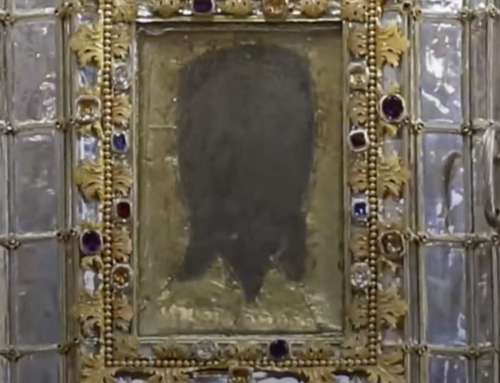
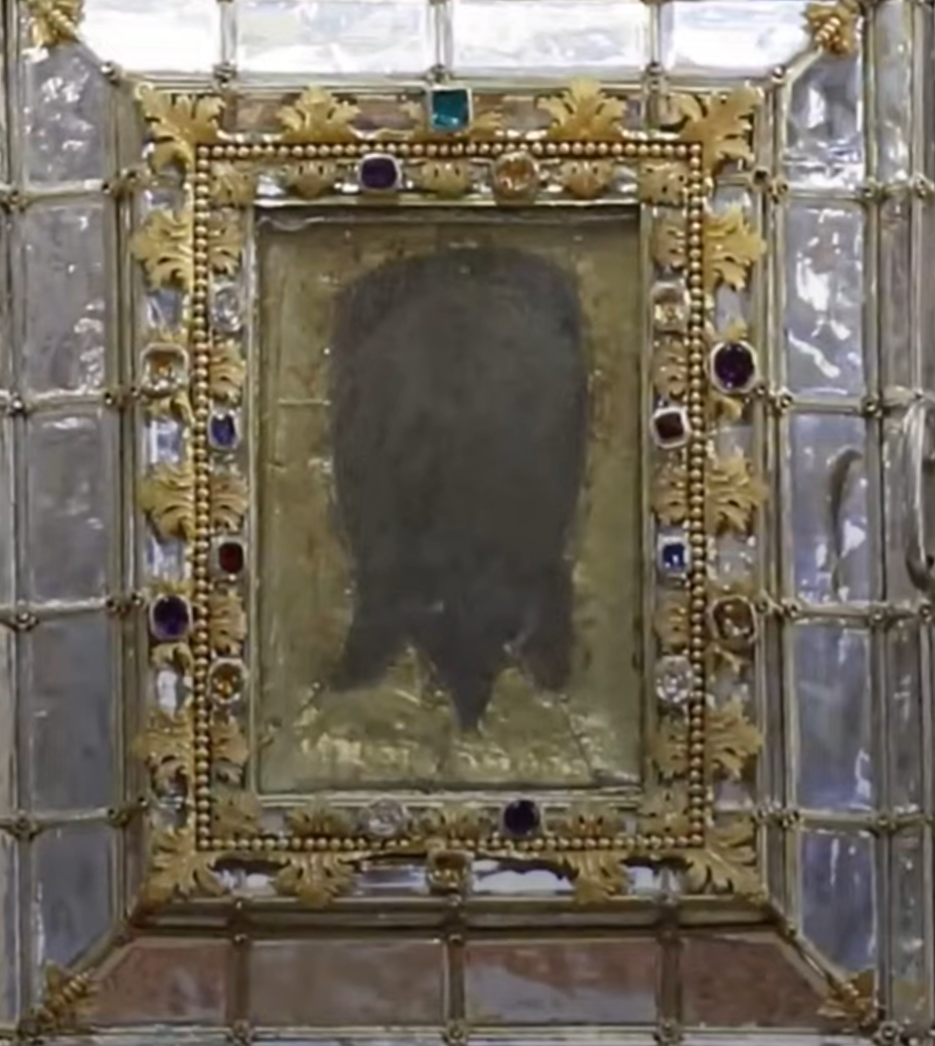
About four o’clock on Saturday morning, March 18th, feast of the Archangel Gabriel, with his eyes still closed, and without the least rattling in the throat, he three times drew a heavy breath at long intervals. At the third, Mr. Léon de Marolles, his cousin, who had never left him, said with emotion: “He is no more!” It was indeed the last breath of his holy relative which he had the consolation of receiving. He died without a struggle; nothing extraordinary had occurred in his last moments to the eyes of those who surrounded him. He preserved in death the angelic calm of his beautiful face, which had long indicated that his soul no longer dwelt on earth. His eyes remained closed. He was seventy-nine years of age. His body was laid in his oratory before the venerated picture of the Holy Face, in the very spot where pilgrims from all countries daily thronged, where his lively faith and his fervent prayers had obtained so many miraculous cures and conversions. His color was but slightly changed; the sight of him inspired neither sorrow nor sadness, but rather excited a sweet emotion of joy and confidence.
“It would be impossible to describe the edifying scene which is passing before my eyes;” writes a witness of it, “crowds, succeeding each other in a continuous stream, come to kneel in prayer by the mortal remains of him whom they already regard as a protector and a saint. It is equally impossible to number the pictures, the rosaries, the medals, which have touched the face or hands of the dear deceased. All feel and realize that they are near one who was a friend of God, and they pray with fervor.”
Such was the scene presented by his oratory during Saturday, Sunday, and on Monday, until ten o’clock in the morning, the hour appointed for the funeral. His obsequies were a kind of religious triumph, one of those public manifestations, such as the influence of true virtue has alone the power to produce. The prefect of Indre-et-Loire, the municipal officers, the vicars general, and the metropolitan chapter were present. The Cathedral was filled as on days of extraordinary ceremonies. In this immense crowd were seen the faithful of every condition and rank, priests, religious men and women of different communities, representatives from all the associations of charity, the heads of different trades, workingmen, the poor in large numbers, the children of the Orphan Asylum, the old people of the Little Sisters. This interesting cortege went to the house of the deceased in Saint-Etienne Street, and accompanied his remains to the church, whence they followed it to the cemetery.
“The Lord, Who delights to exalt the humble,” permitted, in order to add to the pomp of this religious ceremony, that they should be obliged, in consequence of the rising of the waters of the Loire, to make a long detour, and conduct the funeral procession over the stone bridge connecting with Royale Street. The venerable deceased had requested a simple funeral. His idea was understood and carried into effect. The front streamers of the funeral ear were held by an old man and an old woman from the pensioners of the Little Sisters, and the other two, by little children from the Asylum. Whilst, the corpse was being lowered into the grave at the cemetery, some among the crowd were heard to say:
“Is that the place for so holy a man? He should be laid in a church.” Others added: “The day will come when his body will be removed, and he will receive the honor he deserves.” Whatever may be in this respect the judgment of the Church, which it does not belong to us to anticipate, his mortal remains, whilst awaiting the resurrection, repose, as he requested, under the same marble slab which covers the bodies of his mother and daughter. On the cross which surmounts it, has been engraved simply his name and the date of his death. The only distinguishing mark of this tomb, is the white marble prie-Dieu, originally erected in memory of Henrietta. Pilgrims and the friends of the venerated deceased, when kneeling there, offer their prayers in the very spot where he so often prayed for others.
We have no correct portrait of Mr. Dupont. There was a small one painted on wood, which was quite a good likeness of him as he was in his youth; attaching no value to it, he gave it to Adele. Foreseeing towards the end of his life, that after his death it might be used in a manner not agreeable to him, he took advantage of the absence of his servant, entered her room, removed the picture which she had hung on the wall, and threw it in the fire. It was in winter, and he quietly took his seat near the fireplace. When Adele returned, she noticed at once that the precious portrait had disappeared. She ran to her master, lamenting the loss, and found him rubbing his hands with delight; laughing heartily, he pointed to the frame which was nearly consumed. He would never allow his photograph to be taken. His portrait which hangs at present in the room in which he died, was drawn by a friend, from memory, and from an imperfect photograph taken after death. The picture in the hall at the entrance of the oratory is from the pencil of Mr. Lafou. The head of the venerable deceased reposes upon’ his couch, and he appears to sleep. A breath of the resurrection, a ray of heavenly joy plays over the closed eyes and the lips: it is the reflection of the image of the Sacred Face, which the artist, by a master-stroke of genius, has represented as soaring above in the dim distance. A more striking or charming illustration could not have been given to the oft-repeated aspiration of this grand Christian: “May I expire, ardently desiring to see the Face of our Lord Jesus Christ.”
Those who knew Mr. Dupont in the prime of life, love to recall his fine form, tall, straight, and well-proportioned, deriving additional advantage from his dignified carriage and magisterial gravity. His bright, clear eye, his broad brow, his noble and regular features, gave an air of distinction to his physiognomy; habitually calm and serene, his countenance mirrored the various emotions of his soul, and, in this respect, strikingly reminded us of the sweet and tranquil, and, at the same time, sympathetic and expressive face of the holy Pope Pius IX. When kneeling in adoration before the Blessed Sacrament, when presenting himself for holy communion, or making his thanksgiving after communion, his countenance was sometimes seen to glow with a kind of “phosphorescent light,”— these are the words of the ecclesiastic who had often witnessed it— an emanation, as it were, of the interior fire of his soul, which added to the beauty of his features. An author who visited him towards the end of his life said of him: “The abiding sentiment of the presence of God gave a certain majesty to his bearing. His countenance shone at times with a soft light which commanded respect.”
In conversation, his gestures were natural, often expressive and picturesque, lending a particular interest, an additional charm to his descriptions and narratives. He had a habit of expressing his admiration or surprise by extending his arms and lifting his eyes to heaven. A shrug of the shoulders testified indifference or contempt. He threw himself back in his chair, laughing or rubbing his hands, when relating the discomfiture of Satan, of the “old man” as he called him. He exhibited an exquisite politeness and urbanity in his intercourse with every one; he had the elegance, culture, and refinement of good society, and yet, without any art or affectation.
His dress and habits of life were simple and without luxury, but, in every respect, conformable to his rank and of irreproachable neatness. He was accustomed to walk with a recollected air, at a rapid pace, enveloped in a long overcoat with deep pockets and wide sleeves; he politely saluted his acquaintances and his friends, accosted them readily, detaining them at the corner of a street, or on the side walk to communicate to them a pious anecdote, to relate an edifying piece of news, to quote a verse of Scripture, or a sentence from the Office of the day, if the individual was an ecclesiastic or a religious. To him could be applied with perfect truth the following description taken from the prophet Isaiah: Honorabilem vultu et prudentem eloquii mystici: “The honorable in countenance, and the skillful in eloquent speech.”
Modesty and propriety accompanied him as an atmosphere; nothing in any manner connected with him was either neglected or affected. He was the same in his drawing-room; he was cordial and polite to all who visited him, treating each as became his condition and office. His conversation was lively, playful, rendered interesting by its originality, and always interspersed with editing incidents. Courteous and amiable with all, he expressed frankly and simply his sentiments to those who were irreligious and unbelievers, unless discretion or charity obliged him to keep silence. On such occasions he controlled himself in his speech, and took refuge in a chilling reserve, or an absolute silence.
In order the better to appreciate the culminating point of virtue to which we have seen him attain, we will cast a retrospective glance upon his whole life, and briefly recapitulate its principal phases.
Mr. Dupont, during the course of his seventy-nine years, endured trials evidently sent by Divine Providence, as so many steps to conduct him by degrees to that summit of perfection which He designed him to attain. Death deprived him, suddenly, of an amiable wife whom he tenderly loved; this was the first blow. Again death visited his home, and robbed him, successively, of his daughter and his mother, thus breaking the two dearest and sweetest ties of nature. He resigned himself, not without keen sorrow, but with the generosity of faith and the heroism of holy love.
Forced to leave his native isle, he is guided by the hand of God to the city of St. Martin, where he fixes his residence, and where graces are lavished upon him. The career of piety and good works invites him, unfolds itself before him, appearing easy and attractive; he enters upon it with all the vivacity of his Southern temperament, and the ardor of his firm faith; he finds in it his occupation, his delight, the charm of his life. By a special illumination from above, he is detached, by the example of St. Teresa, from many worldly pleasures which he still loves, and he determines to embrace, although remaining in the world, a more fervent life of prayer, penance, and union with God. He passes a portion of his nights in adoration before the Blessed Sacrament. His communications with Sister Saint-Pierre, and devotion to the Holy Face, complete the work and make of him a man of prayer and reparation. The afflictions of the Church, the humiliations of France, and later, his own infirmities, conduct him, towards the end of life, to the road to Calvary, and finally, “nail him to the cross with Christ,” according to the expression of St. Paul. The sufferings endured during his last illness, furnish him with occasions of frequent and minute sacrifices, which render him more and more conformable to the Divine Crucified, and elevate him to a degree of perfection which is found only in the Saints of God.
A letter was one day received at the post-office, simply directed: “To the Holy Man of Tours.” This epithet was so universally applied to Mr. Dupont, that it caused the clerks no embarrassment. The letter was forwarded to its destination, the pilgrim of Saint-Etienne Street. Men the most eminent in science and virtue, entertained the same opinions of him, and used the same language as the people. Not long since, the venerable Coadjutor of Bordeaux, Monseigneur de la Bouillerie, wrote to us: “Mr. Dupont enjoyed the highest reputation, and in Paris, where I then lived, his name was familiar to all. I will mention a circumstance which occurs to me as I write. When I was nominated Bishop, and was about to leave for my diocese, a good girl, who had been for some time under my direction, was lying dangerously ill in a hospital at Paris. She asked me if she could not write to Mr. Dupont, of whom she had heard so many wonderful things. I answered there was no objection whatever to her applying to him, and gave her his address. Then the good girl said, in all simplicity: “Father, should not the letter be directed to Mr. Dupont, Thaumaturgus, Tours?” I mention this circumstance as an evidence of the popular belief in his sanctity.”
The pious prelate adds: “I knew him, principally, by general report, having only once bad the gratification of conversing with him. His ardent love of the Holy Eucharist, and the Christian affection existing between himself and the Reverend Father Hermann, made me acquainted with him. I prayed in his little oratory of the Sacred Face, and even from one short interview, I became convinced that his soul was intimately united to God.”
The same impression was made upon all who approached him. During his life he was accused of being “an enthusiast,” “exaggerated in his sentiments.” Let us consider if this imputation was merited. It is certain that this supposed “exaggeration,” or “exaltation,” whatever name they may choose to use, led to no reprehensible consequences, because it never induced him to step beyond the bounds of the charity due to his neighbor, nor beyond the limits of the obedience he owed legitimate pastors. This fervent layman was ever a docile child of the Church, strictly governed by the regulations she imposes in relation to the acceptance of revelations and events, which are considered miraculous. We find in many of his letters expressions of his sentiments in reference to such circumstances; in them, he asserts that he awaits with respect and deference the decision of ecclesiastical authority. Until that was made, he advised his friends to observe a prudent reserve. In writing of an instance of the kind he says: “I am told that the pretended miracle is a notorious fraud. Silence, therefore. Let us wait awhile.”
Mr. Dupont was “an enthusiast” in his confidence in the power of God and the Saints, in his implicit reliance upon the efficacy of prayer, in his hatred of the demon and of the instruments of Satan, in his ardent devotion to whatever concerned the exterior adoration of the Eucharist. Granted! But can we be too enthusiastic on such subjects? Does not the enlightened Christian regard as a supernatural and extraordinary degree of zeal and fervor in the practice of virtue and fidelity to duty, that which is qualified by the careless and the unbeliever as enthusiasm? Was not this same divine folly the characteristic of the Saints, for which their contemporaries reproached them? Were not the solitaries of Palestine and the Thebiade “enthusiasts,” when, issuing from their deserts in their penitential garb, they suddenly appeared in the streets of Antioch or Alexandria, in order to defend the faith attacked by the Arians, and to fortify, by their example and discourses, the wavering faithful? Were not the martyrs of the first centuries “enthusiasts,” who not only suffered death with fortitude, but who boldly presented themselves before the pagan judges, defied them in their tribunals, and proceeded to torture with a triumphant joy? And at an era nearer our own day, did not men stigmatize as “enthusiasts” those heroes of the Middle Ages, a St. Bernard, a St. Francis of Assisi, and many others, whose love of poverty and mortification led them to practice those virtues with a rigor considered impossible to the strength of man? Mr. Dupont was an “enthusiast” after the manner of these illustrious Saints. Gifted, as they were, with a sensitive and sympathetic soul, like them also he abandoned himself, with transports of joy and unreservedly, to the things of God. His feelings were easily roused by any manifestation of the action of the Holy Spirit. But his was not a thoughtless enthusiasm; it originated in the most solid and correct supernatural motives. The two following incidents will illustrate our idea on this point.
A Jew, the son of a zealous and learned rabbi, who had hitherto lived as a man of the world, careless and unbelieving, was converted, and, having been prepared by Mr. Dupont, was baptized and made his first communion. After this holy action, the darkness was removed, as it were, from his eyes; he quoted from memory long passages of the Holy Scriptures with facility and correctness, adding admirable explanations. Every thing he had formerly learned from his father concerning religion recurred to his mind; he comprehended and interpreted all in a Catholic sense; he had become at once a fervent and well-informed Christian. Mr. Dupont, charmed with the wonderful operations of grace in this soul, never wearied conversing with him, and, in his admiration, he would exclaim: “Behold him! yesterday he was ignorant; to-day, he knows far more than ourselves.”
One day when there was a number of persons in his room, and they were about to commence the prayers, two workmen presented themselves to be cured. On their entrance, Mr. Dupont was struck by their peculiar manner; he interrogated them and discovered at once that they had no idea who he was, but supposed they were dealing with a bone-setter. The servant of the Holy Face explained to them that cures were obtained there only by prayer. They did not comprehend him. The unfortunate men had lost even the first ideas of religion. Immediately, on the spot, the charitable apostle began to instruct them, and running through the principal truths and the commandments, he touched upon confession. Until then they had listened with interest; but when he explained the sacrament of penance, they commenced to shake their heads and mutter to themselves. Mr. Dupont repeats the instruction, and insists upon the necessity of this dogma, which is so salutary and consoling to mankind: they are not convinced. At last, the zealous catechist exclaims: “It is not hard to throw yourself at the feet of the minister of God, and say: “Bless me, Father; for I have sinned,” “Oh! certainly not, it is not hard,” cried out an old peasant who was seated at the other end of the room. “You may well believe it was not men who invented that. Men! they would have told us to say: ‘Punish me, Father; for I have sinned!’ and our good God makes us say: Bless me, Father; for I have sinned! ’” Mr. Dupont arose, and walking to the peasant with his peculiar air of dignity, laid his hand on his head, saying: “Let me kiss the head which, through the Holy Spirit, has conceived so beautiful a thought!” Thus did this great servant of God know how to admire and feel!
Perhaps also, some may be surprised that he was inclined to consider as providential the coincidence of certain dates and facts, or to attribute directly, either to a Divine action, or a satanic influence, the least good or evil event which came under his observation, or of which he was informed. But, in reality, was this disposition of mind which did not exclude the exercise of free-will, opposed to the doctrine of the Gospel? Does not Jesus Christ emphatically call Satan “the prince of this world?” Is Providence an empty name? Does it not designate the paternal solicitude of the Creator, watching over His creatures even in minute affairs? Does not our Lord represent to us the hand of our heavenly Father extended towards His children, numbering even the hairs of their heads, feeding the birds of the air, adorning the flowers of the field, not letting even a sparrow fall to the ground without His permission? Was then, this constant reader of the Holy Book so very wrong, when he reduced to practice, in his conversation and sentiments, those divine and touching lessons contained in the instructions of the Gospel? If his conduct and language were at variance with the views of his contemporaries, of those who saw him only from a distance, or who were scarcely acquainted with him, and who formed their judgment of him without knowing his supernatural motives and his mystic explanations, was it not that the result of the pernicious influence of an age sunk in materialism, or the effect of the ignorance of a multitude of Christians, who, at the present time, are accustomed to speak, judge, feel, and act in direct opposition to the Gospel? Here again, it was evidently the simplicity of faith which elevated the servant of God to those sublime heights, and inspired him with his clear ideas.
Another general observation on Mr. Dupont’s life should not be omitted. This grand Christian of the nineteenth century, like the greater part of the holy personages whom the Church honors with a public veneration, did not attain at once the summit of perfection. It was successively developed, had its phases, its degrees. And, as in the ascetic and moral order, there was progress, so in the intelligence of his faith, and consequently, in his expression of it, there was a marked difference, a sensible advance, which presents him to us ascending, as it were, higher and higher, under the impulse of the breathing of the Spirit of God.
If his natural temperament, the vivacity of his disposition, the ardor of his zeal, and the poetical turn of his imagination, rendered him in his youth inexact, extreme, and too human in the manifestation of his faith, by degrees he gained the mastery over these defects, and he acquired a correctness and clearness of sentiment, an exactitude of expression in accordance with the most vigorous theology. On his part, there was the same enthusiasm for the beauties of the supernatural, the same jubilation of heart at every manifestation of the Divine action; but there was also more distrust and reserve in the acceptance of human testimony. His peace of soul and purity of heart, increasing as holy love augmented, were more and more reflected in his words and his exterior acts.
Such was Mr. Dupont during the last fifteen or twenty years of his life. Such we have ourselves known him, and we give personal testimony to the truth of the description of the holy man as presented above. We have known eminent priests, men of experience in the things of God, who never conversed with him without being struck by the correctness of his ideas on different texts of Scripture, or on various matters of doctrine and piety.
We may add that the aureole of sanctity which environed him, brought Mr. Dupont, by letters or visits, in communication with laymen, priests, or religious, of an impetuous and eccentric zeal, inclined to introduce new works or devotions, who went either to consult him or to engage him to adopt their views. He was likewise in correspondence with religious women, or ladies of the world, of ardent temperament and keen intellect, with imaginations easily inflamed, who fed upon chimerical projects, or who were the victims of a bitter deception, and who applied to him for light, consolation, and encouragement. We have in our possession a large number of letters written by the servant of God to persons of this kind. What particularly attracted our attention in these confidential communications, which are frequently only short notes, and what characterizes them, is the sobriety of language, the calmness of judgment, the prudence of the counsels, joined to the utmost delicacy of charity; but above all else, there is a firmness of opposition, decided and candid, to whatever appears extreme and far-fetched, and on that account regarded by him as false or impracticable. Every line reveals the impress of a sound mind, of a mind humble, upright, and always aiming at what is practical. It was not in vain that this fervent layman so often repeated the invocation to our Lord: Faciem tuam illumina super servum tuum, et doce me justificationes tuas: “Make Thy face to shine upon Thy servant, and teach me Thy justifications.” The spirit of wisdom with which he was filled, proves that his prayer was heard.