Isolation and Suffering — Last Period of Devotion to the Holy Face.
God, designing to purify his servant more and more, was about to afflict him in all that be held dear. The Nocturnal Adoration, which had been interrupted for a long time, was resumed with great difficulty; the associates were unable to assemble oftener than once a month; the meetings were continued, thanks to a few fervent men whom Mr. Dupont had inspired with his own sentiments; but he was no longer there to keep alive the flame by his words and example. This was a painful privation to him as well as to them. On the other hand, it is well known that our public disasters during the war of the Prussian invasion, by dispersing or removing members of families by death, were necessarily attended with changes and interruptions of social relations. The pilgrimage to the Holy Face, as a consequence, became very different from what it had previously been. Visitors, without ceasing entirely, diminished sensibly in numbers. We may truly say that the devotion was the same, as is proved by the correspondence of that time; many, who could not undertake the journey, requested by letter to have phials of the holy oil forwarded to them, and begged the prayers of the servant of God. But crowds no longer thronged his room; isolated pilgrims presented themselves, one at a time. Already he was, himself, scarcely able to receive them: he began to feel the weight of his infirmities. “I regain with difficulty,” he said, (February 2, 1871,) “the strength I lost two or three years ago. I am at an age when this should not surprise me. I am now in my seventy-fifth year. It behooves us all to endeavor to walk perseveringly in the ways of God.”
There is a void around him occasioned by the death of his dearest friends, his relatives, his neighbors. He speaks with deep emotion in one of his letters, which constantly become shorter, of the death of the “Rev. Abbé de Solesme,” of the loss of his “dear cousin Adrien de Beauchamps,” and also of the death of “a good neighbor, with whom he had been intimately associated for more than forty years….”
To his other infirmities, was added a partial loss of sight. “I have discovered,” he says, (December 10, 1874,) “that my sight is very defective. I was forced to guess at all that portion of your letter written in red ink. You cannot imagine the effort I was obliged to make in the attempt to read it, and unfortunately, it was trouble lost! Another misfortune is, that as only a few come, at rare intervals, to visit the prisoner of Saint-Etienne street, I have not the chance of aiding my old eyes by young ones. Add to this, the gout in my hands forces me to write so slowly that I forget half the words.”
He makes no complaint of a state in which he views the divine will. “Yesterday evening, I suffered from vertigo,” he writes to a friend. “The physician assures me it is of no consequence. Still, I realize that it does not require a cannon ball to destroy this earthly envelope. I have evidently entered into a state beset by infirmities, the true way of penance, in which, willingly or unwillingly, we must do the will of God. Ask for me the grace to receive this penance lovingly.” He is ready to accept all the incommodities of old age, particularly the loss of his memory which had always been good. “If my limbs render me very slight service,” he says, “my memory scarcely serves me at all. Such is my condition; humanly speaking, it is sad; but God wills it, amen! it is right, and just as it should be.”
He aspires more than ever to “silence,” desires “to be forgotten,” and requests a friend to help him to maintain himself in these dispositions. An excellent person was endeavoring, through kindness, to divert him. “I shall write him,” he said, “that the greatest need of my soul is to remain in perfect silence. You know what good reasons I have to keep myself at anchor in the port of abjection.” Another lady proposed to him to interest himself in a good work; he answers: “You ask me what is simply impossible. In my present state of decrepitude, I am entirely unfit for service. I am able for nothing, I do nothing, I am worth nothing.”
He had not, however, lost his serenity, nor his amiability in receiving his friends and in entertaining his guests. The following incident is a proof of this, and it is also an evidence that the decay of his faculties was not such as, in his humility, he supposed. We quote from the letter of a gentleman living at present in the North, who had formerly frequent communication with him. “One became an admirer, a disciple, a friend, after having seen or heard him, or even after having received one of his letters. To see him was a powerful attraction to me to visit Tours. My last visit was in November, 1874. I had received several invitations to dine, but I preferred accepting one from Mr. Dupont. His health appeared to me much weakened by age and infirmities; but his kind reception was the more gratifying, and his memory had not failed. On entering, I met a countryman walking at an ordinary pace, his countenance wearing a contented expression. It was only after he left that I learned the following fact.
“An inscription, which Mr. Dupont was attaching to a crutch placed in his hands by the countryman, certified that the man was lame when he entered, being unable to walk without the support of a crutch. After having prayed before the Holy Face, he arose perfectly well, and deposited his crutch as evidence of his cure. The servant of God informed me, with the simplicity which characterized him, that when the countryman came he was a cripple, and that after having prayed he returned home with the full use of his limbs. I dined with him alone. I cannot express to you the happiness I experienced in being near this holy man. His whole conversation consisted of quotations and admirable comments upon the Old and New Testament. My memory, imagination and heart were fed, enlightened, and charmed by the fervor of this beautiful soul. He gave me, at my departure, a small parcel of earth brought to him by a pilgrim from the garden of Olives. He sealed the envelope, inscribed on it: Ex pulvere Gethsemani, and kindly signed his name.”
The above represents in what manner Mr. Dupont at that time received his friends when they visited him. This was undoubtedly one of his last receptions. For the future, he was to live in silence and solitude. When the pilgrims, who went to pray before the Holy Face, did not inquire for him, or when he was unable to receive them, he sent his servant, whom he had trained to that pious employment, to supply their wants.
He made use of the sacrifices imposed upon him by this isolation, as a means of advancing in virtue. His patience was unalterable; his humility was beyond expression. One of his intimate friends had the idea to test it, and she gives us the following account: “In order to amuse myself, and enjoy his humility, I said to him one day: ‘Would you believe that I was really impatient this morning with a good man who was going away, because you were not in your room! I told him he had no faith, that he was an unbeliever,… that you were nothing but the distributor of the oil, and that it was the Holy Face which performed all the cures.’ ‘Oh! how truthfully you spoke,’ he said, as he extended his hand to me; ‘I will put on your forehead some of that excellent oil, which is miraculous in its effects upon the mind as well as upon the body.’”
He kept himself aloof, as far as he could, even from his ecclesiastical superiors, avoiding with great care everything which might attract to himself any mark of esteem or interest. In the latter years of his life, he was visited by the Archbishops of Tours; far from being elated by this honor, he seemed embarrassed and confused rather than gratified. His only desire was to be unnoticed and forgotten. It was from this motive, that he constantly refused to allow either his portrait or photograph to be taken. One of his goddaughters was very urgent in her request for his photograph: “I am not in a position,” he replied, “to have my photograph taken. I am called upon to see so many persons that I could not enter into so puerile a distribution.” To a friend presenting the same petition, he answers: “I have an excellent reason for not sending you my photograph: it has never been taken.”
. He no longer engaged in any active work of zeal or charity, except in that of the Clothing Society, of which he was president. The meetings were always held in his room, such being the wish of the members; and they never left him without being filled with the odor of his sanctity. He could not assist actively, and often he spoke very little. “But it was enough for us,” says one of them, “to know that he was there in continual prayer. Wherever we might be employed in the work of the Society, we were encouraged and hopeful, considering his prayers to be efficacious to secure our success. It seemed to us that he, individually, had a power of prayer as mighty as that of a religious community, whence the divine praises and the perfume of prayer ascend unceasingly to Heaven.
It was about 1874, that he remarked when reading a life of St. Edmund, Archbishop of Canterbury, a prayer which that illustrious pontiff daily addressed to the Apostle St. John, whence he derived at the hour of death a sweet consolation. The prayer was as follows: “O beloved disciple of Jesus! O virgin Apostle! obtain for me from our Lord the happy death which was granted to thee and the Saints. May I end my life in sentiments of true faith, firm hope and perfect charity! May I, preserving consciousness to the last, be able to confess my sins sincerely, and be fortified with the viaticum of salvation, and the unction of the dying! May I expire, ardently desiring to see the Face of our Lord Jesus Christ!” The concluding words, particularly, delighted Mr. Dupont, This fervent invocation corresponded so entirely to the secret aspirations of his soul, that, like the holy bishop, he repeated it continually. He spoke of it to those who visited him, pronouncing the words slowly, as though he found in them an infinite delight; with his own poor hand, swollen and painful as it was, from gout and paralysis, he made a large number of copies of this prayer which he presented to his friends, or enclosed in letters.
For a long time he deprived himself of the pleasure of visiting religious communities and attending to the works of charity in which he was interested. The only exception he made was in favor of the Little Sisters of the Poor, whom he occasionally visited; his habit was to arrive during their recreation, and pass it with the Sisters. He would then see the old people, and speak a few kind words to each. They collected around him, they called him Father Dupont, they were perfectly at home with him. The mere sight of him was a joy to them and did them good; his words animated by an ardent faith, and his example, encouraged the most suffering to bear their cross with patience. These charming visits, which, by degrees, became very rare, were festival days for the whole community.
When the paralysis and gout gave him a little respite, he took advantage of it to assist at the Holy Sacrifice, a happiness he could no longer enjoy frequently. He would go to the chapel of the Carmelites. It was the sanctuary of his choice, and, for some time, he had selected it as the one in which to hear Mass and receive holy communion. He edified all present by arriving, every morning in summer at half-past five, and at six in winter, braving the inclemency of the seasons, and all the inconveniences arising from the early hour. When the morning was dark, he made use of a pocket lantern. Knowing that the body of Sister Saint-Pierre lay in the chapter-hall directly beneath the holy-water font, he would stop when near it, and, with his simple faith, entertain himself an instant with the dear deceased, concerning the interests of the Sacred Face and reparation.
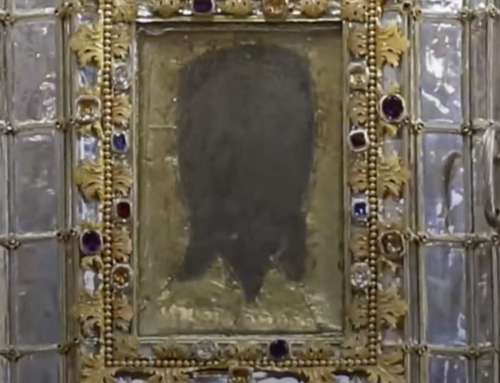
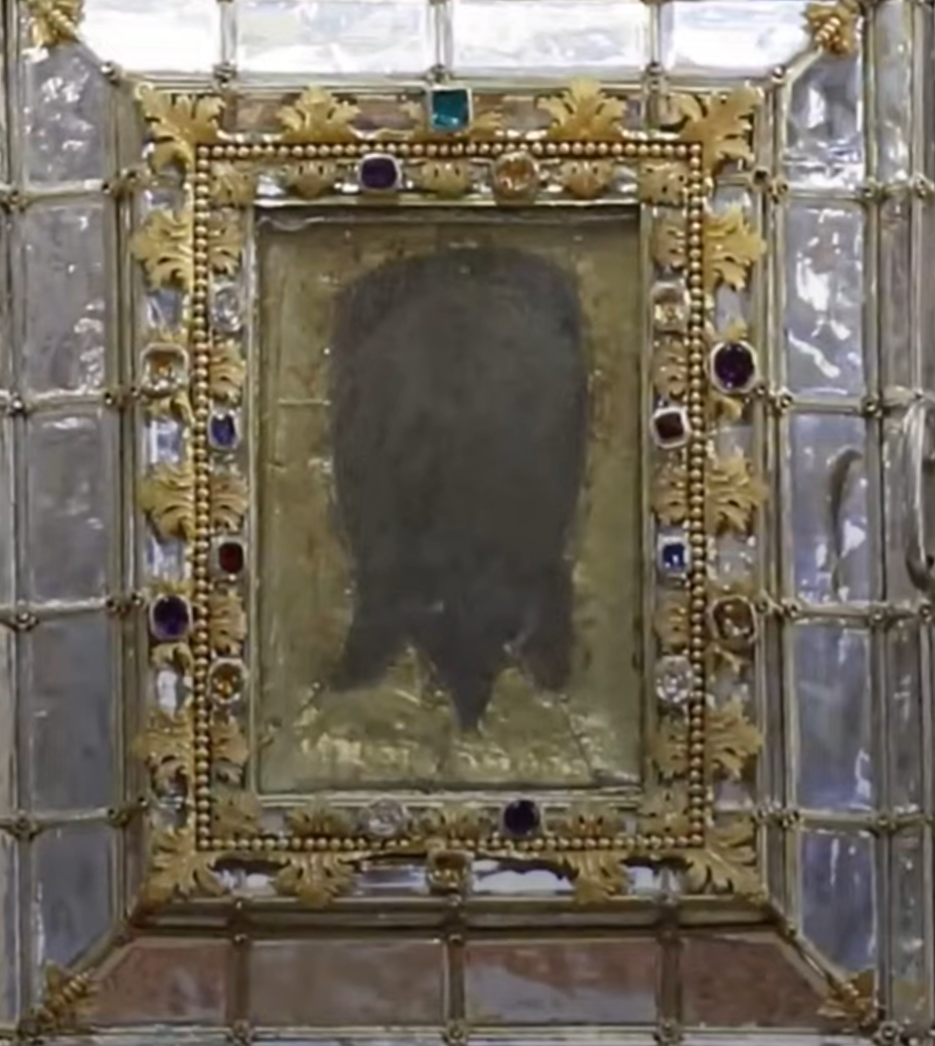
As his sufferings increased, he was forced gradually to resign himself not to leave the house, and at last was confined to his room. That small apartment on the first story, was about to become the scene of the last trials of this true Christian, and then of his death. We should first mention how it happened that he was occupying it. For long time his bed-room was the one which he called his drawing-room, and which in reality had become the oratory of the Sacred Face; it was a pleasant apartment, situated upon the ground-floor, and opening into the garden. He had in it a small iron bedstead concealed by a curtain; he was thus enabled, both night and day, to satisfy his devotion. He was so happy to sleep in the presence of the adorable Face of our Lord. And how often, when alone, he prayed kneeling before the cherished and venerated picture!
On the occasion of his last visit to the baths of Bourbon, he anticipated a long absence. Before his departure, his servant, Adele, requested his permission to order some repairs in that part of the house which was daily thronged with strangers. She had the different rooms on the lower floor, connecting with the oratory, properly cleaned and painted; she was, above all, particular in arranging in the best manner, that spot sanctified by so many prayers and miracles. At last, she was so daring as to remove the iron bedstead, on account, she said, of the inconveniences resulting from its remaining in a room frequented at all hours by strangers. She purchased a new bedstead, and placed it in a room above, which had formerly been used by Madame d’Arnaud as a sitting-room. On his return, astonished to find that he was no longer to pass the night near the Holy Face, Mr. Dupont, calmly folding his hands, said gently: “Can it be possible! Why was this done, Adele?” She explained to him, in her manner, how inconvenient it was to him to pass the night in a room where he was subject to receive so many visitors. Without shewing the least dissatisfaction, the good servant of the Holy Face conformed his will to the Divine will, and resumed his occupations as though the sacrifice had cost him nothing. This happened after 1860. From that time, he always slept in the room in which he died, and it was there, that he remained continually during the last few years of his life, a prisoner from paralysis and gout.
But before following him to this new Calvary, let us stop a moment with him in this first room, his drawing-room and oratory, to which he no longer goes, unless occasionally to receive visitors and write his letters, but where, by the power of his prayers, miracles continue to be effected…
We have said above that the people no longer went in crowds as formerly; but petitions by letter for prayers became far more numerous. The quantity of notes of this kind received during the last years of his life is incredible. We have looked through a portion of those found among his papers.
We see in them marks of the wonderful confidence placed in him by persons of every condition, and from every country. His reputation for sanctity was so great and universal, that petitions were presented him for prayers, as though the address was being made to a saint in Heaven. He is not only requested to recommend their necessities to what they call his “confraternity of the Holy Face,” and to his work of the Nocturnal Adoration, but they apply to him personally; his individual prayers they particularly desire; these they esteem as peculiarly efficacious, and the simple thought, that he remembers them, consoles and encourages. Every kind of necessity is referred to him. An infirm person writes to be cured. A mother recommends her daughter; a wife, her husband. What is most urgently solicited, is the conversion of a sinner, the return of a prodigal son. His prayers and “blessing” are asked for children preparing for their first communion. Strangers open their hearts to him with simplicity and candor, confide to him their troubles, as they would do to an intimate friend; to a confessor, or we might rather say, as they would do to an angel of Paradise, to God Himself. Urgent telegrams are forwarded begging his prayers for a relative dangerously ill, for one in his agony who has not made his peace with God, for a departed friend, for relief from temporal misfortunes. Again the petition comes from a deacon about to be ordained a priest, or a mother recommends the examination of her son; a father, the first communion of his daughter; a curate, the sick of his parish; a wife, her husband threatened with blindness. A poor widow begs him to aid her to pay her rent due since All-Saints. The Trinitarians, recently established, ask him to send them novices. A Christian mother relies upon him for the cure of her son, and his vocation to the ecclesiastical state. Thanks are returned for phials of oil, or additional ones requested. He is desired to unite in novenas for particular favors which are specified. His house was a center, a sanctuary, as it were, towards which thousands of, hearts turned with confidence.
Those who know the state of his health are afflicted, and promise him to pray for his restoration; but the greater part supposing him to be still at his desk before the Holy Face, are astonished at his silence, and beg for a few words in answer. Many such letters to his address were received long after his death; they come even to the present day. For his part, notwithstanding his gout and other infirmities, he was particularly desirous not to interrupt his correspondence; he continued it until the last month of his life. But it caused him much pain, as we may judge by the account he himself gives of his condition. He jests about his handwriting with a friend in America: “My dear friend,” he says, “what a difference between our writing! yours becomes that of a giant; and mine, as age advances, diminishes to nothing. But, after all, that is of no consequence: our business is to advance in the path which conducts to Heaven. The one who arrives there first, will not forget the friend he has left on earth.” In the meantime, he is perfectly resigned: “The gout, without leaving the left hand, seems disposed to settle in the right hand; should this be the case, my insignificant letters must cease entirely; in advance, I say: Fiat!”
From that time he wrote only when circumstances rendered a few lines absolutely necessary. Each of these letters short, simple, and containing a pious sentiment, carried to those who received them a precious emanation of the “good odor of Jesus Christ,” which perfumed his conversations.