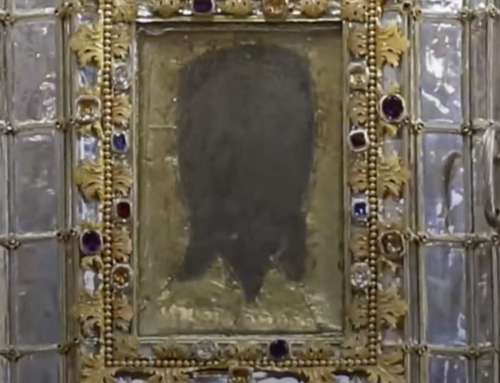
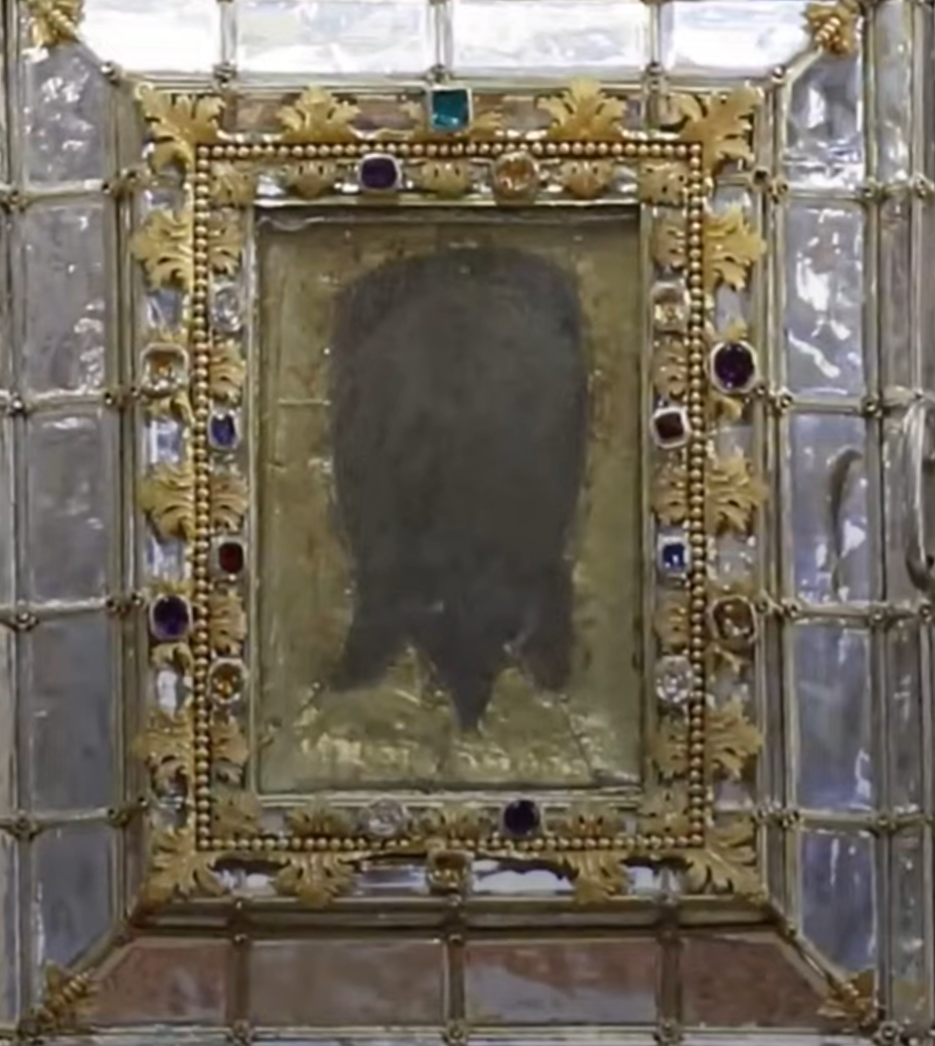
Fourth Period of the Holy Face.
Mr. Dupont lived in a supernatural element. He was ever united to God, and in spirit and heart, in the society of the angels and Saints. The practice of the interior virtues, his unwearied application to prayer, his various exercises of piety, adopted according to circumstances and the necessities of the moment, all these spread around him a sort of heavenly atmosphere, the influence of which was felt by all who approached him. His reputation was great and extended to a distance. Persons from every direction visited him impelled by various motives: the infirm, to be cured; the afflicted, to be consoled; the curious, to study and know him; grave men, to be edified and instructed; others, simply to beg his prayers, and at the same time to receive from him a word of encouragement, or of light in their difficulties and their doubts. We may assert, without fear of passing the bounds of truth, that there was not a work of zeal, of piety, or of charity, founded in France during thirty years, for which his influence was not exerted, either directly or indirectly; not a man of God, of any consideration whatever, who did not make a point of recommending himself to his prayers, or of soliciting his advice as to an enterprise already commenced, or for a project in contemplation.
The visits made to him did not always result in a corporal cure, or in a miracle apparent to the senses; they most frequently proved to be remedies for the soul, leading to a sincere conversion, an amendment of life, or imparting an increase of faith, a supernatural light which poured the balm of consolation into the suffering heart. The room of the servant of God had become a source of graces, a center of benedictions appropriate to every want of the soul. In illustration of this general remark, we will give in detail a few facts which occurred in the years immediately preceding 1870.
A very aged lady was living in an entire disregard of any religious practice. A dangerous illness having prostrated her, she was recommended to the prayers of the servant of God. He was deeply interested in the salvation of her poor soul, and he made daily inquiries as to her dispositions. Her attendant, seeing her mistress reduced to the last extremity, ventured to propose the ministry of a priest, but her suggestion was indignantly rejected. Informed of the discouraging refusal, Mr. Dupont did not, on that account, lose hope, but continued to intercede for the return of this unfortunate soul to God. His prayer was heard; she became more composed, unexpectedly asked for a priest, and made her confession. God restored her to health, and prolonged her life four years. She persevered in fidelity to her religious duties, and died in an edifying manner, fortified by the sacraments of the Church.
An old man, without religion, was hopelessly ill. Mr. Dupont was informed of his condition, and exhibited great solicitude for his salvation. His prayers proved efficacious; the hardened sinner himself requested the attendance of the curate of St. François-de-Paul, who found him in excellent dispositions. He was unable to administer the Holy Viaticum; but, at the moment of death, the man received Extreme Unction in the most consoling sentiments of faith.
In 1853, Mr. Dupont was requested to pray for an infant two months old, in a dangerous condition from whooping-cough, which caused violent convulsions. The man of God answered only by the following mysterious words: “There must be victims in families” A few days later, the child died, although the parents had made a pilgrimage to obtain its cure. After the lapse of five years, the grandfather, who did not practice his religious duties, was hopelessly ill. He was recommended to the prayers of Mr. Dupont. For ten years, his friends had vainly solicited his conversion; it was obtained only two months before his death. But the man, who was naturally upright, returned to God with all the simplicity and docility of a child recently enlightened from above. He received, in perfectly Christian dispositions, the Sacraments of Penance, Eucharist, and Confirmation. The friends who were present were edified by the calmness and resignation of the poor man, so long an alien from his God. A fortnight afterwards, he died surrounded by his family, justifying, by his holy death, the prophetic words uttered by Mr. Dupont five years previously.
Mr. D—–, a good man in the worldly acceptation of the term, lived, as well as his wife, without religion of any kind. The slightest thing which might recall to mind the Catholic faith, offended them. So strong was this feeling, that upon the division of some family property, when an image of the Savior fell to their share, Madame D—- gave it away, saying she did not wish to have in the house an emblem which always brought misfortune. God, Who willed the salvation of these two souls, sent the cross of suffering, to force them to turn to Him; but the grace was to be granted them through the intercession of the servant of the Holy Face. Mr. D—– was struck with paralysis, which deprived him of the use of his lower limbs, and kept him a prisoner in an arm-chair, or on a bed of pain. His condition embittered still more his natural disposition, and made him very difficult to manage. Notwithstanding the devoted attentions of his wife, who never left him, and the care of an excellent servant, he was extremely irascible. To complete his misfortunes, the faithful servant was suddenly unable to continue her attendance on him. A blow, which she had accidentally received, was so serious in its consequences, that the physicians considered a dangerous operation indispensable for her cure. The girl, having heard of Mr. Dupont, went to Tours for the express purpose of recommending herself to his prayers: she united with him in prayer before the venerated image, anointed with the oil, as he directed, and she was immediately relieved.
Mr. D—– was singularly impressed by the cure of the servant; he thought within himself that the saint who had obtained the restoration of his nurse, could as readily obtain his; but he asked himself what claim he had to such a favor. He, a sinner! he was unworthy of it. He determined, however, to write to the servant of God a very humble letter, in which he begged the aid of his prayers, acknowledged that he had never made his first communion, that he did not deserve to be cured, but still he hoped. Mr. Dupont prayed for him particularly, and succeeded in winning his soul to God. He received Holy Communion, became patient and resigned, and terminated his life with a Christian death. Instead of health of body, God had granted him the more precious gift of health of soul. Madame D—–, touched by her husband’s example, was also converted.
A young lady of Tours believed herself called to the religious life, but she was decidedly and persistently opposed in her designs by her father and mother. Suddenly, her eyes became affected so seriously, as to inspire her parents with the fear of a total loss of sight. The proposition was made to her to visit Mr. Dupont, to anoint with the oil of the Holy Face, and make a novena. She gladly consented, not with the intention of soliciting relief from the affection of the eyes which caused her no anxiety, because she was confident that her vocation was from God, but to beg that her father and mother might consent to her entrance into religion. She performed the pilgrimage, was faithful in reciting the prayers and making the unctions; at the end of the nine days she was no better, but the spiritual blindness of her parents had been removed, and she obtained their entire approbation of her pious design. The affection of the eyes proved less serious than was supposed. The young lady gradually improved; she is, at the present moment, Superioress in a house of her Congregation, and gladly relates this incident, in order to honor Mr. Dupont, to whom she feels indebted for the favor.
It sometimes happened that a simple drop of oil given by the servant of God produced, even at a distance, miraculous effects, not only on an infirm body, but also on a rebellious will. A lady relates a pious stratagem and attests its truth. “A man about forty years of age had not approached the sacraments since his first communion. His wife, a devout woman, prayed fervently, and offered large alms with the intention of obtaining his conversion; all was in vain; from neglecting the practices of his religion, he proceeded to a denial of the doctrines of the Church, and lost his faith. His wife confided to us her trouble, and asked advice of my daughter who replied: ‘Since your remonstrances are fruitiest, do not talk to him upon the subject of religion; such conversations tend to embitter his feelings still more, and remove him farther from God. Bring me a shirt belonging to this heart of stone, and we shall melt it.’ Upon the shirt, on the side of the heart, they put a drop of the holy oil sent by Mr. Dupont. A few days later, the man suddenly asked for a prayer book. The following Sunday, the same stratagem was employed, and the unbeliever asked for a priest. He was sincerely converted, and his wife blesses from her heart the servant of the Holy Face; but the man was never told of the means employed to bring him to God.”
The Reverend Father Bouix, the learned translator of the works of St. Teresa, never passed through Tours without visiting the servant of God. “When I called one day,” he says, “I found several persons in his room, who, like myself, had gone to be edified by his conversation. A woman presented herself. ‘Do you remember me?’ she asked Mr. Dupont; ‘you cured me, and I now bring you my son.’ He was a boy about fourteen years of age, who suffered so intensely with an affection of the stomach, that in consequence of the violent pain she had spent two hours in dressing him that morning. They commenced the prayers. Mr. Dupont anointed the boy on the forehead, and directed the mother to pass into the adjoining room, and apply the oil to his stomach. The child returned to the room restored to health; Mr. Dupont said to him: ‘Take that arm-chair, my little friend, and carry it around the room.’ The boy obeyed immediately, to the great joy of the happy mother. Overcome with gratitude and rejoicing in his recovered health, the boy opened his arms, stood on tiptoe, and warmly embraced the man of God, who, smiling at his simplicity, raised his eyes to Heaven, and, in union with those who were present at the interesting scene, chanted the Magnificat in thanksgiving.”
Two very pious young ladies, relatives of Horace Vernet, lived in Tours. One of them was so crippled in all her limbs, that for several years she had been unable to go to the church, unless carried in a chair. She requested one day to be taken to Mr. Dupont, and she was perfectly cured. The congregation were astonished to see her afterwards walking daily to church without assistance. The fact was one of public notoriety, and we have often heard it related by the curate of her parish.
The citizens of Tours have not forgotten Sister Angela, one of those worthy daughters of St. Vincent de Paul, whose apostolic zeal equals their ingenious charity. One day, in ascending a narrow and dark staircase to visit a patient, she fell, and, although not injuring herself dangerously, she suffered afterwards from a tumor on her leg, so large as to inconvenience her in walking, and to cause her to limp. Mr. Dupont noticed it, and pointed expressively to the picture of the Holy Face, as if inviting her to seek there her cure. The Sister hesitated and smiled. The servant of God then spoke seriously, and asked in tone of reproof: “What! a religious deficient in faith! Come, Sister, kneel down and pray.” Ashamed of her first feeling of distrust, she fell upon her knees and united in the prayers; after the unctions were made with the oil, the tumor disappeared. The Sister left his house, no longer lame, but free from pain, and delivered from an infirmity which never returned. She is now in America continuing her works of charity.
The cures effected were at times so far above the laws of nature, that the spectators experienced a kind of religious terror, if we may so express ourselves. A venerable and pious lady, who was visiting a friend in Tours, desired to see Mr. Dupont and pray before the Holy Face. A remarkable miracle was operated in her presence. A man entered who had an enormous swelling on his hand; as the servant of God applied the oil, the swelling disappeared under his fingers. Terrified by the wonder she witnessed, the lady ran from the room, went in all haste to the house of her friend, and related what she had seen, exclaiming that she could not believe the evidence of her senses, the thing was impossible, and yet she admitted that the circumstance really occurred as she represented it; her mind was in confusion; the divine, the supernatural had, as it were, transported her into another world. When she became more calm, she recognized a miracle in the event which had transpired before her, knowing that what is impossible to man, is possible to God, Who can do all things.
A lady, living in the vicinity of Tours, was passing some time in that city. One day when walking with her husband and daughter, she requested them to wait a few minutes, as she desired to procure a phial of oil from Mr. Dupont. She entered his room and knelt for a short prayer, not wishing to detain her husband for any length of time. The holy man occupied his usual place at his desk; as she arose to leave the room, he looked at her, and in a tone of authority said to her: “Sit down. You torture yourself, Madame, and are uselessly disturbed; the woman who fears God will laugh in her last hour. You would make greater progress in the spiritual life, and you would be far happier, if you abandoned yourself more entirely to Divine Providence.” Then referring to the text quoted above, he related the history of his mother who, having feared death during her whole life, died peacefully and with a smile upon her lips; he continued to speak for some time upon confidence, abandonment, and peace of soul. This conversation was so unexpected to the lady, and apparently so uncalled for from one who, was a perfect stranger to her, that she hastened to take her leave, ascribing his remarks to a weakening of his mental faculties, as he was then an old man. However, she begged the aid of his prayers that she might obtain a particular grace which she ardently desired. He answered: “I promise to pray, but your petition will not be granted.” In reality, she did not attain the object of her desires. That very evening she dined with a friend in Tours, and among the guests was a bishop, who had been, for a long time, her confessor, and who still continued to be her director. She related the singular interview of the morning. The bishop took her aside and said: “I have no other advice to give you; Mr. Dupont’s words contain all you require; they sum up my opinion in regard to your spiritual condition, and the wants of your soul.” The lady then comprehended that the servant of God had been enlightened from above in her regard. She still lives, and the above statement is given upon her own testimony.
A pious young lady of Versailles, who had visited the Holy Face, repeated to us another fact which was personal, and almost of the same kind. “As I had already,” she says, “been once cured, I returned to see Mr. Dupont, with the intention of obtaining through his intercession a favor I specified. He listened to my petition, smiled gently, and, taking his pen, wrote upon the register, not the request I had made, but another entirely different, I called his attention to it, but he left unaltered what he had written, and the grace he asked was granted me. I shall never forget the calmness and depth of expression on the face of the holy man; it seemed to say: ‘Poor child! you know not what you ask; there is something better for you; God will grant it.’”