Third Period of Devotion to the Holy Face.
At the death of Madame d’Arnaud, Mr. Dupont was in the sixty-third year of his age, and the eleventh of his zeal in the cause of devotion to the Holy Face. His excellent mother, up to that time directed the household of her son; her society was a great happiness to him; she was a beam of light brightening his home with family joys. The sacrifice imposed upon him by her death, completed his detachment from earth. Henceforth, he will devote himself solely to the work which seems to be the mission entrusted to him by Divine Providence.
From 1860 to 1870, his life was passed entirely before the Holy Face; he appears during this period as if at the culminating point of his zeal for reparation and charity for souls. His whole time is devoted to prayer, the reception of invalids, and his correspondence. He contemplates this immolation in its fullest extent, and he voluntarily determines to accept it. His health is failing; he sees it, he feels it, he says so; but he resigns himself to the loss. God recompenses him, at first, by secret graces which elevate him to a degree of heroic perfection, and, afterwards, by numerous miracles of which he is more than ever the active assistant, it not the direct instrument and indisputable organ.
If we wish to form an idea of his solitary life and his duties, we must hear the account he gives of them in confidence to friends, either to beg their indulgence, or to excuse himself for refusing to render them certain services, which appear to him foreign to his mission. For example, the public festivals which were celebrated at Tours, either periodically or extraordinarily, attracted to his house a larger number of pilgrims and visitors, and increased his work to a great extent. Thus in 1864, he wrote to Mr. d’Avrainville: “I have rarely been so overburdened. Sixteen letters on my desk, four packages of oil to forward, and a great concourse of visitors. If you had been so kind as to pass the Assumption with me this year, as you did last year, you would have fallen in with the meeting of government officials, where all goes on quietly and smoothly, whilst I am overpowered with business.” A few days later, he writes: “In addition to the official assembly, there is to be a fair for the next ten days, and that will bring me a prodigious number of pilgrims, and to-day, fifteen letters in the bargain… I am fatigued; therefore, I shorten my letter…” “You will find that I have grown old,” he says on another occasion to his friend, “and, consequently, I am overpowered by the work demanding my attention. God tempers the wind to the shorn lamb. For myself, I can hardly manage my correspondence. Business rains down upon me from morning until night, and, therefore, the least undertaking requiring order or stability, is altogether impracticable to me. You cannot imagine, my dear friend, the nature and the number of my occupations arising from the devotion to the Holy Face.”
To others, he writes nearly in the same strain, but it is to rejoice with them on account of the miracles which are made known to him. “You are not mistaken in supposing my correspondence is very extensive. Every day it augments, because our Lord continues to recompense the faith of those who put their confidence in the Holy Face. Could you believe that, since the 1st of January, I have received fifty-two certificates of favors obtained after the unctions with the oil? During all that time, eight is the lowest number of letters I have received on any one day.” (April 11, 1863.) To a friend who is travelling: “For myself, I have no thought of going elsewhere, because the affairs of the Holy Face detain me, as it were forcibly, with a daily increase of work. Constantly, additional favors.”
He finally abandons all pilgrimages, even that of Paray-le-Monial. “I have been urged,” he says, (June 27, 1861,) “to go to Paray. I cannot, however, absent myself with impunity for four or five days, because of my correspondence, too voluminous for me to allow it to accumulate upon my desk, even for a short period. I repeat: Fiat! and that, with all my heart, in expiation of the little fruit I derived from the different pilgrimages which I had the happiness of making, when I was free to undertake them, and when I was of an age to offer other service to God than mere good will.” But the sedentary life voluntarily accepted, although so contrary to his temperament and his habits, contributed to develop the malady which the baths of Néris and Bourbon had not entirely eradicated. He had frequent severe attacks of gout and rheumatism of the joints. In 1862, he again tried the waters of Bourbon, but it was for the last time. He was unwilling to absent himself in future; whatever might be the consequence, he would not neglect his mission. In his very infirmity, he saw the hand of God confining him to his solitude. “My lower limbs are only of moderate use to me, and as my suffering still continues, I must believe that there is no remedy, and that God wishes me to remain, more than ever, constantly before the Holy Face. And I add that I can truthfully say with the Psalmist: Sic habitabo, quoniam elegi eam. Here will I dwell, because I have chosen it.”
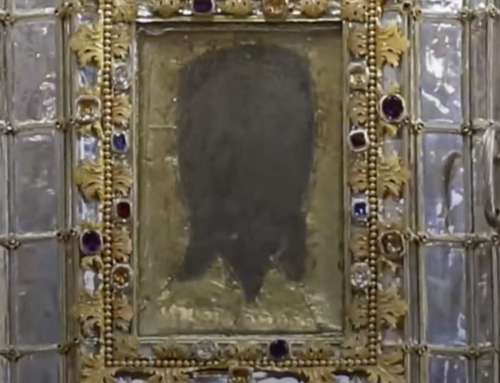
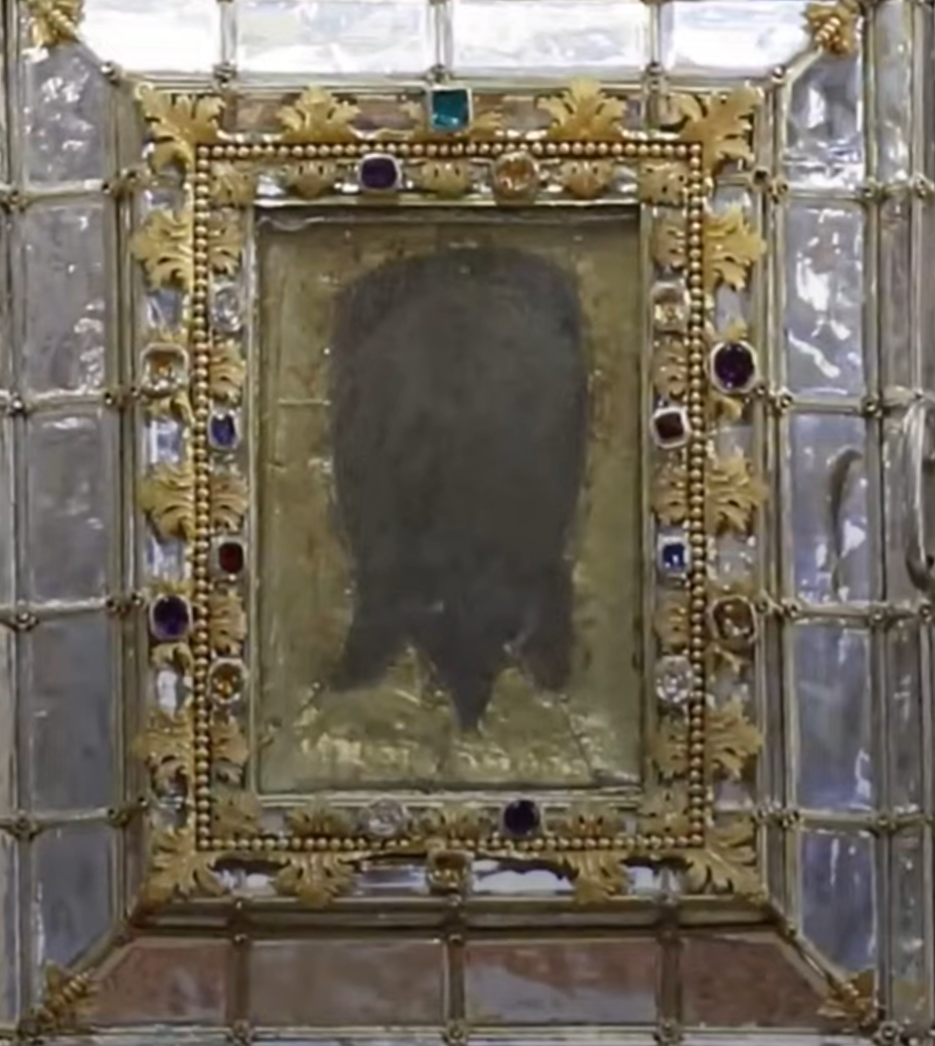
Seated at his desk, or kneeling, with his eyes lifted to the venerated image of the Holy Face, he prays, he receives those who present themselves, he works. The concourse of pilgrims and of the infirm, is sometimes so great that the court in front, the porch, the adjoining grounds are crowded with people, baggage, and vehicles of every kind. One of his friends writes: “I can vouch for an incident, of which I was myself an eye-witness. As I was one day going to the depot at the time the train arrived, I saw one of the porters (they are forbidden to enter the enclosure in order to prevent them from importuning travelers,) make a speaking-trumpet with his hands, and call out in a loud voice: ‘Are there any passengers for Mr. Dupont’s?’ The distance from the depot to the house of our Saint is very short; some of these rogues would drive the invalids around the city for the purpose of consuming more time, and thus increasing their pay. A pilgrim was, on one occasion, about to leave Mr. Dupont, in order, he said, to be at the depot in time for the departure of the train. He was informed that he had ample time as the train would not leave for an hour, and that five minutes would suffice to walk to the depot. Whereupon, the pilgrim told him that he had been a whole hour going between the railroad and Mr. Dupont’s. He had evidently been driven around the city.
All the invalids who sought a cure did not obtain it; and among those who did, many, after some time, relapsed into their former condition. But for both, a greater grace was generally the fruit of their conversations with Mr. Dupont. They returned home edified, preserving a remembrance of this holy man which, under various circumstances, proved beneficial to them. This result was of frequent occurrence. It is particularly remarkable in the case of a noble lady who sent us in writing a detailed account of her visit We present a portion of it; it will unfold to the reader the influence exercised by the servant of God over the souls of those with whom he had held correspondence.
“The remembrance of Mr. Dupont,” she says, “was always associated in my mind with the idea of sanctity. I was in my sixteenth year, and my ill health was a source of great anxiety to my family. I accompanied my mother and sister to Tours, and we were introduced to Mr. Dupont. He commenced by asking if we had, been to confession; on being told we had confessed recently, he replied: ‘No matter, you must confess and communicate, if you wish to obtain what you ask.’ As we were strangers in Tours, he directed us to a confessor. He consented, however, to give us some of the oil from the lamp, and to pray with us. We returned twice to his house, and left Tours two days afterwards; my health had already commenced to improve, and for about eighteen months I was tolerably well. After that I relapsed into a worse condition than before; but my former confidence in obtaining a miraculous cure did not return; if I desired to see Mr. Dupont, it was rather to be edified by the sight of the saint, than to seek the health I had sought in vain elsewhere, and which God had always refused me. Even passing visitors, judging from his exterior, regarded him as a man entirely dead to himself, and living only for the love of God and his neighbor. To pass his life in the service of others, required a great self-abnegation; yet, he never exhibited weariness in receiving visitors, exhorting them or praying with them; all was done with unfailing sweetness and serenity. With what piety and recollection he said over and over again the same prayers! He always repeated them kneeling, and he wished the invalids to follow his example, notwithstanding the fatigue it might cause them. He would recite them several times for the same person when circumstances required it. And not a word escaped him to direct attention to himself; he seemed to have renounced all personality, and to live solely for the service of his Divine Master.”
When the infirm were not cured, Mr. Dupont, without expressing any surprise, endeavored to discover the cause; he often found it in the want of faith and of confidence in the effect of prayer. He recognizes this distrust by certain signs, which would have escaped others, and which he points out with simplicity. Two ladies, who were going to the baths, presented themselves, on their way, as petitioners before the Holy Face: they did not obtain their cure. He remarked: “It is, generally, on returning from the baths, rather than when going to them, that graces are bestowed. It is said of the woman in the Gospel: In medicos erogaverat omnem substantiam suam; ‘She had bestowed all her substance upon physicians.’” He does not complete the sacred text, which tells us that this woman, approaching Jesus Christ, touched the hem of his garment, was instantly healed, and merited to hear from the Savior: “Thy faith hath made thee whole.” Desperate hours are the hours of God. When we can no longer hope for aid from man, we turn to Him alone, and place all our confidence in His power and love. It sometimes happened that eminent and holy persons asked, without obtaining their cure. Thus, Mgr. Ségur went to Mr. Dupont at the commencement of his blindness; but God reserved him, to furnish the example of a prodigy more wonderful than the one he demanded.
Others, on the contrary, were satisfied with sending a letter, or even a dispatch, and their petitions were immediately granted. As the servant one day informed Mr. Dupont that dinner was on the table, he handed him a telegram. Prayers were requested for a child that was dying in a northern city. Mr. Dupont, who still preserved towards his mother the respectful deference of his youth, was unwilling to inconvenience her by his absence; he therefore laid the telegram before the picture of the Holy Face, saying as he did so: “Thou seest, Lord, that the case is urgent!” A few days afterwards, he received a letter of thanksgiving informing him that, at the very hour, a change had taken place for the better, and the child’s life was saved.
In general, the miracles operated in Mr. Dupont’s drawing-room, converted the invalids who simply witnessed them, as well as those who were more favored, into apostles of the Holy Face, and propagators of the devotion. The testimony of each added weight to that of the others. Every week, and almost every day, furnished new instances to the collection of certificates already accumulated in such numbers. We select a few of the more striking from the events of this period.
One of the most remarkable was the cure of Mademoiselle Hortense Dupin. We copy the certificate of the arch-priest of the diocese:
“I hereby certify that Mademoiselle Hortense Dupin of la Flèche, fifteen years of age, had been suffering for seven months from a malady, called by the physicians paraplegia; having employed, without success, every remedy prescribed in such cases by practitioners, the doctor declared that no medical treatment could effect a cure. The young girl, for several months, had been unable to walk more than a few steps in ten minutes, even when leaning upon a stick and supported by a friend; at last, she lost all power of motion.
“On Thursday before Pentecost, Madame Dupin took her daughter to Tours, and had her lifted from the carriage into Mr. Dupont’s drawing-room. Mr. Dupont united in prayer with the mother and child, gave some of the oil which burns before the Holy Face to the mother, directing her to anoint with it the knees and back of her daughter. The prayers and unctions were twice repeated on Friday, when Mademoiselle Dupin was able to walk with perfect ease around Mr. Dupont’s room, whence she went to the Cathedral, knelt before the altar of the Blessed Virgin, then visited the church of St. Julian, and returned to her hotel. The following day, on arriving at her own home in la Flèche, she sprang lightly from the carriage, and she has, ever since, walked without inconvenience or pain of any kind.”
We shall now hear what Hortense herself writes on the subject to the servant of God. “Every one thanked God and pronounced my cure miraculous. The physician, who had attended me for seven months, was amazed on being told by a lady that she had seen me at High Mass, and that I walked without difficulty; he said it was impossible, and came at once to our house to ascertain the truth; he could scarcely credit the evidence of his senses, when he saw me walk. To many persons who questioned him, he replied, that I could have been cured only by the power of God, that no physician could have restored me to health, particularly in one day. My condition was so well known throughout the city, that every one sympathized with me and my parents; my cure has, consequently, attracted much attention. People came in crowds to see me, some, even from a distance of eight leagues. All who were infirm desired to be taken to you, and, although God did not will that all who went should be entirely cured, they have experienced some relief, as have those, also, who used the oil in their own homes. The curate of la Flèche and other priests were pleased to see me cured; but their pleasure was increased, when many persons, who had not been to their duties for years, and who had little confidence in prayer, decided to confess and communicate before using the oil.”
The great art of the servant of God, if we may apply that word to him, consisted in encouraging persons, and in communicating to them a little of that faith and confidence which obtain all things in prayer. Madame G—–, a woman between fifty and sixty years of age, paralyzed in both limbs for eighteen months, having uselessly tried all the usual remedies, was, at her request, taken from the country to Tours where her son resided. Leaning upon two crutches, and provided with a folding-seat, she dragged herself along, as best she could, to Mr. Dupont’s, having stopped, in her progress from the center of the city to Saint-Etienne Street, at least twenty times to rest on the folding-seat. The unctions were made, but without effect. Mr. Dupont encouraged her, excited her confidence, and requested her to make a novena of prayers at home, giving her a phial of the oil. She suffered intensely in going to her son’s. The following day she proposed returning to Mr. Dupont’s. Her son, who had no confidence in the oil, had allowed her on the eve to do as she pleased; but he now decidedly opposed a second visit. “You were,” he said, “excessively fatigued yesterday; you must not go to-day; say your prayers and anoint with the oil as much as you choose; but let it be done at home.” Madame G—– submitted to so positive a refusal, particularly as it seemed reasonable; she said the prayers at home, and made the unctions; perceiving suddenly that she was better, she laid aside one of her crutches, attempted to walk without it, and found she could do so very well. “I am better,” she said to her son; “see, I can walk with one crutch. I think I can even do without the other.” Saying this, she laid it aside also, and walked with ease. “Now, my son,” she exclaimed, “you certainly will not oppose my going to Mr. Dupont.” Arriving without crutches, without support, feeling no fatigue, notwithstanding the distance, she related what had passed, and united in the usual prayers offered in thanksgiving. Having completed these, Mr. Dupont said: “You are now cured; but you must make a trial of your limbs. Visit in thanksgiving every church in the city.” Madame G—– acceded to the proposition, and walked from church to church in the seven parishes; she performed the whole distance with ease, and without particular fatigue.
A young girl of Notre Dame-la-Riche was suffering with one of her feet, which was enormously swollen. Not being able to walk, she was carried before the Holy Face. As they commenced the prayers, she expressed aloud her desire and the object of her visit: “My God, if it be Thy will, grant me my cure.” Mr. Dupont gently reproved her: “That is not the manner in which you should pray. You have not faith… Say to God in a more positive manner: “Lord, cure me!,… If you wish to be cured, you must command God.” “Oh!” exclaimed the young girl, “I cannot do that, I cannot command God.” “You have not faith,” replied Mr. Dupont, “you must say: I wish to be cured! Cure me! We must have an unlimited confidence in prayer, and never hesitate to ask.” “And yet,” said the poor young girl, “it seems to me that I have faith.” Exciting her faith by an increased effort, she recommenced the prayers. She was somewhat relieved, and was able to walk home, although not without pain. Encouraged by the unexpected improvement, and reproaching herself for want of faith, she said; “O my God, it is true that I distrusted too much Thy power and goodness in my regard… I see it, I know it, Thou canst, Thou wilt cure me; I ask this favor of thee; grant it to me, O God! grant it to me!” She returned to the man of God, and left him radically cured. He had succeeded in elevating the faith of this person to the level of his own, to the level of that faith concerning which our Lord has said: “Amen I say to you, if you have faith as a grain of mustard seed—say to this mountain, remove from hence, &c.” We have mentioned that the servant of the Holy Face preserved the certificates and the autograph letters, which attested the miraculous graces obtained in his oratory, but that he made an exception in the case of certain facts so striking and personal, as to alarm his humility. There are several of this kind properly authenticated, an account of which cannot be found, although the papers were placed in his hands. We have convincing testimony of the truth of the following incident, although there is no mention made of it in his papers.
This miracle was attended by remarkable circumstances. Mr. H. d’A—– had the kindness to send us, at our request, after a pilgrimage to the Holy Face made by himself and his family in May, 1877, a written account of the fact. “My wife,” he says, “was in such a condition that she had been for weeks incapable of any movement whatever; she was lifted as an infant. So extreme was her weakness, that she could not even endure the scratching of a pen on paper, or the slight noise made in unfolding a newspaper. My father-in-law and myself considered her death as inevitable, a necessary consequence of her extreme weakness, even without any new complication; for a long time she had been unable to take any solid food. The case was desperate; the cure was complete. My father-in-law and my aunt, convinced that all human means were ineffectual, left together for Tours, to see Mr. Dupont. They had appointed Tuesday to visit him, but the cars having been delayed, they were forced to remain all night at Tours, and consequently to defer going to his house until the following day, June 5, 1867. As we were living forty leagues distant from Tours, we were entirely ignorant of the unforeseen delay. At the moment we supposed that the pilgrims were with Mr. Dupont, we united our own with their intention, and recited the usual prayers to the Holy Face.
“This was on Tuesday, the 4th, the important day for us; but, as there resulted no improvement in the condition of the invalid on that day, and, as oil the 5th, we concluded that our relatives, having terminated their pilgrimage, were on their return, we had nearly lost hope. However, on Wednesday, at the very moment when my father-in-law and my aunt were praying with Mr. Dupont before the Holy Face, the patient suddenly exclaimed in astonishment that she needed no support to her head, and could even raise her hand.
“The following day, on the arrival of the pilgrims, we recited the prayers of the Holy Face and applied the oil. She immediately expressed a wish to leave the bed, and moved her arms in a manner that, for the three past months, had been impossible. She arose, cast herself on her knees whilst making an act of thanksgiving, and did so without pain…
“I have, sir, given you herein a faithful account of an event which occurred ten years ago. But the remembrance of some events could never be effaced from the heart, even were one to live a hundred years.”
This simple narrative exhibits in a strong light the greatness of the miracle, and the efficacy of the prayer of him who was the instrument in obtaining it. It also furnishes an explanation of the deep emotion manifested by these two noble pilgrims, when, accompanied by their children, they revisited the drawing-room of the servant of God, now transformed into a chapel. There they heard Mass and communicated in thanksgiving, pronouncing with tears of gratitude the name of Mr. Dupont, reverently regarding him as a thaumaturgus and a saint.
The Countess de Vaux, in religion, Sister Teresa, Superior General of the Congregation of St. Louis, founded at Juilly by the celebrated Abbé Bautain, relates the following fact: “One of our pupils, Mademoiselle de L—–, fifteen years of age, was the victim of a galloping consumption. Four days after the commencement of her illness, the physician of our Institution requested a consultation. A married sister of Mademoiselle de L—–, a resident of Paris, brought a physician who made a specialty of lung diseases. After a thorough examination of the patient, he pronounced her case hopeless, adding that he scarcely thought she could live a month longer. Her sister proposed taking her home, but the physician declared that to move her would hasten her death, and all she could now do would be to prepare the family for the painful separation. On hearing the result of the consultation, instead of being grieved I rather rejoiced, as I recalled to mind that I had already obtained several cures by the oil of the Holy Face. After making the two physicians repeat in a decided manner that there was no hope for Mademoiselle de L—–, I felt perfectly calm, and was convinced that she would recover. The physicians had no sooner departed than I applied the oil over the lungs, and commenced the usual prayers of the novena (five Pater and five Ave,) during which, as is always the case, her illness and weakness increased; in the same proportion did my faith in her recovery augment. On the ninth day, her expectorations were exactly similar to those on which the doctor had based his diagnosis of the case; on seeing them, he said: ‘This is the last.’ ‘Oh! yes.’ I replied, ‘it is, in truth, the last.’ On the following day, when making his usual visit to the patient, he found her free from fever and oppression. The young girl was very cheerful, and was taking a bowl of rich soup. ‘How did this happen?’ he asked in extreme surprise. ‘Do not be offended, doctor,’ I answered; ‘but as you considered the poor child incurable, I consulted a skillful physician, the most skillful of all physicians.’ I then told him of the unctions with the oil, saying: ‘You see that even galloping consumptions cannot resist the great physician, the good God.’ From that time, (1862,) Mademoiselle L—– has never experienced any lung trouble. She is now (October 30, 1878,) a religious in our Community: she desired to consecrate to God the life he had miraculously granted her in our house.”
The infirm were very eager to present their petitions, but they were not always careful to acknowledge the graces they had received, or to offer a just tribute of gratitude to God for the favors He bestowed. The man of God considered an exterior act of thanksgiving to be a duty; and if that were omitted, he foresaw that the individuals would pay the penalty of their neglect. Thus, in a village not far from Angers, a consumptive woman, given up by the physicians, and too weak to move herself without assistance, was instantaneously cured. Shortly afterwards she was attacked by another disease. When Mr. Dupont heard it, he was not surprised. “So long,” he said, “as she does not fulfil the duty of gratitude by sending a certificate, she will not recover.” Twenty-five years had passed, and the certificate had not been sent. Very recently, with a view to obtain a cure, an attestation properly authenticated was forwarded, and, at the time we write, the individual, now nearly restored to health, has made a pilgrimage of thanksgiving to the Holy Face, and has personally related to us the details of the miracle accomplished in her regard.
At certain periods the concourse of visitors was not so great. Mr. Dupont does not fail to remark it in his correspondence. “For the past month,” he says on the 19th of January, 1864, “there have been very few pilgrims to the Holy Face, and I have not received a single certificate. I make no complaint whatever, I simply mention the fact.” Two years afterwards, the 19th of September, 1866, he writes: “I am still at anchor in the spot you know so well; nevertheless, I see the number of pilgrims decreasing; this causes me no anxiety, as I feel my strength diminishing, and I must preserve sufficient for my correspondence, and forwarding the phials of oil, both of which require a moderate attention.”
What caused the decrease in the number of visitors? In the course of time, novelty wore off; persons became so accustomed to the events which transpired in the drawing-room of the man of God, that they ceased to pay attention to them; fewer people went, from curiosity; it was frequented only by pilgrims and invalids. And moreover, persons from a distance had recourse to him by letter, and requested oil to be forwarded to them, having had experience that, by these means, cures were often obtained. And should we not, also, read in this circumstance a particular design of Divine Providence, Who thus allowed his old servant to rest, and gave him the time to make a more immediate preparation for the final journey and the eternal recompense? However that may be, Mr. Dupont seemed neither pained nor surprised; he derived consolation from it, and even rejoiced that he was less besieged by persons, who lavished upon him honors which were painful and humiliating to him. As far as the glory of God and the good of souls were concerned, he knew, through the confidential letters that were addressed to him, that a supernatural action continued to be exerted in a secret, but not less efficacious manner. He was also fully indemnified by the pilgrimages to Lourdes, which were already rousing the masses of the people and assuming large proportions, in consequence of the wonderful cures effected by the use of the water. He even regarded this as one of the chief causes of the diminution of the number of visitors to his little oratory; it was, he thought, the adorable Face of our Lord impelling souls towards the Immaculate Virgin of Lourdes, in order that they might receive still more abundant graces. Mr. Dupont did not go to Lourdes. The state of his health and the devotion to the Holy Face, deprived him of this consolation; but the attention he gave the great event, which has rendered this place memorable, requires us to dwell upon it for a short time.