Chapter 4
The Carmelite Monastery of Tours
“There I found the child Jesus
and the Holy Family.”
(Words of our postulant.)
“Accompanied by my father, I left the town of Rennes on the feast of my dear patron, St. Martin of Tours, the 11th of November, 1839, and travelled towards Tourraine, my future home. I reached Tours on the 13th, and proceeded immediately to the convent where I arrived at 5 o’clock in the afternoon. What rendered this event remarkable to me was, that it was St. Martin who presented me to ‘all the saints of Carmel,’ for on the next, day their feast was to be celebrated. I felt assured that these good saints would not refuse me admission on the day of their feast, for I had prayed fervently, entreating them to admit me into their company; they could not have given me a better or more striking proof of my perseverance than that of having received me on such a day.”
Our little Breton postulant seemed to have had no curiosity to visit the city. “That,” said she, “is of little importance to me. Having quitted the travelling coach, my father conducted me to the Carmelites; he gave me his benediction and said with great emotion, while embracing me for the last time: ‘The will of God alone, my child, gives me courage to make this sacrifice.’ Poor father! May God reward your admirable resignation to His decrees!.. Very soon the doors were thrown open and my father remitted me to the care of this new family who presented themselves to receive me. If at that moment I offered to God the sacrifice of a fond father, he gave me in return a most excellent mother, who was to render me inestimable services. This was the reverend mother Mary of the Incarnation, prioress and at the same time mistress of novices. When in the world, Our Lord one day gave me to understand that the mother whom he destined for me would have a special grace to conduct me in his ways; and, in fact, the promise was verified as soon as our reverend mother understood my interior dispositions. This knowledge came to her by degrees, and according as God judged it proper for his glory and the salvation of my soul.”
“After I had embraced my new sisters, the reverend mother conducted me to the altar of the Most Blessed Virgin Mary, my heavenly mother, to thank her for my admission into the holy house of Carmel, and to place myself under her special protection. The hour of recreation soon drew nigh: I was invited to sing and I did not wait to be importuned, for I had sung the same hymn many times while awaiting the happy day of my entrance into Carmel. It was as follows:
Oh! Bless’d be God! I’ve found that peace
For which I’ve sighed so long;
For Him my love shall never cease,
He’ll ever be my song.
“There were fifteen stanzas which I sang with such cheerfulness that no one thought of interrupting me.’’
The new postulant seemed inclined to continue, when suddenly the reverend mother prioress, who had been absent, entered the recreation room. Finding one disposed to sing, the others to listen, and all apparently enjoying themselves, she considered it a splendid occasion to test the postulant. “Well,” said she, “you have been in a hurry to display your little talent.” A dead silence ensued. After a few seconds, the mother prioress, turning toward the little singer, said: “See if you can entertain us with something better” “Oh! reverend mother,” replied she, “I have sung you the very best thing I know.” Such was her simple reply. Not a shadow of disappointment or embarrassment could be observed on her countenance. It was very evident that by virtue as well as by natural disposition, Perrine was not of a melancholy turn of mind.
“This frank gaiety,” said she, “was already a proof of my vocation for Carmel; for our holy mother, St. Teresa, would not allow sad or melancholy subjects to remain among her daughters; of this I was fully aware. The following day, I attended the Divine Office, during which I had a very ridiculous temptation, and as it was the only one I remember having had against my vocation, I shall relate it. Observing the officiant, the chantress, the chorists and other sisters going to the middle of the choir, make a genuflection, say something in Latin, then return for others to take their place,— I was alarmed at the number and variety of these ceremonies. I thought I would never have intelligence enough to know how to do so many things, nor to perceive when my turn would come to do likewise. I concluded that perhaps it would be much more expedient for me to take my little bundle and return to Brittany. But how could I get home! I had only forty francs in my purse; surely that would not meet the expenses of so long a journey. I had forgotten that I had given even this to the good mother prioress. However, I consoled myself by saying: have patience and we shall see what will happen. I was conducted to the confessional:— further dismay. I perceived a small slab of iron painted white, pierced with little round holes, and placed in the wall according to the Carmelite custom. They told me that I should speak through this grating to the confessor:— Patience again, my soul, and we shall soon see how all these things will terminate! From the chapel I was conducted to the novitiate. There I found the child Jesus and the Holy Family, the cherished objects of my affection. From this moment the Holy Family, for whom I had quitted the world and entered Carmel where I knew they were specially honored, smoothed away all my difficulties and I found all things easy and agreeable. I was so much at home that it already seemed several years since my arrival. Then I understood by my own experience that there is vocation, not only for an order, but also vocation for a particular House of that order, as I had no attraction for any other convent; on the contrary, from the moment I entered that of Tours I felt that I was where God wished me to be.’’
Let us for a few brief moments interrupt these interesting details to make acquaintance with the house into which Perrine was led by Divine Providence.
The monastery of Tours is by no means the least considerable among the many which the daughters of St. Teresa have established in France. We behold in its foundation a visible proof of St. Martin’s protection of his episcopal city.
Divine love had already formed a bond of union between the Carmelite Reformer and the Thaumaturgus of the Gauls, which her biographer has not neglected to mention. The virgin of Avila writes: “To-day is the feast of St. Martin to whom I have a special devotion, for I have frequently received extraordinary graces from Our Lord during this octave.”
It was, as we have seen, on the feast of this holy bishop that Perrine had received marked assistance in the pursuit of her vocation; it was also during the celebration of that same feast that she found, not far from the tomb of the glorious apostle, the asylum wherein her perfection was to be accomplished. Is it not an indication of the watchful care of Providence to have enriched the city of St. Martin with a community so thoroughly imbued with the Teresian spirit? It will be our agreeable duty to trace, summarily, the origin of the monastery and its principal historical phases down to the time of the admission of sister St. Peter.
The monastery of Tours was established in 1608. Four years previous, that of Paris was founded by cardinal de Berulle, madame Acarie and Blessed Mary of the Incarnation. The latter was related to M. de Fontaines-Marans, seigneur de Rouziers, in the vicinity of Tours, whose favorite daughter had entered among the Carmelites of Paris, but because of ill-health she was obliged to return home. To indemnify this beloved child who still sighed for the peaceful solitudes of Carmel, M. de Rouziers proposed founding a monastery at Tours with the hope that she would be received as benefactress, thus enabling her to satisfy her pious desire, and at the same time remain near the paternal mansion. It was madame Acarie in person who negotiated for this foundation with the pious nobleman. Cardinal de Berulle appointed mother Ann of St. Bartholomew, prioress of the projected monastery, and nominated seven sisters to accompany her. This was the devoted friend of St. Teresa who expired in her arms. She had come from Spain with several other sisters, accompanied by cardinal de Bertille. The annals of the monastery have preserved the following account of the foundation: “We left Paris on the 5th of May and arrived here on the 9th. The journey was tedious and painful; but St. Teresa appeared and consoled her faithful friend. She seemed to walk by her side on a path strewn with thorns, exhorting her to continue her arduous undertaking in the following words: ‘Courage! I shall assist you.’ From the moment of their arrival, the sisters took possession of the house prepared for them, and the Blessed Sacrament was deposited in the chapel the Sunday within the octave of the Ascension, the 18th of May.”
“On the same day, mother Ann of St. Bartholomew recommended the new monastery to Our Lord during her communion, supplicating him to bestow his graces on the little flock of missionaries present, and on all those who, in the future, would present themselves to serve Him. ‘My adorable Master assured me,’ said she, ‘that he would grant my request; and from that moment to the present time I have witnessed the marvelous accomplishment of his promise.’”
At this period the population of Tours included a great number of heretics, descendants of the Huguenots who, in the preceding age, had been the cause of the most frightful civil wars. When they learned that a number of nuns were coming to reside in their city, and were even crossing the Loire, they exclaimed: “May they go to the bottom of the river before reaching the shore!” However, their impious desires were not realized. The grace of God soon triumphed and changed these hostile feelings. The nearest neighbor of the Carmelites cited them before the law because of a stray hen, but he was so filled with admiration at the sight of their exquisite charity, that he soon abjured heresy. This incident was much commented upon by the sectarians, who uttered all sorts of invectives against the Carmelites; one of them saying: “These Teresians are capable of making Catholics of us despite ourselves.”… They would have had still greater reason to fear had they known how many prayers and penances were daily offered for their conversion in the interior of the cloister.
The new monastery had already attained such a reputation of sanctity that persons of the highest rank came from far and near to solicit the privilege of taking the holy habit. From the first year of the foundation, there were as many as twenty postulants at a time. Among those whom the venerable mother Ann of St. Bartholomew admitted to profession, we are pleased to find the name of one of the daughters of a Breton gentleman, Mlle. Querlingue, in religion Mary of St. Elias; another young lady from Rennes, Mlle, de la Rivière, in religion John of St. Joseph, who was afterwards sent to the monastery of Morlaix. These two being, as it were, the first among the most precious fruits of sanctity which catholic Brittany was one day to produce.
The holiness of the first professed was mirrored in the disciples formed by them. We have a proof of this in the fact that from among those who founded the monastery of Tours four were chosen to spread the Reform of St. Teresa; so capable were they deemed of implanting the true spirit. Many others were afterward taken from this monastery for the same purpose. But to return to our subject:
Mother Ann of St. Bartholomew was specially favored by God. These are her words: “The Divine Majesty bestowed on me many graces, though I had no confessor with whom I could easily communicate, for our director understood no Spanish, nor I the French, yet I confessed as best I could, and our superiors came to visit us once a year. Our Lord supplied this deficiency by the consolations which he sent, for he now bestowed on me the graces of which I had been deprived at other times. These strengthened me in the practice of virtue and penance for many days together. It seemed that sufferings redoubled my strength and without reflecting on it, I felt myself closely united to God, and so to say, clothed with the spirit of St. Paul, which caused me to exclaim with him: ‘What shall separate me from the love of Our Lord Jesus Christ!’ I was, as it were, environed with the love of my Savior: if he had not sustained me by his almighty power and strengthened my nature against the many favors with which I was overwhelmed, I never could have been able to bear them. I repeated with the great Apostle: ‘I wish to be an anathema and to die for my brethren and my Lord Jesus Christ.’ And as it happens that on such occasions, the soul lovingly immolates herself without reserve, Our Lord once said to me: ‘It is the glory of the Just to do my will,’ adding words so full of tenderness that I was as if beside myself with divine love.”
In all the difficulties of this foundation, she applied for aid to St. Teresa, who appeared to her several times. Not to lose sight of her holy friend she wore a small picture of her. When quitting the monastery of Tours, mother Ann of St. Bartholomew left her mantle as did the prophet Elias to his disciple; doubtless her spirit likewise; for the religious of this monastery have ever been distinguished for the most sublime virtues, particularly for an inviolable fidelity to obedience, and for the vigilance with which they preserved in all its purity the true spirit of their holy mother, St. Teresa of Jesus. They were not unfrequently called upon to found or govern other houses of the order, upon which they drew down celestial benedictions. We refer in particular to a sister from Quatrebarbes, in religion mother Elizabeth of the Holy Trinity, prioress of the monastery of Beaume, who died in the odor of sanctity. Others in 1617 founded the monastery of of Riom, at Auvergne; again others, that of Nantes, in 1618, of Senz in 1625, and that of Angers in 1626.
The year 1616 was memorable for the erection of the church belonging to the monastery. The first stone was laid on Holy Tuesday March 29th by the Queen, Mary de Medicis, when returning from Midi after the marriage of her son Louis XIII with Ann of Austria. The edifice was blessed on Friday, the 3rd of May 1619, and dedicated to the Maternity of the most Blessed Virgin. The solemn consecration took place during the priority of Mother Margaret of the Blessed Sacrament, spiritual daughter of Blessed Mary of the Incarnation. The monastery then changed its primitive title of “Notre Dame des Anges” to that of “The Incarnation or, the Holy Mother of God,” for it is mentioned in the ancient documents under these two appellations. At present it bears the latter title.
It is related that at the time of the canonization of St. Philip de Neri, M. Odoir, a good priest well known in the Order, came to Tours. The mother prioress requested him to offer the holy sacrifice of the mass, to obtain through the intercession of St. Philip, the restoration of two of the sisters who were ill. On retiring from the altar after having offered the Holy Sacrifice the saintly priest said to the prioress: “Reverend mother, one of your sisters is restored to health,” (which was really the case); he added: “The religious of your community are very pleasing to God, for whilst I was administering to them the holy communion, Our Lord seemed so desirous of reposing in their hearts that the Sacred Host departed from my fingers with great eagerness.”
The Carmelites of Tours have always been remarkable for their great devotion to the Sacred Heart of Jesus. One day during prayer, the prioress beheld Our Lord, who showed her his adorable Heart wherein were lovingly enclosed all the sisters of the community. When Jansenism sought to devastate France by effacing the true spirit of Christianity from the hearts of the faithful, the Carmelites of Tours preserved intact the purity of the faith, and accepted with entire submission all the decrees of the Holy See. On several occasions, the religious of this monastery were chosen by their superiors either to defend or to establish sound doctrine in other convents, in which the members had insensibly become imbued with the spirit of heresy. The strict adherence of the prioresses to the decisions of the Holy Church was even manifested in the writings of this period; every circular addressed to the different houses of the Order invariably terminated as follows: “We remain true daughters of the Church, submissive, by the grace of God, to all her decrees.”
When the revolution of 1789 burst forth, the number of professed was nineteen, every one proving herself worthy of her holy vocation. One day several of the municipal counsellors, under the title of commissioners, presented themselves at the parlor, forced open the door and entered the interior of the cloister to propose to the sisters what they termed, “The Oath of Liberty:” all peremptorily refused to take the oath, declaring that they had offered to God their vows, from which no human power could dispense them; that they knew of no liberty more glorious than the practice of their monastic duties.
In a few days the officers returned. Impressed with the idea that obedience to the superior was the cause of the previous failure of their efforts, they proposed a re-election, at which they themselves would preside, exacting that all the religious of the house, even the lay sisters and novices, should have a voice in the election. Imagine the astonishment of the officers when they found that the same superiors were unanimously chosen. “We have been fooled!” they exclaimed. Finding that these means proved ineffectual, they had resort to another expedient: that of speaking privately to each religious. They made every effort to spread disunion and trouble among the members of the community. But all their endeavors only served to cement more closely the bonds of faith and charity which existed among those good sisters.
It was not long before they were driven from their monastery and forced to seek a shelter among their friends, who received them with fear and sorrow. Soon, however, they were arrested and thrown into prison. We cannot give an adequate idea of what they endured during their cruel imprisonment, One of the sisters, blind and aged eighty-seven, too feeble to walk, was left for four hours in an open court-yard where she was exposed to all the severity of the season; she contracted inflammation of the lungs and died eight days after, deprived of all assistance, but consoling herself with the thought that she gave her life for the love of her heavenly Spouse.
The other sisters were several times transferred to the different prisons of the city. One day, they received the announcement that they were to be taken out; the poor nuns thought they were to be brought to the place of execution; joy was manifested in their countenances for death had long been the object of their desire. On the way, they learned that they were only journeying to another prison. The populace had been bribed to utter all manner of abusive language against these holy sisters while they were traversing the public thoroughfares. One of these saintly souls regretted that day to her last moment exclaiming: “Alas! must I die in bed after having lost such an occasion of martyrdom!” Language cannot depict the terrible sufferings they endured during these eighteen months of imprisonment. The bare boards were frequently their only bed, and their food was coarse and loathsome; the fidelity with which they kept their rules of abstinence, in the midst of their excessive sufferings, filled to overflowing their cup of bitterness; for notwithstanding all their privations, they constantly practiced their rule of abstinence. At length, the prison doors were thrown open and they were permitted to go forth. They dispersed among devoted friends, and awaited patiently the hour of re-union.
Nevertheless, they lived in all possible regularity, under the most exact obedience, religiously united to their Superior, who remained in office until after their re-establishment. Every Saturday she sent to each one whatever was necessary for the week; on Sundays they assembled for their religious exercises, held the chapter, and asked their permissions, as if they had been in the convent. They possessed nothing in particular, but guarded their vow of poverty as strictly as if in the cloister.
After the storm had subsided in the year 1798, they were enabled to resume their former manner of life. Then it was a source of consolation to them to reflect that during this long period of sufferings, their regular observances had never for one moment been interrupted, not even during the sad days of their imprisonment. Their first habitation was a miserable little house, where they were obliged to support themselves by the labor of their hands, but Providence soon came to their aid. A benefactress gave them the necessary money to purchase an old institution of which they took possession in 1805.(1)
They then resumed anew the practice of their holy customs, but were not able to observe the strict enclosure. It was only in 1822, after they had returned to their old convent, endeared to them by so many titles, that Almighty God accorded them this consolation. They found a part of the buildings destroyed, yet there still remained a portion of the old house which had been consecrated by the sojourn of the venerable Ann of St. Bartholomew and her first daughters. The church was in a dilapidated condition, in consequence of having been used as a ware-house during the six years of trouble; the main-altar, however, had not been disturbed, nor the large painting of the mystery of the Incarnation, under whose invocation the Carmelite Monastery of Tours had been placed. The Blessed Virgin seemed to have taken upon herself the duty of watching over and preserving the edifice consecrated to her, which the following fact, cited literally from the annals of the monastery, will prove.
“The proprietor of our house was earnestly solicited to sell the church for a theatre, for which, from its favorable position, it was well adapted. On the eve of the day on which the sale was to take place, one of the commissioners went to the church to conclude some business arrangements. What was his astonishment to see two little streams of water issuing from the painting! He approached, and saw that these tiny rivulets came from the eyes of the Blessed Virgin. Astonished at the marvelous occurrence, he examined the picture very minutely, to ascertain if this proceeded from any natural cause, but could discover nothing. The painting was at an elevation of thirty feet from the door, and was suspended on a wall three feet thick, on which not the slightest appearance of moisture could be perceived. This man, who professed no religion, was so impressed by the event, that he ran in alarm to relate what he had seen to the proprietor, saying with great earnestness: ‘If you sell that church for a theatre, you and your family will be lost forever, for I have just seen the Virgin Mary weeping there.’ We know not if the proprietor attached any importance to this extraordinary fact: the church, however, from one cause or another, was not sold. The commissioner, in his fright, hastened to the abode of our Mothers to report what had taken place; several of whom went to the spot and bore testimony to the fact.”
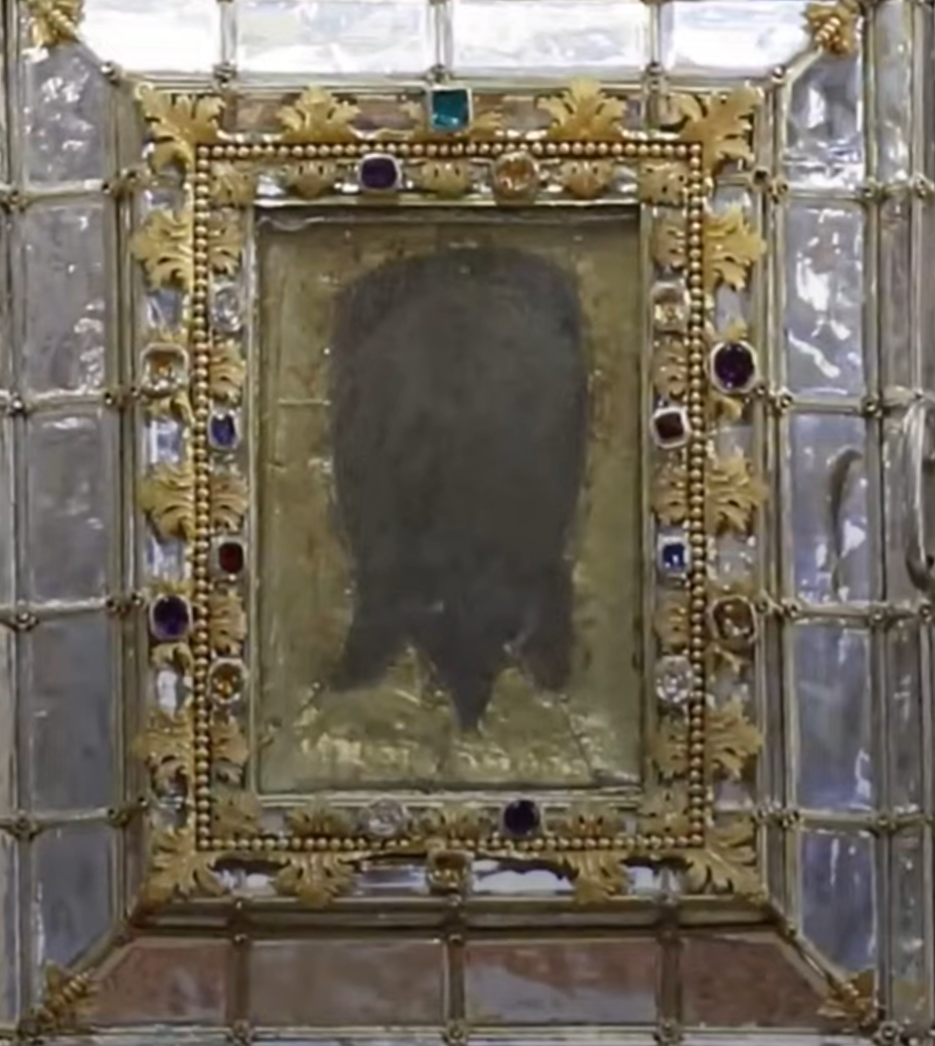
This miraculous picture is still to be seen over the main altar in the church of the monastery. The Carmelites also possess another very interesting historical picture worthy of veneration; a beautiful image of Our Lord, the original of which, it is said is preserved at Gênes, and is regarded by pious tradition as the true portrait of our Lord Jesus Christ which he, himself, sent to king Abgare.(2) A small number of copies of the picture have been taken, and are to be seen in Spain. M. Gauthier, a gentleman from Angers, brought one on his return from Spain with Cardinal de Bérulle, where they had gone to solicit the Carmelites to establish a house of their Order in France. This picture, he kept in his possession for years, but finally gave it to a friend; at present, it is in the possession of the Carmelites of Tours. It is painted on wood; the countenance of Our Lord is life-size and exquisitely beautiful; the view of it inspires the beholder with admiration and love, so delicate are the delineations, and so vivid is the harmony of the coloring. Need we be surprised that from among all other religious houses, Our Lord should have chosen this particular monastery to rejoice in the possession of such an incomparable treasure! For it was here that he first manifested the mystery of his dolorous Face, and chose this spot as the cradle of the devotion of Reparation.
The Carmelites of Tours preserve many other objects of inestimable value to them. Among others, a celebrated relic of St. Teresa, a large particle of the bone of her right wrist, with the authentic documents signed by the Archbishop of Grenada, by the Discalced Carmelite Monks, and by other dignitaries of the province of St. Ange, in Upper Andalusia. This precious relic was brought from the frontiers of Spain by a royal courier, and sent to the Carmelites. Another treasure, with which they are enriched, is the mantle left them, as we have already mentioned, by the venerable Ann of St. Bartholomew. And still another equally treasured, the pall used at the profession of Mother Magdalen of St. Joseph, the daughter of the noble founder, of whom we have already spoken. It is under this same pall that, at present, the sisters prostrate themselves on the day of their profession. Lastly, they have the happiness of possessing a piece of the veil of the most Blessed Virgin, sent them in 1835 by the Carmelites of Chartres.
At the time of the admission of Sr. M. St. Peter, only seventeen years had elapsed since the return of the Carmelites to their monastery. They faithfully guarded these precious souvenirs of the great example of virtue which their ancient Mothers had left them. Some of these venerable religious are still living and sustain the primitive spirit of the monastery. The rules are observed in their full vigor.
Mother Mary of the Incarnation, a soul well-tried in every virtue and of whom we shall speak later, gave to the entire community an impulse as energetic as it was salutary. It was under the direction of this worthy Superioress, that our little Perrine was immediately placed. For such a school, the young postulant was already well prepared, by her worthy and able director, to mount by rapid strides to the highest summit of religious perfection. Let us hasten to return to her artless narrative, in which she herself will relate her first experiences in cloistered life.
1. The ancient House of Refuge situated in the parish of Notre Dame la Riche, which was afterward given up to its original destination.
2. St. John Damascene relates this fact in the following manner. (De Orth, fide, lib. IV, cap. XVII. Orat, de virginibus.) Abgare, king of Odessa in Syria, sent a painter to our Lord Jesus Christ to take his portrait. The painter could not succeed in consequence of the great brilliancy, or effulgence of glory which emanated from the august countenance of the Lord. But the Saviour placed on his divine face a piece of linen which immediately took the impression of his sacred countenance; our Lord then sent this linen to Abgare to satisfy his pious curiosity.
Fleury, in his Ecclesiastical History, Vol. XII, p. 49, narrates the same circumstance more at length. He quotes all the authors who have mentioned the fact; he, himself, seems not to have the slightest doubt of its authenticity.