Chapter 23
Her Burial – Her Work
“She will protect your house, the diocese and France.”
(Words of Mgr. Morlot.)
“Sr. Mary St. Peter died on Saturday, day consecrated to Mary, the 8th of July, near mid-day: our dear sister had often begged of the Blessed Virgin to present her soul to God, and we see that her request was granted. From the moment the servant of God breathed forth her last sigh, the conviction of her beatitude filled all hearts; each felt more like praying to her than for her; each recalled her virtues, and loudly proclaimed that she was a saint.”
“We must remember they were still ignorant of the rare favors and celestial communications which the Lord had bestowed on her. In the community she became the object of general veneration; the ambition of each was to have a particle of some thing belonging to her; they touched her with objects of piety: nor could they be separated from her precious remains. Her countenance bore a peaceful and happy expression; her limbs, which during her illness were stiff from the excess of emaciation and suffering, became flexible immediately after death.”
“There was one sister who did not share in the general opinion of the sanctity of Sister Mary St. Peter. She had never beheld her commit any fault, it is true, but her life so simple and ordinary, did not seem to her to merit so much praise. Annoyed at the difference of opinion existing between herself and the other religious, about a month before the death of the sister, she had earnestly addressed to God the following prayer: “My God, if Sr. Mary St. Peter be as holy as they say, make it known to me, I beseech thee by giving me some relief (this sister was ill) so that I can join in the community exercises.”
“She was heard, and was able to follow the rule minutely, to the great surprise of all; yet she was not convinced by this first proof. But at the death of the sister, she had a dream which gave her subject for reflection. It seemed to her as if she were with the other nuns, round the bed of the dying sister, who expired before her eyes. She saw her immediately resuscitated under the figure of a most beautiful child, who descending from the bed went to embrace each of the sisters except herself, and disappeared out of sight forever.”
“The day following at communion, she felt entirely changed. The life of her pious companion appeared in all its holiness, and she was filled with regret for not having recognized the sanctity of her companion.”
“During the time our dear sister was laid out in the choir, a great number of seculars came to pay their last respects to the dear departed. Many exclaimed: ‘How like an angel! Oh! may she pray for us! A considerable number of people attended her funeral.”
“It was remarked during the solemn requiem service which lasted nearly an hour and a half, that the large candles placed at the corners of the coffin, burned without being consumed. They remained burning brightly, although there was such a strong draft in the chapel that the candles held by the sisters were quite wasted away. This was proved by a fifth candle which had not been used because it was shorter than the other four: the same difference was found to exist between them when measured after the ceremony.”
“Heaven also gave signs in favor of the humble Carmelite; several had recourse to her intercession and have assured us that they experienced in an extraordinary manner the effects of her power with God. When the news of her death was spread abroad, the people came from all parts to ask for little souvenirs of the dear departed. (1)
“It was noticed that little particles of her clothing, exhaled a delicious fragrance which did not resemble any known perfume, it was a celestial odor penetrating even to the soul, exciting the love of God and virtue.”
“Both seculars and religious have attested the fact: one in particular assured us, that on opening a box which for some time had contained little pieces of her habit, a delicious perfume was noticed, like the fragrance of a beautiful bouquet of flowers. A lady of Ingouville, in the diocese of Rouen, was taken ill with a violent fever, for which the doctors could prescribe no remedy; a piece of Sister St. Peter’s veil was forwarded her. Scarcely had it been applied than she felt an interior process being performed within her which lasted four hours. The dreaded crisis, the first symptoms of which had already been announced, was averted; she passed a quiet night, and the next day was proclaimed out of danger.”
To this pious narrative, literally transcribed from the Carmelite annals, we shall add what we have gleaned from authentic documents. Mgr. Morlot, who as we have said, came to give his blessing to the dying sister, having received information of her departure from this life, wrote in the following terms to the mother prioress: “It is with the most lively sympathy I read of the death of this good sister, but we must rejoice with her rather than weep over her. Let us hope that she will continue in heaven what she has so well begun on earth. She will protect your house, the diocese and France!.. Of this I am convinced; to-morrow, I shall offer for her and for your community the august sacrifice of the mass.”
When the circular, composed according to the custom, after the death of Sister St. Peter, was forwarded to the prelate, he wrote: “I have read the notice of the death of Sr. M. St. Peter with the deepest interest, and I doubt not of the good impression it will produce in all the houses of your Order. I am confident, that this chosen soul, now in the possession of eternal glory, will efficaciously plead our cause before the Lord, after having prayed on this earth with so much faith, and practiced here below the beautiful virtues which distinguish the true spouses of Christ.”
Such were the personal sentiments of the archbishop of Tours and they were shared by all those who had any relationship with the pious Carmelite; but there was no one more impressed than M. Dupont. To him the day of such a saintly death was a day of joy, the beginning of glory for the humble virgin, and for her work of predilection. He had assisted with a radiant countenance at her funeral obsequies, and as if in triumphant procession followed her mortal remains to the cemetery of Saint Jean des Corps, (2) a place already hallowed in his eyes, as six months previous he had deposited the last remains of his only and dearly beloved daughter, Henrietta. When he received the obituary notice from Carmel, he read it with transports of admiration. Sit Nomen Domini benedictum! He wrote the mother prioress: “I believe we are nearing the realization of the wishes of the venerable sister, apostle of the Work of Reparation. It is impossible that the circular will not produce a great effect in the hearts of Christians who will use all their efforts to demand grace and mercy. May God be blessed, and may his Holy Name be forever glorified!” M. Dupont desired that a number of copies be sent to his friends.
From this time, one of his pious practices, was to go frequently to pray over the tomb of this venerable sister, and keep it in perfect order. He directed his steps alternately to the tomb of his daughter and to that of the Carmelite, recommending to her all his affairs. Those who came from afar to confide to him their difficulties, he frequently sent to the cemetery of St. John to pray. On his way, thence one day, he said to a priest who accompanied him: “This is one of my secrets: that I address myself to this saintly soul when I desire to receive any particular grace from God.” Under the impression thus given, the grave of the Carmelite received many visits.
In order to perpetuate this kind of pilgrimage, and to testify his veneration for the memory of the deceased, he determined to buy a more suitable burial-place. He took the necessary steps and bought in his name and at his own expense, thirty lots, the deed of which he presented to the community on the 27th of September, 1854.
“But,” said he, “God will yet do more to glorify his faithful servant. For a reason only known to Him, the remains must be removed to Carmel.” It was not long before this pious desire was fulfilled. Three years later, immediately after the great inundation of the Loire in 1856, the cemetery was transferred without the city limits and M. Dupont took advantage of the circumstance to have the remains of Sister St. Peter exhumed and restored to her monastery. On the 13th of November, 1857, the anniversary of the day the sister had entered religion, he accompanied the inspector before sunrise to open the tomb. A walnut coffin lined with zinc had been prepared. M. Dupont, with the utmost care and religious respect collected, and placed in it the hallowed remains, even the smallest particles of dust; and to the great joy of the mother prioress and all the religious, he obtained permission from competent authority to have the precious remains deposited in the interior of the monastery. They still repose in the chapter room, which is at the right of the chapel on entering. A slab near the holy water font bears this simple inscription:
Here reposes
Sister Mary St. Peter of the Holy Family,
Professed of this Monastery,
who died on the 8th July, 1848,
AGED 31 YEARS AND 9 MONTHS.
“Conceal her, O Lord in the secret of thy Face.”
M. Dupont, who often came to hear mass in the Carmelite chapel, never entered without pausing a few moments at the spot, above which the tomb of the revered sister had been deposited, and in his simple faith, holding converse for an instant with the dear departed.
A more intimate and fruitful union was still to draw these two souls more closely together. In the designs of God, M. Dupont’s mission was to develop the work, revealed to Sister St. Peter as the means of salvation for France; the Work of Reparation for blasphemy and for the profanation of the Sunday, by the worship of the Holy Face. More than any other, the pious layman had received more knowledge of the wonderful favors granted to the virgin of Carmel.
He was already admirably prepared by the piety of his life, to devote himself to “Reparation.” What struck him most forcibly in the revelations of the sister, was the means, indicated by Our Lord to his servant, of repairing the outrages committed against his adorable person; namely, the devotion to his Holy Face. Completely enraptured with this idea, he labored to propagate this devotion without any premeditated object, solely for the glory of God and the salvation of souls, wishing to be, as he said, “the voice” of the revelations of Sister Mary St. Peter. A circumstance, very simple in itself, soon gave a decisive character to his pious enthusiasm.
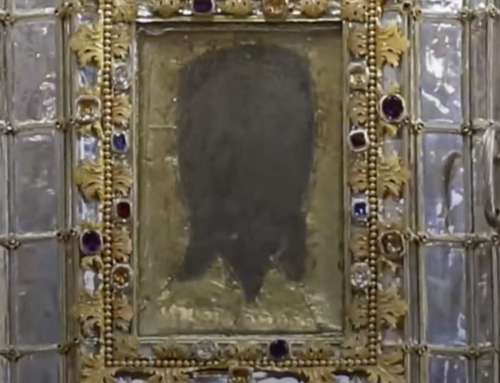
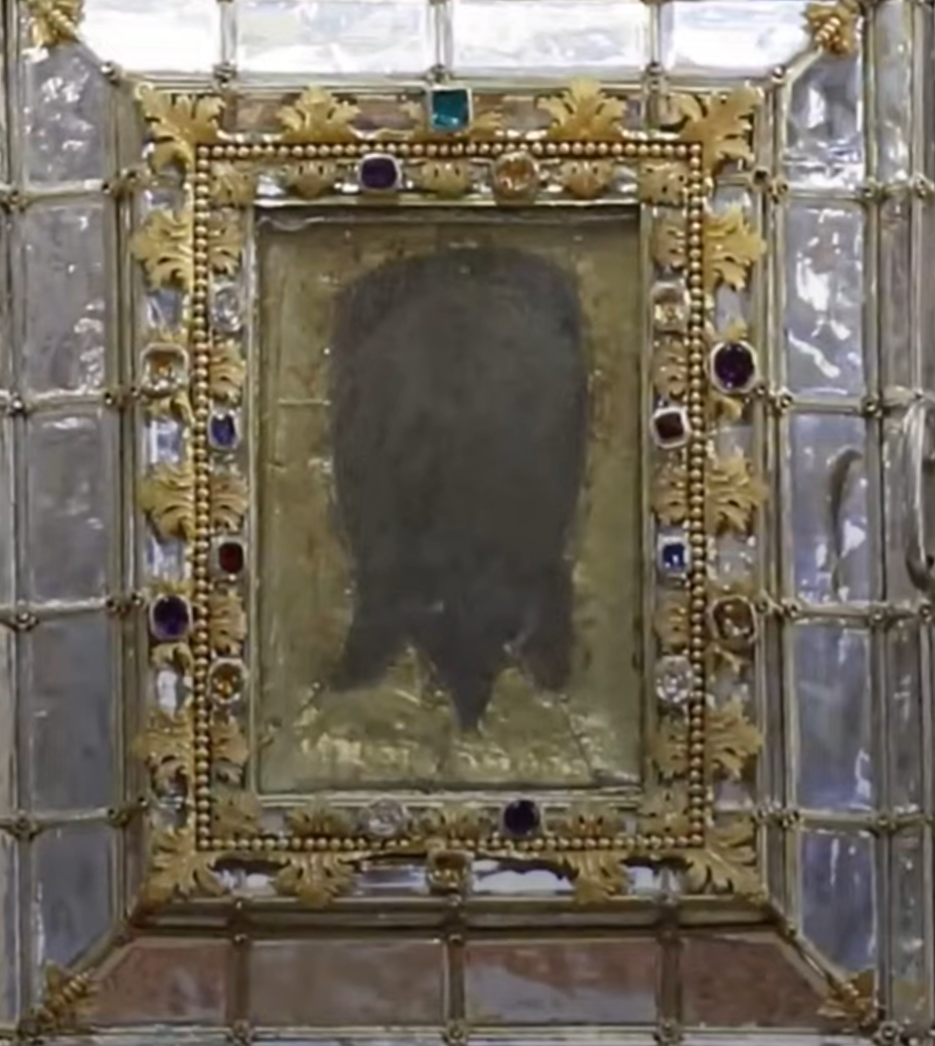
Lent was drawing to a close. The mother prioress, who was perfectly aware of M. Dupont’s opinion with regard to the devotion of the Holy Face, offered him a present of two pictures of the Holy Face, copies of Veronica’s veil which is preserved in the Vatican. These the prioress had received from the Benedictines of Arras, with whom she had corresponded for several years on the subject of the Work of Reparation. These holy pictures came from Rome and were soon copied and spread among the faithful by the zeal of the religious of Arras, who, from the time of their establishment in 1816, had a lively devotion to the Holy Face, inspired them by the writings of St. Gertrude; these religious took a marked interest in the revelations of the Carmelite of Tours. They possessed a certain number of pictures with the authentication. At the request of Mother Mary of the Incarnation they sent her several copies, two of which she gave to M. Dupont, who framed one and hung it in his parlor. It was before this venerable image that he passed the last twenty-five years of his life, thus becoming the apostle of Reparation. The most extraordinary cures, conversions miraculously brought about, peace and harmony restored to families, in fact, so numerous were the wonders performed through the prayers of this saintly man before the “Holy Face” that his house soon became the favorite resort of pilgrims from far and near.
M. Dupont looked upon these miraculous graces as so many manifestations of the will of God; this explains why he attached so much importance to the certificates brought him, which he preserved with the greatest care, as a faithful guardian, in order to place them in the hands of the ecclesiastical authority, when inquiries would be made relative to the mission of Sister Mary St. Peter.
“Verily,” says M. Dupont, “if the communications of Sister St. Peter were acknowledged as revelations, what a blow would be given to the infernal spirits!”
“The prodigies, operated by the oil of the lamp burning before the Holy Face, will naturally draw the attention of the authorities of the Church to this subject, and she will be called upon to give a decision relative to the writings of the pious Carmelite. We find among her revelations, the most consoling promises made to those devoted to the Holy Face. She proclaims in every letter that the Holy Face ought to be the external object of Reparation. What is the conclusion? Every day we are here witnesses of the remarkable cures which have taken place under our very eyes, cures so extraordinary that if we sought to establish the facts they could be called miraculous. Every day at least two or three are operated here before the Holy Face, after the application of the oil; without mentioning the wonders wrought by the application of the oil demanded by the sick, too ill to be brought hither. These facts authorize us to believe that there is here a clear manifestation of the will of Our Lord, to procure our salvation by the work which he himself, demanded from Sister Mary St. Peter.”
His joy was extreme when, on his deathbed, he learned that the archbishop of Tours, Mgr. Colet, had at last broken the seals, and that the examination of her precious writings, so long condemned to secrecy, was confided to the learned Benedictines of Salamanca, the worthy sons of his illustrious friend Dom Guéranger. On hearing this news, his countenance became illuminated, he raised his eyes to heaven and exclaimed: Nunc dimittis servum tuum, Domine.
A weight seemed to have been raised from his heart; shortly before he expired, on the 18th of March, 1876, turning his eyes toward the cloister of the Carmelites, where thanks to his zeal and devotedness reposed the body of Sister Mary St. Peter, he exclaimed: “How brilliant is Carmel! It glitters with rubies and emeralds.”
He made no mention of the “Holy Face” in his will, saying to those around his bedside: “God will provide for it.” His confidence was not unfounded. God had placed on the archiepiscopal throne of St. Martin, a most worthy prelate, who, at the first glance had recognized the providential mission of our Carmelite, interpreted and followed up by M. Dupont. An archiepiscopal decree transformed the private oratory of the holy man of Tours into a public chapel. The venerable prelate himself presided at the ceremony of consecration, on the 27th of June, feast of the Prince of the Apostles, and patron of “this fervent religious who,” said he, “had inspired the Work of Reparation and the touching devotion, which for so many years, has been practiced in this holy spot.” At the same time he established the confraternity in Reparation for Blasphemy and the Profanation of the Sunday, affiliated to that of St. Dizier; but taking advantage of the clause giving full liberty to the director to modify the minor rules, he gave it a distinctive character, making it in reality a confraternity of the Holy Face properly speaking, which was, as we have seen, the primitive object of Sister St. Peter. Finally, this most worthy successor of St. Martin founded a society of regulars, under the title of “Priests of the Holy Face” to attend to the new chapel and look after all the necessities of the pilgrimage which had commenced even during the lifetime of M. Dupont.
They live in community in the house of M. Dupont, binding themselves to follow in his steps under his protection, and to devote themselves to all the reparatory works of the epoch. Thus the work of the pious Carmelite and that of the “Holy man of Tours,” has been canonically recognized and consolidated.
The diocese of St. Martin thus recovered the glory of which it had been accidentally deprived, it re-entered into the right which belonged originally to it, that of being considered the hearth on which the sacred fire of Reparation was first enkindled. From that time, the work, under the auspices and in the very dwelling of M. Dupont, has received a marvelous development, and is to-day spreading in other lands. The oratory of the Holy Face has become in a few years the center of prayers and “expiation,” toward which turn all hearts from the different points of France, and we may say, from the entire Church.
The pious invocations composed by sister Mary St. Peter, and improperly called Litanies of the Holy Face, have been authorized by a number of bishops; Pius IX himself, without giving them a liturgical approbation, has blessed and enriched them with an indulgence; they are at present translated into English, Spanish, Italian, and German, to satisfy the many demands of the faithful. Confraternities of the Holy Face, similar to the one founded at Tours by Mgr. Colet, are established in many cities, notably at Versailles, Reims, Laval, Perpignan; and St. Brieuc. We even behold it passing over to other lands, to Belgium, Holland and even to America.
From all sides the people demand the “Holy Face” this faithful copy of the veil of Veronica, identical to that venerated by M. Dupont. It would be impossible to calculate the number of these sacred effigies, exposed for pious veneration in thousands of places, and nearly always having a lamp burning before them. They are to be found in private houses, in oratories, in asylums and in communities, in public chapels, in parishes and in cathedrals. Even in the time of M. Dupont there were pictures of the Holy Face venerated in the hospital of Vincennes, at the Visitation of Paray-le-Monial, and at the Benedictines of Arras.
In our day, Notre-Dame de Paris, the cathedral of Perpignan, the Basilica of Lourdes and the provisory chapel of the Sacred Heart at Montmartre also contain a copy of this picture.
The Priests of the “Holy Face,” undertake to have them expedited from Rome, in order to facilitate their propagation, or rather the propagation goes on of itself, so natural, so necessary does this idea of Reparation seem to the faithful.
This Reparation is urgent, every Catholic heart feels its necessity; pious souls greet it with transports of joy. Now if it be true that France, God’s privileged nation, the Eldest Daughter of the Church, if it be true that among all peoples she is the most guilty, she is therefore the most deserving of punishment, for “Much shall be required of him to whom much has been given.” If it be true that here more than elsewhere, the profanation of the Sunday is the acknowledged evil, that blasphemy is unblushingly tolerated, and that both the one and the other engender more crime, produce more ruin and ravage society more than any other evil, is it not then just that we should look up to generous Christians (whose number is infinite in our dear France) for the accomplishment and for the propagation of a work so repeatedly besought by Sister Mary St. Peter in the Name of the Lord? And since the cradle of the Work has been providentially placed in the very heart of the country, in this city of Tours, which has the happy privilege of possessing the tomb of the great protector of the nation, together with the house in which the pious devotee of the Holy Face died in the odor of sanctity, what more natural, what more just than to make it the center of our affections, of our prayers, of our hopes? What more patriotic, what more Catholic than to unite together to re-establish and to repair, even as we behold impiety, aye infidelity itself, rally its votaries to ravage, to destroy.
The work revealed to this noble religious, is, as she has remarked, “a crying necessity and a pledge of mercy.” Let us then have but one heart and one soul in uniting to appease divine justice, and we shall experience the effects of His mercy, which shall be the more gracious and abundant as our reparation shall have been more prompt and fervent.
FINIS.
1. We were careful, when acceding to this pious desire, to remark that these things ought to be looked upon simply as souvenirs, and not as objects worthy of the veneration due to the relics of the saints recognized as such by the Church. (Note to the Carmelite Circular.)
2. The old Cemetery, thus named from the bloody defeat sustained by the Normans in the ninth century, at the aspect of the relics of St. Martin.