Chapter 10
The Archbishop of Tours
“Our Lord revealed to me that he charged me with the care of France; that he would send me as his ambassadress to make a treaty of peace.”
(Words of the Sister.)
Nothing of what we now know concerning Sister Mary of St. Peter, had yet passed beyond the walls of the cloister; as we have heretofore remarked, only the ecclesiastical superior, the sister’s confessor and a few very intimate friends, had been informed by the mother prioress of all that had occurred; not even the archbishop had as yet received any information. The grave nature of the last revelation to the cloistered virgin, and her pressing solicitation to have the matter brought before the archbishop made it obligatory on the Rev. Mother to inform his Grace of all that had transpired.
The archbishop of Tours, Mgr. Morlot, had been transferred from Orleans to the archbishopric of St. Martin some two years previously. This prelate was a man of extreme delicacy of conscience and of exemplary regularity. The highest dignities were successively conferred on him, such for instance as the honor of the Roman purple with which he was clothed in 1854; and also with the title of Archbishop of Paris, to which dignity he was elevated in 1856; these honors served to increase rather than diminish his detachment from the transient honors and pleasures of this earth, and of which we have more than one admirable proof. His life, prematurely shortened by the incessant labors of his episcopal charge, was finally crowned by a most edifying death. At Tours, as at Paris, he has left numerous traces of his episcopal life of forty years.
His affable and courteous manner and his cordial benevolence have rendered his name illustrious. He had a particular veneration for the Carmelites; it was with pleasure that in 1846 he assisted at the installation of these religious in their new monastery, and consecrated their chapel with the greatest solemnity. At the time of the disastrous inundation, which happened shortly afterward, he hastened to offer them the hospitality of his own palace, thus enabling them to continue in peace their religious exercises
Prudence in a very remarkable degree was his characteristic virtue. Unhappily this natural propensity, fostered by his advancing years, his experimental knowledge of mankind, and by the critical circumstances through which he had passed, amounted at times to an almost excessive reserve occasioned by timidity, which others, less circumspect, did not hesitate to attribute to apathy, or weakness of character. His caution and timidity were not unfrequently an obstacle to the progress of the affairs under his jurisdiction, yet he was right-minded and good-intentioned; but when a point of any difficulty arose he allowed himself to be swayed by the opinion of his counsellors, who were often the cause of turning him from a decision prompted by his natural good sense. His administration had more than once suffered from this course of action of which we may judge from his conduct in regard to Sr. Mary St. Peter, and consequently toward Mr. Dupont, for whom, nevertheless, the pious prelate professed the highest esteem, of which we have given elsewhere some notable instances.
The holy man of Tours was the first to bewail in secret the excessive prudence of the archbishop; and although he, himself, suffered many a stern refusal, yet, he never for an instant was wanting in the deference and perfect submission due his authority or to his person. Prayer was his weapon against the rigorous decisions of his Grace. One day, a question arose touching the revelations of Sister St. Peter, when the pious layman received another refusal, very mortifying to his ardent zeal. On leaving the archbishopric, he met an ecclesiastic, one of his friends, to whom he confided his disappointment. Both were walking on the solitary part of the Rue des Ursulines alongside of the high fence which surrounded the episcopal domains. Drawing near the Carmelite convent, M. Dupont suddenly stood still, and taking a medal of St. Benedict from his pocket said: ‘Come, we must have recourse to extraordinary means,’ and after having devoutly made the sign of the cross on the medal, he threw it over the walls into the garden, saying: Ascende superius, (Let us seek aid from on high.) The answer was not long in coming. That, same evening M. Dupont full of joy, went to his friend, the priest, and informed him that Mgr. Morlot himself had sent for him, and with the utmost urbanity had granted the object of his request.
Indeed, the worthy archbishop esteemed his virtuous parishioner. How many times had he not sent him pressing invitations to dine at his palace, but the humble “pilgrim of Rue St. Etienne,” as he styled himself, always declined as politely as possible. One day, however, in deference to his aged mother, who urged the impropriety of so many refusals, he accepted the invitation; arrived with the other guests in the dining-room he observed that there was one place wanting at table in order to accommodate the number about to dine; one of the servants, in mistake, had just then removed the chair, which did not fail being observed by the attentive eye of our guest, who stooped down and whispered in the archbishop’s ear: “You see Monseigneur, that I ought not dine with the great; there is no chair for me.” Mgr. Morlot was quite disconcerted at the mishap, and while giving orders to his domestic to prepare a place, M. Dupont had already reached the bottom of the stairs, and was out of sight before a messenger could overtake him.
A short time after the death of Sister St. Peter, when there was question of the nocturnal adoration, and still later, when the society of St. Martin for the clothing of the poor was established, the venerable archbishop manifested his eagerness to second M. Dupont in all his views. We have before us a sketch of the rules and regulations arranged by the very hand of the prelate, together with expressions of approbation for the zealous and charitable founder of these two holy works.
These details do not appear superfluous in order that our readers may understand the character of the prelate with whom Sr. Mary St. Peter will soon find herself in direct communication. It had already been decided upon by Father Aileron, ecclesiastical superior of the Carmelites, and Mother Mary of the Incarnation, that a minute account of all that had transpired from August 25th, should be presented to the archbishop. Mgr. Morlot, with his characteristic reserve, was not willing to give his opinion in a matter so grave and of such vital importance without mature deliberation. He ordained that the various writings and statements which had been drawn up by the sister be brought him, and of these he, himself, took cognizance. He could not fail being impressed with the evidence of sincerity which pervaded every page, and approved of the conduct of her superiors toward her, encouraging them to continue as heretofore. With regard to the communications themselves, he was so much impressed, that he did not hesitate to let it appear in his pastoral for the ensuing Lent of 1844, from which we extract the following, relative to the profanation of the Lord’s Day:
“Have the work-shops been closed? Has manual labor been suspended on the Lord’s Day? Show me the street or the throughfare of the city in which the noise of commerce has for one instant been interrupted! Everywhere the same clamor resounds, the same agitation, the same commotion sways the multitude as on week days. The children of men pursue their avocations with the same ardor as on the days assigned to labor. Here we behold them erecting stupendous edifices which the hand of God refuses to bless; there, exposing the produce of their industry, pursuing their speculations, their negotiations, their insatiable craving for wealth, for power, for honor.”
“Look at our villages, pass on to our hamlets, what do we behold? The forgetfulness of God which necessarily follows in the train of profanation, and the countless other disorders, none the less deplorable. Yet the most diabolical of all these outrages committed against the majesty of God, is the shameful desecration of the Sundays and holydays: one part of the day is consecrated to business; the other, to pleasure; forbidden labor being always followed by disorderly pleasure. Servile occupation is succeeded by intemperance and immorality.”
Still enumerating the consequences of this profanation, the prelate continues: “On the one hand, we behold open revolts and scandalous outrages committed against the divinity of God; on the other, lukewarmness, nay more, total indifference in the fulfilment of duty. These provoke the wrath of the Most High, whose justice, though patient and long-suffering, is, nevertheless, inevitable; whose vengeance, though tardy, is certain; for God has no need to punish day by day; His power is eternal and not to be confounded with the justice of man, intimidated by the number of the guilty, and which, beholding the multitude to be punished, lets the sword fall powerless from its hand. It is not thus when God wishes to punish, it is not the number of the guilty which arrests his hand, he then counts but the just, and when these have disappeared from the face of the earth, his arm falls mercilessly.”
The venerable archbishop was not satisfied with this appeal, addressed officially to his flock. On the 15th of March, he authorized in his diocese the association already founded at Notre-Dame de la Riche for the Reparation of Blasphemy. The pastor, Father Aileron, in establishing this society in his parish, had availed himself of the power conceded by the Pontifical brief of August 8th, 1843 (of which mention has already been made).
Permission had been granted to the sister, at her own request, to write to the archbishop.
“I had,” said she, “the honor of writing to his Lordship; my worthy superiors had already informed him of all that the Divine Master had made known to me regarding the Work of Reparation. Then the pious prelate had the little circulars printed which had been previously published at Nantes. He added his own approbation on the 15th of March, 1844, recommending the Association to the attention of the clergy of his diocese, and expressing the desire that they would encourage the faithful to repair the outrages committed against the sovereign majesty of God. A great number of these circulars were distributed, but there was no association established according to the demand of Our Lord; it seemed that the hour had not yet come. Let us adore in silence the hidden designs of the Most High.”
These last words indicate the disposition in which the sister had received the decision of the archbishop; although grieved that the Association of Reparation was not officially established in the diocese, yet she was consoled by the encouragement of the prelate, and by the approbation which he had given to her communications. She hoped that the time was not far distant, when he would place himself at the head of a movement, which she believed so necessary for the salvation of France. Nevertheless, when she perceived that he took such a neutral stand, she deplored it deeply, and attributed the cause to her own sins; for she suffered “in seeing the Majesty of the Most High outraged with impunity, and her countrymen, hastening to their own destruction.” In her distress, the humble virgin turned to her heavenly Spouse who had confided this noble mission to her, of which she had so faithfully acquitted herself. Then the Savior gave her to understand that during the interval, it was in her own soul he desired to make reparation; of this she thus gives an account to the mother prioress:
“Permit me to relate in all simplicity, what has passed to-day within my soul, after holy communion. Our Lord inspired me to present myself before him in the name of France, to receive him in the kingdom of my heart, and to offer him my communion in a spirit of reparation for the crimes of which our nation is guilty. After having received this divine King, I prayed most earnestly for France; then he communicated himself to my soul, telling me that he charged me with the salvation of France, and constituted me his ambassadress to treat of peace with him; also that I should remain humbly prostrate before him in the most Blessed Sacrament of the altar, praying for France and for the establishment of the Work of the Reparation. Then he counselled me to reflect well on the obligations of the office he imposed upon me; for when an ambassador withdraws from a kingdom, it is received as a sign of war. Our Lord gave me to understand that I must not voluntarily withdraw from his presence in the most Blessed Sacrament, but that I should remain there in spirit in the name of France. Then I answered: ‘My Lord, I have given myself entirely to thee for the fulfilment of thy intentions, do with me what thou wilt.’ And I prostrated myself, adoring the designs of God who makes use of what is most miserable and despised to perform his works: I accepted the charge which he imposed on me, praying him to render me fit to accomplish his designs over me, and to fulfil them himself in me.”
“I have applied myself for several days to adore Jesus in the Blessed Sacrament. On quitting the choir to resume my occupations, I leave my heart at the feet of my good Savior, and in whatsoever part of the house I am engaged, I try to keep in his divine presence. This is the nature of the spiritual exercise which he demands of me at present; he wishes me to remain there at his feet, praying in the name of France.”
The Divine Master lent a favorable ear to the humble prayers of his servant; he revealed to her the heinousness and enormity of the sin of blasphemy. “It seems as if Our Lord said to me: ‘You cannot comprehend the abomination of this sin: if my justice were not restrained by my mercy, the guilty would be destroyed in an instant; even inanimate beings would feel my vengeance, but I have an eternity in which to punish the wicked.”
“Then he made me understand the excellence of this Work of Reparation; how far it surpassed all others, and how pleasing it was to God, to the angels, the saints and to our holy mother the Church. Oh! would that we could understand the glory we could obtain by repeating these words: Mirabile Nomen Dei.” (Admirable is the Name of God) in a spirit of reparation for blasphemy!” A short while after, she wrote the following: “You are aware that Our Lord, some time ago, directed me to pray for France, telling me to guard the sheep, of whom he was the Shepherd; that he chose me on this day to be his little shepherdess, giving me his mysteries and his most holy life for my domain; that I could draw forth grace from his divine wounds for his sheep. In fine, that he gave himself to me as a mine of gold wherewith to pay the debt which France owes to his divine justice, permitting me to draw on the treasury of his Sacred Heart. Then Our Lord gave me to understand, that I must be careful not to act as did the unfaithful servant of the Gospel, who made no use of his talent; that he would demand of me a rigorous account, and that I would find no difficulty in drawing from the mine of gold, which he himself had acquired by his labors and sufferings. I believe that he desired to find some one who would become a mediator between himself and France, in order that he might extend to it his mercy.”
During this interval, the sister had had much to endure, for God did not spare her; interior sufferings were to prepare her to accomplish his work: her mind was at times overspread with darkness, and in the face of her arduous mission she was confronted with the experience of her own weakness and incapacity.
“This work,” said she, (June 6, 1844) “is in me as a burning fire which causes me to suffer more or less, according to the good pleasure of God. During prayer I never cease begging of the Lord to spare France, to establish in all her cities the Work of Reparation, and to raise up apostolic laborers to preach this work. ‘Thou dost behold, my sweet Jesus, how poor and miserable I am; I implore thee to give all that I am now suffering to some soul more courageous than I who will render thee more adequate service.’”
Once, however, Our Lord caused her to feel his presence for nearly two hours. “During this delicious repose, I thought I heard his sweet voice say to me: ‘Courage and confidence, my child! Courage and confidence! Engrave these words on your heart. Oh! if you only knew the advantage you derive in supporting these sufferings, you would thank me for sending them to you! I have come to visit you but not to remain with you in a sensible manner. You will partake of my chalice, but be consoled; although you behold me not, still I shall not be far from you, for I will hold the chalice while you drink therefrom. After this trial, I shall send you consolations; you have justly merited these sufferings by your infidelity; however, it is not in anger, but in mercy that I send you such trials.’ I then took the liberty to ask him if the crown which I made in honor of his Name and of his holy mysteries was agreeable to him. He replied: ‘All that is done to glorify me is most agreeable.’ He counselled me to practice this exercise when I would be incapable of mental prayer.”
A new aspect of things comes over the life of Sr. Mary St. Peter. The Carmelites had just quitted the venerable and cherished monastery which had been the cradle of their foundation. The following is the account we read in their annals in regard to this subject.
“Toward the end of the year 1843, our old monastery was sold, the purchasers having paid a reasonable price, with the express clause, that for the space of twenty years the chapel, (of which only the walls were left), should not be used for any other than its primitive purpose. After the conclusion of the negotiations, the moment came to put our hand to the work, and commence anew. The plan of a monastery was made, which was as much as possible in conformity with the rules and customs of our order. Particular attention was paid to the arrangement of all the regular places of the house, in order to facilitate the practice of our holy observances. Our Rev. Mother Mary of the Incarnation, then superior, as well as our worthy ecclesiastical superior, toiled at this work with unremitting zeal and devotedness. God plainly showed that he had chosen them for this work, by the abundant benedictions he bestowed on their labors.”
As we have said, a convenient site on the Rue des Ursulines, back of the archbishopric, had been bought. Mgr. Morlot solemnly blessed the corner-stone in the month of September, 1844. While awaiting the completion of the edifice, the Carmelites were obliged to remove to a small dwelling-house which had neither gratings nor cloisters.(1)
Although beautiful in appearance and finely situated, it was small and inconvenient for religious, the absence of gratings being one of the greatest annoyances. In such cases, every Carmelite carried the grating with her, if we may be allowed the expression: a thick black veil enveloped her from head to foot, scarcely permitting her to breathe or to move. Such was the habitual condition of Sr. St. Peter during those two years, when as portress of the interior, she was obliged to communicate directly with persons from without, and to transmit the messages to those within. Let us listen to the naive complaints to which she gives vent.
“The time had come when Our Lord had prepared a great trial for me, for I was obliged to quit the dear convent where I pronounced my vows, and where I had been overwhelmed with graces by his merciful liberality. I found myself in a secular house having no grating, and I still held the office of portress which kept me in continual contact with seculars. Condemned to stay for nearly two years in this parlor, and observing that a great number of persons were always coming, some to solicit prayers for the sick, others for the conversion of those dear to them; some again to be consoled in their pains and sufferings, while others were drawn thither by mere curiosity;— this novel situation threw me into extreme affliction. Fearing to lose the spirit of retirement and recollection, for which I had such an attraction, I said to myself: ‘Alas! can I ever hear the voice of my Lord here!’ I went to our Mother and manifested to her this repugnance, which I experienced for my position. I would have been only too happy had she changed my office, or at least, if she had given me a companion to share my duties with me, yet, notwithstanding her great charity, she judged it better to leave me alone and unaided.”
“To avoid the frequent visits of seculars, I said politely to all who presented themselves, that the mission of a Carmelite was to hold intercourse with God in silence and retreat and but little with man; that they might expose their sorrows to other religious, and seek consolation from those not living, as we, in seclusion; that we would pray for their intentions; all my reasoning was of no avail. I cannot help laughing even now, when I think of one good women who insisted on bringing her daughter to see me, in order, as she said, that I might give her some advice about her approaching marriage; as I declined to comply with her request, she was obliged to go and consult someone else, better posted than I on such matters.”
“My good Master allowed me to suffer from this extreme repugnance for my new position for some time: but one day, he had the goodness to come and console me in the inmost recesses of my soul. He told me that I should not grieve thus at having an office which brought one in such constant communication with my neighbor; that I should receive these people with the same spirit of charity with which he welcomed all those who approached him when passing through the towns and cities of Judea; promising me that this office would not be injurious to my soul, and that he would draw much glory therefrom.”
Six months passed, during which the communications, in reference to the Reparation, remained as if suspended, and the sister was conducted by a path of aridity, darkness and temptation. She seemed ready to fall under this weight when God favored her anew.
“He made me understand that the intelligence of man cannot conceive the heinousness of the affronts offered God by the sin of blasphemy.(2) This crime pierces his Sacred Heart, and covers him with wounds like another Lazarus. He pointed out the compassionate dogs who consoled poor Lazarus by licking his wounds, and invited me to render him a similar service, employing my tongue every day to glorify the Holy Name of God despised and blasphemed by sinners. I never stopped to consider whether this exercise would give me interior consolation or not; it was sufficient to think that I soothed his divine wounds and gave him some relief. It seemed that he also said: ‘Do all in your power to have this Work established; I shall enrich you with my merits that you may obtain it from my Father. Ask in my Name and it shall be granted you.’
Here terminates the first account of the sister, relative to the Reparation in general; she concludes with the following declaration:
“It is in the Sacred Heart of Jesus that I have found this Work; it is also in this Divine Heart, burning with zeal for the glory of his Father, that I remit it through the hands of the most Holy Virgin and of the glorious patriarch St. Joseph, under the protection of the angels and saints, in expiation to the divine mercy who has deigned to make use of so vile an instrument. I declare that it is I, Sr. M. of St. Peter of the Holy Family, unworthy Carmelite, who have received these revelations regarding the Reparation for Blasphemy, and who have written them, in obedience to the orders of my superiors, for the greater glory of God, and also for the tranquility of my conscience. I tremble at the sight of the mission imposed on me by the Lord.— A multitude of souls will be saved if his designs be accomplished. I also declare that I have spoken with all truth and sincerity.”
“At this time a circumstance took place which the sister herself relates. A priest who had heard something of this Work came one day to beg me to pray for two graces: one for himself, the other for one of his confreres. The question at stake was the salvation of a soul, and also the shielding of the reputation of two persons in whom they were greatly interested. This priest said to the saintly religious: ‘I believe in the Work with which the Lord has charged you; but in proof of your mission, beg for these two graces. If you obtain them, I promise that my confrere in the ministry and myself will devote ourselves to propagate this Work.’ I accepted his proposal, telling him that I would undertake the mission confided to me in the name of obedience; for when I ask any special grace, from God in the name of obedience, I obtain it more readily. He consented and took his leave. I went immediately before the Blessed Sacrament to pray my good Savior to defend his cause for the glory of his Name, and to grant the two priests the favors which they desired assuring him that they would become, as they had promised, zealous defenders of his Name; after which I made use of all the little eloquence I possessed to touch his Divine Heart, commencing with a novena. Our Lord gave the proof required to make known the truth of his Work: the priest who had spoken to me, received the grace he so much desired, on the evening of that same day; the second also received his request a little later. He told me that the Lord had heard his prayers beyond his most sanguine expectations, and that the unfortunate affair in question, had eventually turned to the glory of God and to the happiness of those who had, at first, been so much grieved.”
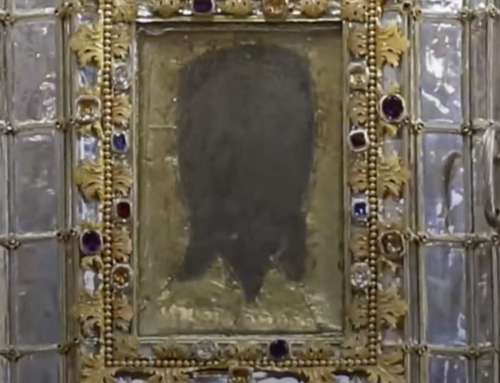
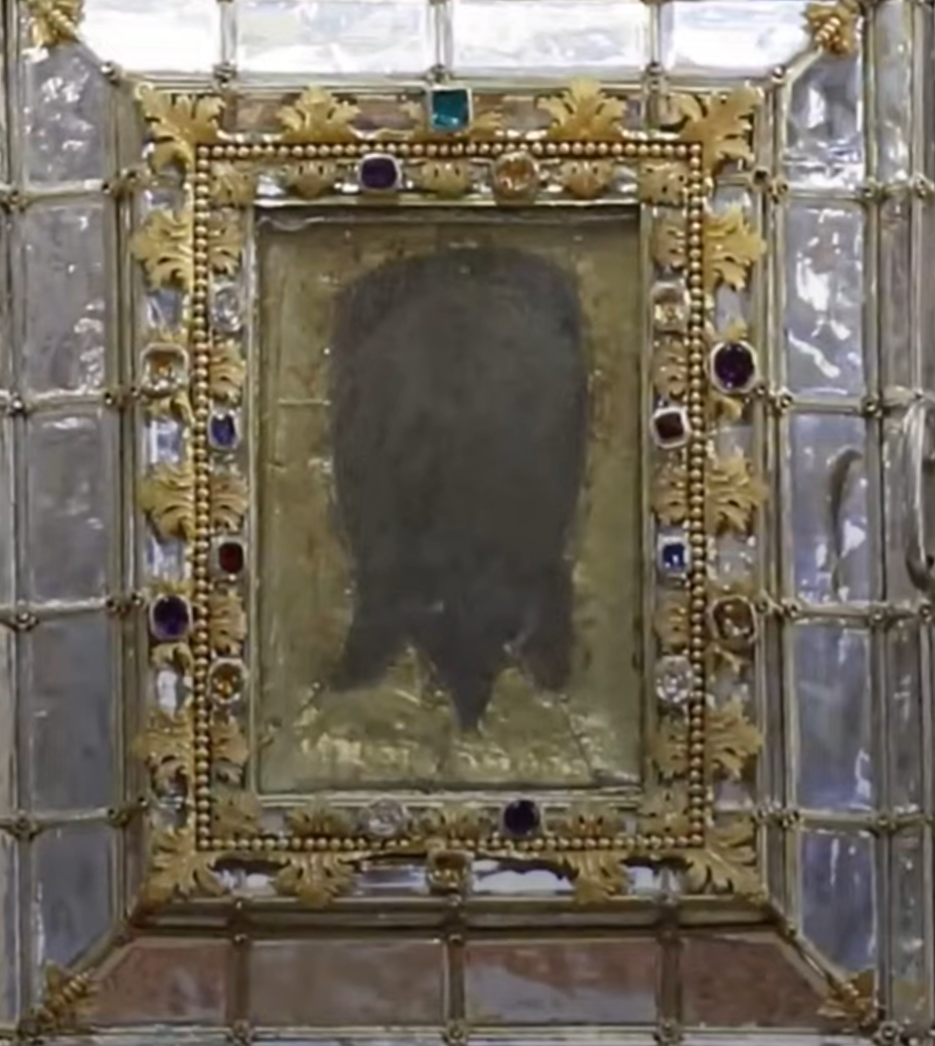
1. This house, situated on La Place Grégoire, back of the cathedral and opposite the Grand Seminary, is at present in the possession of Canon Allégret, who entertains the greatest respect for the memory of Sr. St. Peter, and for the former habitation of the Carmelites; he has fitted up a little oratory with a picture of the Holy Face in the same room which had served as their chapel.
2. On this subject St. Alphonsus de Liguori says:— “Blasphemy, so widespread in our days, is an abomination to the Lord. It is the most deadly of all sins; and is ordinarily unpardonable, for it is a crime of the highest magnitude that can be committed against the Divinity; a crime which attacks God openly and directly; a crime therefore which God rarely pardons.” (Tanney’s life of St. Alphonsus V, IV, ch. XV.) In his last years speaking of France, he says: “Blasphemy is the cause of maledictions on the earth. Unfortunate France! how I pity thee and thy millions of poor, innocent victims who will be involved in thy disgrace!” Ibid., c. xxiv.