THE HOLY FACE OF TOURS
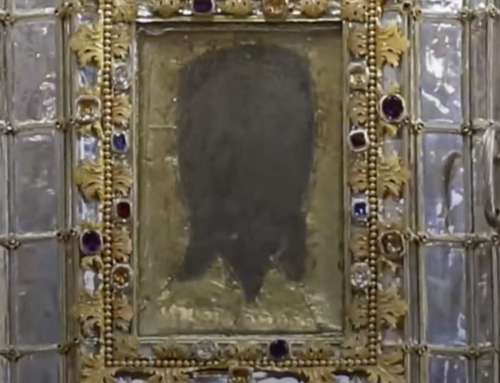
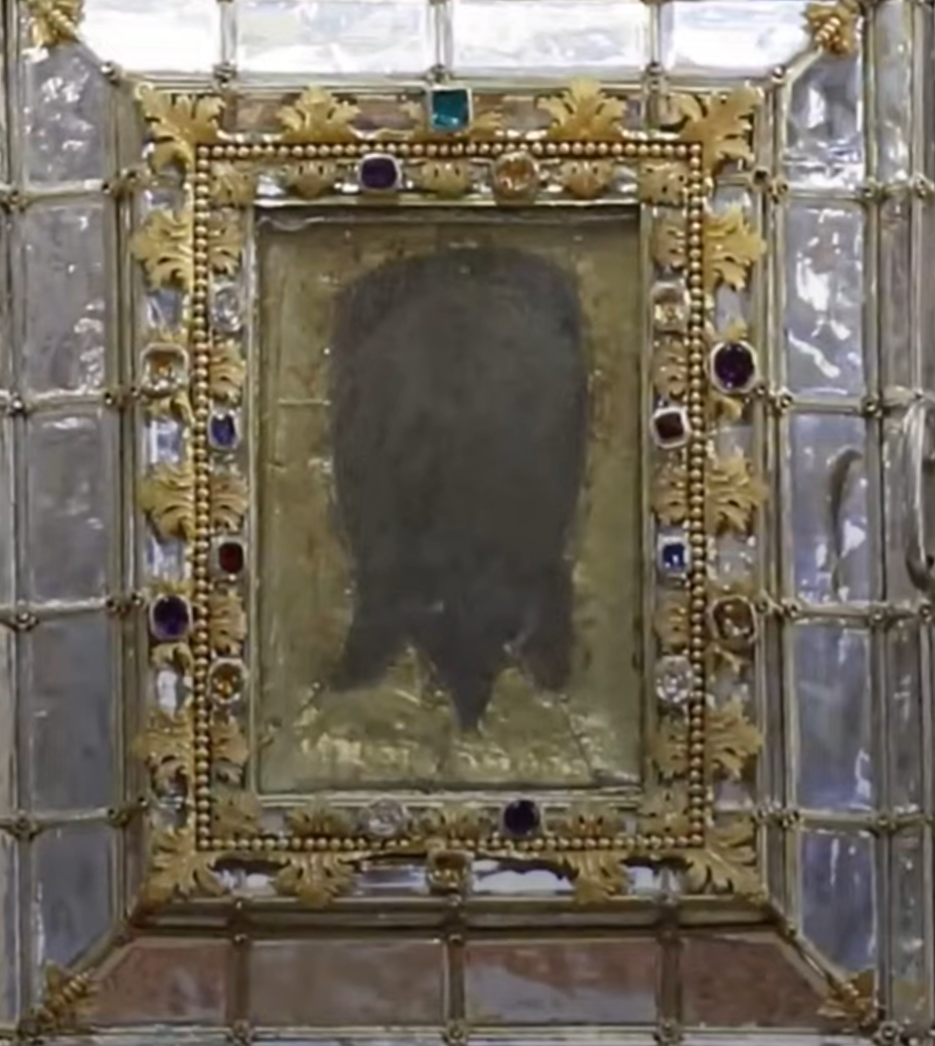
The holy Effigy honored at Tours with a special worship in the chapel known by the name of the “Oratory of the Holy Face,” deserves to be mentioned as being one of the most celebrated copies of the veil of Veronica.
It dates its origin from the season of Lent, in the year 1851. Some years previously the Prioress of the Carmelites at Tours had confidentially imparted to M. Dupont the sacred communications made by our Lord to Sister Marie de Saint- Pierre respecting the mysteries of the Holy Face. On becoming acquainted with them, he was seized with an ardent love for the Divine Face, making it his favorite subject of devotion, and delighting to render it the topic of conversation with his friends, whether priests or pious laymen. The Prioress of Carmelites had received from the Benedictines of Arras three fac-similes of the celebrated picture so jealously preserved at Rome in the basilica of St Peter of the Vatican. To these representations were attached certificates of authentication. They had been engraved at the period when during the exile of Pius IX., at Gaeta, the features of the august Effigy impressed upon the veil of Veronica had, through a most astonishing miracle, suddenly appeared to become animated with life. The Mother Prioress of Carmel felt that it would give the servant of the Holy Face no small pleasure if she were to offer him two of the copies which had come from the Eternal city, and she accordingly did so.
M. Dupont, on receiving them, gave one of these copies to the Lazarist fathers of Tours, to be placed in the chapel set apart for the nocturnal adoration; the other be kept for himself and hung it up in his drawing-room. The day that he put it there was Wednesday in Holy Week. In placing it in so conspicuous a position, in the most frequented portion of his house, it being the room where he was accustomed to receive his visitors and friends, he wished, by so striking a mark of religious homage, to render it still more impressive. He, moreover, lighted a lamp before it, similar to those placed before the Blessed Sacrament in churches, destined to burn without interruption night and day.
This act of piety of the servant of God quickly attracted observation. He himself delighted to draw the attention of any one who chanced to visit him to the holy picture, proposing to his ordinary visitors that they should kneel down before it and pray, and to the sick that they should anoint themselves with the oil of the lamp. Graces were at once obtained, and miracles worked. It was the beginning of a domestic and private worship, which M. Dupont’s ecclesiastical superiors authorized by their silence, and which many priests and faithful ardently embraced.
During the twenty-five years which elapsed, previous to the death of M. Dupont, his drawing-room, enriched and sanctified by the holy Picture, was the center of constant pilgrimage in honor of the sorrowful Face of the Man God. Little by little, numbers of persons, not only belonging to Tours and. the neighboring dioceses, but also to all parts of France and even to foreign countries, flocked thither. Physical miracles and conversions were almost daily obtained and took place in sight of the public. In the midst of this supernatural movement, he who was called the Holy Man of Tours, humbly sought to efface himself; he rejoiced in and willingly gave praise to the divine power manifested in the miracles; he even preserved with jealous care the medical certificates and other documents attesting the graces which had been obtained. But he did so only because he saw in them a confirmation of the heavenly communications made to Sister Saint- Pierre, and a striking proof that our Lord willed that this glorification of His Holy Face should be a providential means of reparation for the blasphemies and profanations of modern society.
On all sides, in imitation of the servant of God, the desire was manifested to have in a church, a chapel, or private oratory, copies of the veil of Veronica sent from Rome and similar to that of M. Dupont. At the same time, in the midst of the confidence and the veneration felt towards them, it was always understood that it was right to make a distinction and establish a difference between them and the picture preserved in the Oratory at Tours. That was in the eyes of all the supreme “Miraculous Picture;” it was willingly styled “the Holy Face of M. Dupont;” it was to it that prayers and recommendations were especially addressed; and it was from the lamp burning before it that the oil was supplied for the anointings used for the sick. It would be difficult to enumerate the multitude of miracles of which it has been the source. The process commenced for the cause of the Holy Man reveals every day something new.
On the death of M. Dupont, in 1876, his drawing-room, having been canonically transformed into a public chapel, the august Effigy remained in the same place where the servant of God had put it, namely on the right hand side of the altar which has been constructed there. A rich frame, the gift of the Christian mothers of Tours, and in addition to the old lamp, four new lamps similar to those of the tomb of St. Peter at Rome, were placed before it, enhancing the simplicity of its primitive surroundings. It continues to be the object of a worship no longer private in its nature, but public and solemn, and diffused throughout nearly the whole world. For it identifies itself with the homage of faith and of reparation approved by the Archbishops of Tours and the Sovereign Pontiff Leo XIII., with regard to the divine Face of our Lord. The privilege of a great catholic archconfraternity and the concession of numerous indulgences have recently given to it the highest possible sanction. A supernatural attraction also adds to the respect inspired by the sacred Picture; it is the secret and irresistible emotion which the sight of it produces on all who contemplate it with some degree of attention — priests, religious, men of God and simple laymen, wise men and ignorant, worldly persons and sinners, have been seen to enter the Oratory, as though by chance or from mere curiosity, and, on perceiving the sorrowful expression of the Face of Christ, have felt themselves to be attracted towards it, to be touched and affected sometimes to tears. A fervent prayer and a good confession have frequently been the unexpected result in the case of several amongst them.
Such, then, is the worship rendered since 1854, to the effigy of the Holy Face of our Lord, exposed at Tours in the Oratory of M. Dupont. Its date is recent, but it evidently identifies itself with the worship which Rome has rendered from time immemorial to the celebrated veil of Veronica. It continues and renews in our midst the devotion which dates from past ages in the Church; it has also given birth to a great providential work and one of evident reality— the work of reparation for blasphemies and for the profanation of Sundays, two social crimes which, at the present day, even in the very midst of Catholic nations, have assumed an extent and a degree of perversity unknown until now. It has become, through the approbation of the Head of the Church and the zeal of her clergy, the source of special benedictions and of graces of all kinds, which tend more and more to spread into the different parts of the Christian world. How striking and how worthy of remark these things are! It is always there, that miraculous picture, established in its place and venerated by M. Dupont; it is there in its modest and holy sanctuary, attracting the eyes and hearts of all; surrounded by ex-votos which increase and multiply every day; presiding over the divine mysteries celebrated continually by priests of every nation; over the nocturnal adoration of the most fervent men of the country; over regular instructions and solemn benedictions of the Blessed Sacrament; over pilgrimages brought thither by various motives from the environs or from distant countries; lastly, over a multitude of exercises and of pious works which have for their distinguishing characteristic an out-burst of the most generous love towards our Lord, and of zeal for reparation by means of His merciful Face! Before it, in that memorable spot where we have beheld it for thirty- eight years, illuminated by its crystal lamp, having at a little distance from it, as its associate and pendant, M. Dupont’s Bible, also honored by a lamp, let us often, inspired by the faith of the Holy Man of Tours, repeat the prayer of the Psalmist— Deprecatus sum Faciem tuam in toto corde meo: miserere mei secundum eloquium tuum.