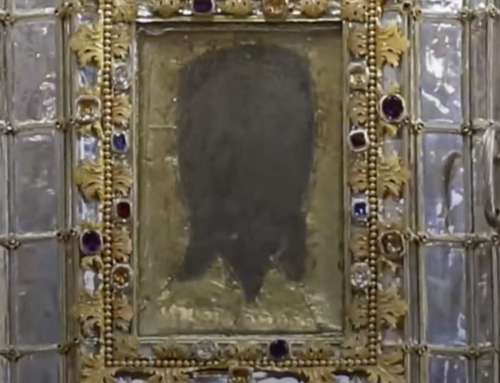
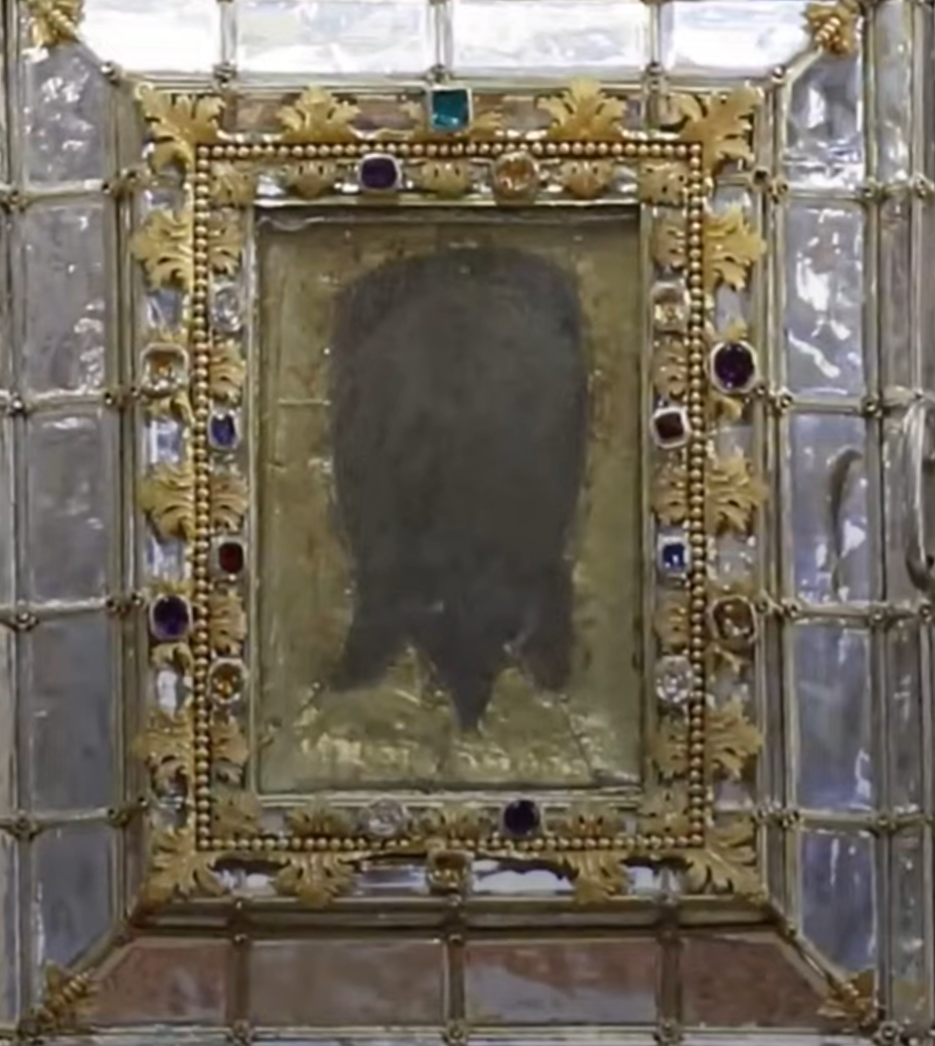
THE HOLY FACE OF LUCCA
At Lucca, in Tuscany, the name of “Volto Santo,” Holy Face, is given to a wooden crucifix of which the face, wonderful in its beauty, is the object of public veneration. During eleven hundred years the worship of the “Volto Santo” has subsisted at Lucca: six years ago (1882), the eleventh century of its translation was solemnized with both religious and civil pomp. The following is, in a few words, an account of the origin and the history of this memorable effigy(1).
It is attributed to the pious Israelitish Senator of whom the Gospel makes mention under the name of Nicodemus, and who was at first a secret disciple of Jesus, until, instructed and enlightened by the Divine Master, he openly followed in His footsteps, and, together with Joseph of Arimathea, took Him down from the Cross after His death and gave Him the honors of burial. Driven from Jerusalem by the enemies of the Savior, deprived of his title, and despoiled of his goods, he was reduced to extreme poverty and took refuge at Ramla, a little town situated between Jerusalem and Joppa. It was there that he died. This is the tradition which has been constantly preserved in Palestine from time immemorial. It is a fact that the Franciscans possess at Ramla, a town of 3,500 inhabitants, a very ancient convent where they exercise hospitality towards pilgrims, and in which an oratory is shown bearing the name of St. Nicodemus.
Tradition also relates, and all ancient and modern historians who have written upon the Holy Land equally attest, that the celebrated representation of Christ crucified, known under the name of “the Holy Face’’ was sculptured there. It is venerated in the principal church at Lucca, and according to the expression of Pope Innocent VIII., renowned throughout the whole world.
In his solitude and exile, the pious disciple, in order to reproduce the form of the Christ, had only to recall to mind his most recent remembrances. He had but lately rendered the last offices to the adorable body of the Redeemer, he had touched Him with his hands, taken Him down from the Cross, and laid Him in His sepulcher. The features of the Divine Crucified Savior, bruised and disfigured by suffering and death, had remained profoundly impressed upon his memory. Recalling to recollection the words which he had listened to from the mouth of the Savior in his memorable interview with Him— As Moses lifted up the serpent in the desert, so must the Son of Man be lifted up…, he endeavored to reproduce, by means of sculpture, the mystery of the Man God suspended from the Cross, and to represent Him as he bad seen Him with his own eyes. He then set himself to work. In accordance with an old custom, prevalent amongst the Jews, who were obliged, no matter to what rank they belonged, to practice a manual trade, he bad, spite of his senatorial dignity and distinguished birth, employed himself in sculpture all his life, and he was therefore a proficient in the art.
He employed a piece of oak to make the cross, and a cedar of Lebanon wherewith to reproduce the body of Jesus. Tradition relates that having terminated the Crucifix, with the exception of the head, the able artist found himself arrested by the difficulty of carving that portion of the divine Body, though he had doubtless present to his mind and in his heart the ineffaceable features of his well-beloved Master. The pious sculptor, following the example of the Saints, who, in like case, had recourse to fervent prayer, prostrated himself on his knees and, whilst prolonging his secret intercourse with God, he suddenly fell into a peaceful sleep. Hardly had he awakened from it, than he rose and hastened to contemplate his work. With what astonishment and emotion was he not overpowered, when he found that the face had been finished by the hand of an angel who had adapted it to the remaining portion of the body. It was admirably carved, vividly representing as it did the Majesty, the sorrow and the mercy of the Man God upon the Cross. Filled with joy and at the same time greatly moved and affected, Nicodemus prostrated himself on his knees before the beloved crucifix which so perfectly reproduced to him what he remembered of the ineffable face of his adorable Master. He placed it in a post of honor in his dwelling, and summoned all the faithful, who, having been dispersed by the persecution, had taken refuge in the town and the neighborhood, to come and venerate it.
Such is, in substance, the tradition relative to the origin of the “Volto Santo.” Now it will be well to bear in mind that there are in the East traditions supremely worthy of respect. “If there he anything,’’ says Chateaubriand, “proved upon earth, it is the authenticity of the Christian traditions of Jerusalem.” This remark specially applies to the tradition which looks upon Nicodemus as the sculptor of the crucifix, the so called “Holy Face” of Lucca. It has the authority of a grave and trustworthy tradition, and consequently has an historical value which it would be presumptuous to reject or to contest. Consequently a crowd of writers, deeply versed in sacred history and in the laws of criticism, do not hesitate to admit it; amongst them may he named Pope Innocent XI., Cardinal Baronius, Dom Calmet, Bellarmin, Paleoti, Gretzer, Henschenius, Mansi, Muratori, etc. These weighty authors will doubtless suffice to enable our readers to give full credence to what has been stated above on the subject.
We will now proceed to describe the Holy Effigy. The cross, of the usual form, is 4 meters 34 centimeters high, and 2 meters 75 centimeters broad. The thickness of the wood is 7 centimeters and the breadth 27 centimeters. The wood is of oak, dyed black. The Christ, sculptured in cedar wood, is fastened to the cross by four nails. The heads of the nails which pierce the hands are small, whilst those which fasten the feet cannot be perceived on the upper side, it is only the place where they have been driven in which can be seen. The body is larger than the natural size, measuring 2 meters 25 centimeters from the head to the sole of the foot. The venerable head of the Savior is a little inclined to the right and bent forward as though to receive the prayers of all who have recourse to Him and to look upon them in mercy. On first beholding it, reverence is the chief emotion with which His lace inspires the spectator; it even seems to be terrible in its aspect, but if it be contemplated more attentively, it will soon be perceived that it wears an expression of majesty and suffering united with sweetness and gentleness which inspires an emotion of love. That the face of the Redeemer should have been at once sweet and majestic, majestic and terrible to the wicked, sweet and amiable to the good, seems to be most natural. St. Catherine, writing to a lady at Lucca, says to her when speaking of the Holy Face— “Go to the most sweet Cross! Its Face looks lovingly and gently on the good.” Now, on a certain occasion, — it was at the commencement of the present century, — the Holy Face had been uncovered that it might be shown to a great personage. As soon as he had looked at it, he cried out, being seized with terror,— “Hide it, hide it.” It was the same Face, only there was a great difference between St. Catherine of Sienna and the worldly personage in question.
The hair of the “Volto Santo” is black, divided down the middle after the manner of the Nazarenes, and falling abundantly upon the shoulders. The beard, of the same color, is neither short nor long, as becomes a man still young; it leaves the chin uncovered and descends in two separate tufts. One thing worthy of remark is that the Effigy represents Jesus, not dead, but living and suffering; the eves are open and the lips, which have fallen a little apart, seem to move and to give to the Effigy a marvelous expression of life. There is no crown of thorns, which is in conformity with ancient custom; Jesus was not indeed crucified without the crown, only the primitive Christians preferred to recall to mind, not the ignominy, but the glory of Him who had ascended the Cross to save the world and to draw all hearts to Him. The face is Oriental in type, the Savior in this respect resembling his brethren, who were of the children of Israel. Another peculiarity distinguishes the “Crucifix” of Lucca; and that is that with the exception of the face, the whole of the figure is clothed. Nicodemus, through respect, would not represent the body of his divine Master in a naked state; he therefore sculptured a garment which entirely covers the figure. Moreover, it was customary in the early ages of the Church thus to represent Christ on the Cross.
During a long period of time, the sacred treasure left by Nicodemus at his death was carefully kept in the most private part of his habitation, that it might not be discovered by the Israelites who bore the Effigies of Christ and of the Saints in mortal hatred. Under the Pontificate of Adrian I., and the reign of Charlemagne, pilgrimages to the Holy Land began to be set on foot. Amongst the pilgrims of a certain epoch was a Piedmontese Bishop, Gualfredo, by name, who sojourned for a long time in Palestine and who had a revelation of the mysterious effigy of the Redeemer. He consequently formed the design to take it from the infidels and to transport it to Italy. He was aided in this projects by succor sent from on high. For he found, as though by accident, on the borders of the sea, a skiff in which he placed the crucifix which, impelled over the waves, arrived on the shores of Tuscany, in front of the port of Lucca. Vessels, seeing that it was without a pilot and destitute of a rudder, attempted to seize the boat, but the mysterious skiff escaped from their pursuits with supernatural swiftness. The Archbishop of Lucca, being informed of what had happened, betook himself there at the head of his clergy, when the skiff immediately delivered itself up into his hands, and the precious treasure became, through the Divine will, the possession of the city of Lucca, formerly evangelized by St. Paulin, a disciple of St. Peter. The cathedral was for a long time dedicated to St. Martin, the illustrious Bishop of Tours.
The Bishop of Lucca constructed, in a place adjacent to his cathedral, a chapel in which the “Volto Santo” was placed. From that moment the devotion of the people towards it increased daily, and miracles were so greatly multiplied, that it was found necessary to transport the holy Relic to the Cathedral itself, where it still remains. Soon its celebrity became universal; it attracted to it thousands of pilgrims of all ranks of life, not only belonging to Italy, but to all the countries in the world.
The affluence of people produced marvels of another kind, those namely of catholic charity. According to the chronicles of the time, Lucca and its suburbs numbered not less than twenty hospitals, destined to receive gratuitously the pilgrims of the “Volto Santo.” In the middle of the thirteenth century the hospitals of the diocese, having their own revenues and patrimony, rose to fifty. The pilgrim, as soon as he arrived in the territory of Lucca, was certain of immediately finding a house of refuge where he could rest if he were tired, obtain food if he were hungry, and be nursed if he were sick. He had no need to be afraid that he would have to remain all night alone in a desert place, for on his path he would be sure to meet with a friendly band to lead him to a hospitable house. A chaplain was stationed all day long under “the porch” of the church, that be might be always ready, to bestow upon the pilgrims the offices of sacerdotal charity.
When descending the mountains, on coming from Florence, torrents and impassible bogs had often to be traversed. There was, consequently, formed a society of Religious called “Brothers,” or “Knights of St. James of the Heights,” because they met at first in a little church dedicated to St. James, the patron of pilgrims. They were the first who bad the honor of constituting an order of chivalry, which has served as a model to all subsequent societies of the same kind. These Knights of the Heights constructed bridges, or made boats for traversing the torrents, rivers and marshes. They carried the traveler on their shoulders, often waiting for him in dangerous places leading him to the hospital, and administering restoratives to him. Towards evening the convent bell began to ring and continued to do so until it had become quite dark, in order to give notice of the proximity of the hospital; it was this bell which was known by the name of “the bell of the wanderer.”
The city of Lucca was, for a long Lime, the capital of one of those small Italian republics which were formerly so flourishing and so celebrated. It had consequently its own form of government, and as this government was eminently Christian, the people of Lucca gave a religious character to their political and civil life. They were the first to stamp their coin with sacred effigies, on one side bearing the Holy Face and on the obverse that of St. Martin and sometimes of St. Peter. It was only at our own epoch, the 26th of April 1858, that these effigies were suppressed by a decree of the government of Tuscany, to which Lucca then belonged. The day when this law passed was looked upon as a fatal day, and in fact, just a year afterwards, on the very same day, the Grand Duke was dethroned, and quitted Florence and Tuscany never to return there.
The seals of the state of Lucca also bore the effigy of the Holy Face on one side, and on the obverse St. Martin on horseback with his lance at rest. Acts and contracts were drawn up in honor of the Holy Face. The law condemned blasphemers of it to the most severe penalties. Finally, although a republic, the Luccese had elected the Volto Santo to be their king, in right of which there was placed upon its forehead a rich and splendid royal crown. The feast of the Holy Face was the national feast; it was celebrated, down to the end of the twelfth century, on Easter Tuesday, and after that epoch on the 14th of September. This did not however prevent St. Martin from having a feast of the rite of the first class, as patron of the diocese. On Good Friday and the 14th of September, prisoners were set free in the name and in honor of the Holy Face. These facts sufficiently prove how greatly the inhabitants of Lucca loved and honored their holy Effigy and how Jesus Christ had really become their King.
A confraternity of the Volto Santo was established at a very early period. It had its rules and a vast organization, which rendered it at once a religious and civil institution whose object was to favor, by all possible means, the devotion to the Holy Face. Its meetings were held in the Cathedral on the third Sunday of every month. They were announced in advance, by special messengers who went from house to house in the different parishes, and they were terminated by a solemn procession in the neighborhood of the church, in the sixteenth century the Confraternity was merged in that of the Holy Sacrament which was very ancient, and which then assumed the title of the “Confraternity of the Holy Sacrament and of the Holy Face.” It had a double object, the first of which was to provide every thing that was necessary for celebrating, with due pomp, the offices of Holy Thursday and of Good Friday, and the second the procession on the feast of Corpus Christi. In 1837, the Archbishop of Lucca reestablished the Confraternity of the Holy Face; some years afterwards it already numbered ten thousand associates.
From Lucca the devotion of the “Volto Santo” spread not only throughout the principal towns of Italy, but also throughout the whole of Europe, it may be even said throughout the whole world, and everywhere it nourished in an extraordinary manner. To speak only of France, in Paris above all, the Holy Face was designated by the name of the “St. Voult” of Lucca, or “St. Vandèle.” The mother of St. Louis, Blanche of Castile, had a great devotion for the Holy Face of Lucca; it was at her command that the celebrated history of Leboino upon the “Volto Santo” was translated, and this translation was placed in the National Library, where it is probably still to be found. In a very ancient Processional of Paris there is a special commemoration of the “Volto Santo;” it was made on Holy Thursday and it had relation to the outrages inflicted by the Jews and the Roman soldiers on the adorable Face of the Savior.
At the epoch of the cholera, in 1835, the Luccese who had escaped the scourge attributed their preservation to the “Volto Santo” and offered to it as an ex-voto a golden lamp, of the weight of 24 lbs. Nor have they forgotten the visit of Pius IX., in 1837, a circumstance which they took care to recall to the recollection of the holy Pontiff when they presented to him, in 1871, a superb fac-simile of their celebrated Effigy. Finally, in the month of May 1883, when the eleventh centenary of the arrival of the crucifix of Nicodemus occurred, the whole of Lucca gave itself up during three days to the celebration of a religious and civil festival, the magnificence of which recalled the most splendid epochs of its bygone history.
A chapel in the middle of the Cathedral is destined to the Crucifix. It is a small edifice in white marble, round, in form, and admirably sculptured by an ancient artist, belonging to the country. There is an altar in it where mass is said, and the altar piece of which contains the reliquary. In order to sec and venerate the Relic on days other than those of the public exhibition of it, it is necessary to have the permission of the Archbishop and the Chapter. This permission was granted to us in October 1886. This private exhibition was however accompanied by a certain degree of solemnity. It was necessary to wait until the close of day and until the doors of the basilica where closed. Then a canon habited in a surplice and accompanied by two clerks carrying lighted tapers, uncovered the holy Crucifix, and after several liturgical prayers permitted us to contemplate and to venerate it at our leisure. Its aspect appeared to us to be in accordance with the description already given of it. Seen in front, it has an expression full of sweetness and gentleness, but looked at in profile it is severe and menacing. This act of piety is not accomplished without the soul being filled with profound emotion of which the remembrance is ineffaceable.
The remains of Nicodemus and those of Gamaliel are preserved and venerated at Pisa, where an altar is dedicated to them in the Duomo. We celebrated mass there when returning from our journey to Solero (in the diocese of Alexandria), to which place we had been sent by the metropolitan Chapter of Tours in order to receive relics of St. Perpet, one of our most illustrious Bishops, and to whom we owe the first basilica of the great miracles worker of the Gauls, St. Martin.
(1) This Notico is a faithful, although very incomplete, summary of on extremely interesting pamphlet, which is itself only the abridgment of a learned ancient work. It was published on the occasion of the feasts of the centenary, under the title of Notizie storiche del Santo Volto di Lucca, per il sacerdote Almerico Guerra, canonico onorario della Metropolitana Luchese (1881).