THE HOLY FACE OF ALICANTE
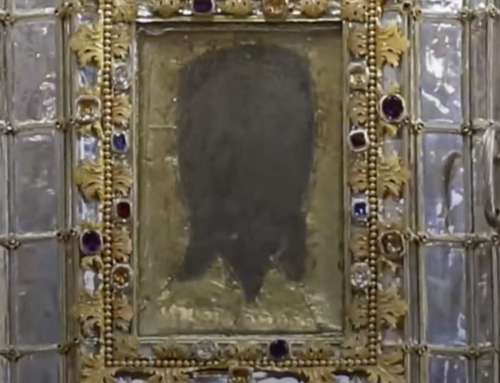
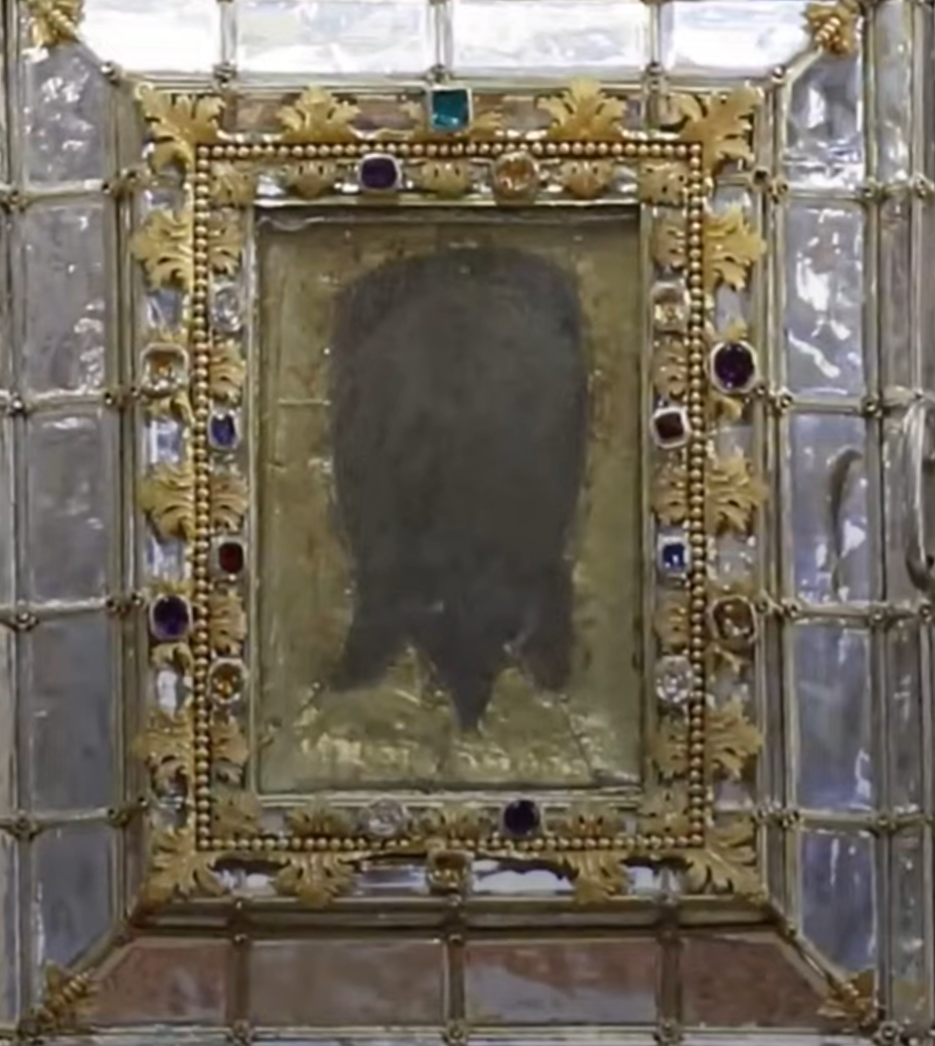
Alicante is a Spanish town in the southern part of the province of Valentia, and is situated upon the Mediterranean coast, where it possesses a commercial and much frequented port. Very near to the town, in a monastery of Poor Clares, known by the name of the convent of St. Veronica, there is a beautiful and celebrated effigy of the Holy Face, which is the object of a great popular devotion. The veneration paid to this ancient Effigy is attached to the fact we are about to relate.
In the year 1489, an excessive drought was so prevalent in Alicante and the neighborhood, that all the fruits of the earth were menaced with complete destruction, and it was then that the priest of a rural parish was seized with the idea of making a solemn procession from his church to the convent of the Observantine Minims. In this procession, inspired as it was by a spirit of penitence, a Holy Face, copied from the one at Rome known as the veil of Veronica, was carried amidst public prayers in which a great concourse of people joined. A Religious of the Minimes, Father Villa Franca by name, was charged with the pious and honorable task of bearing it in his arms. “All at once(1) the holy Effigy became so heavy, that the Friar’s arms were obliged to be supported. Moreover, when he had ascended an elevated spot in order that the whole assemblage might plainly see the Effigy, it was remarked, the day being perfectly serene, that a tear, more limpid than crystal, was falling from the right eye. At the sight of this miracle, the whole multitude with one voice implored the divine mercy.” Just at that moment, Father Benedict de Valence, a Franciscan Monk whose sanctity was held in great repute, and who was titular preacher to the King of Spain, as well as provincial of Aragon, made his appearance. “The church being too small to contain so great a multitude, the Father began to preach in the open air a most touching sermon, and at the conclusion of it asked his hearers to meet him again on the following day and in the same place. It happened that the next day was a Friday, and during the sermon, the sky, which the day before had been perfectly serene, was suddenly veiled with thick clouds. Father Benedict, who was holding in his hands the holy Effigy and elevating it in the air, was suddenly plunged into an ecstasy. At the same moment two other Holy Faces, exactly similar, appeared in the midst of the clouds. When the preacher came to himself, his ecstasy having ceased, he gave the blessing to the people with the Holy Face he was holding in his hands. Then the two other representations which had mysteriously shown themselves in the sky disappeared, and the cloud, dividing itself into four portions, disposed like a cross, shed forth an abundant rain which restored to the earth its freshness and gave new life to its productions.”
Another time, when the man of God was showing this same Effigy to his hearers who were imploring aloud the divine mercy and forgiveness of their sins, a great cross of various colors, similar to a rainbow, was observed to he suspended above the Father’s cross.
These miracles inspired the inhabitants of Alicante with great devotion to the Holy Face of our Lord, and the blessed Benedict prevailed on the city to found a monastery of Poor Clares, in the place where it had been seen to weep. Subsequently, a splendid church was built, and it is there that the precious Effigy is still preserved and that it is publicly venerated. It would take too long to enumerate the miracles of all kinds which have rendered this worship more and more popular. Suffice it to say that in maladies, droughts, inundations and other scourges which have visited the country, the citizens of Alicante have never had recourse to their Holy Face without experiencing its powerful protection.
The faithful were accustomed to visit it in its sanctuary on the Fridays in Lent. Every year, about the 17th of March, a triduum of feasts was celebrated with indescribable solemnity. So great, in the eighteenth century, was the renown of the Sacred Face of Alicante, that there was not a ship in the port, coming from the East, or on the point of sailing thither, which did not salute the Picture with a salvo of artillery. This example was more than once imitated by protestant English and Dutch sailors. At the present day the captains of merchant vessels raise their flag when they come in sight of the monastery. The people of the country continue to visit the church and often go there barefooted; they also have masses said in honor of the Holy Face and in gratitude for the benefits obtained by its means.
The annual procession always takes place with the magnificence and pomp which Spain knows so well how to bestow upon religious ceremonies when the civil authorities join in them together with the clergy. The Holy Face is then uncovered, hymns are sung in its honor, and it is solemnly shown to the people. It is afterwards carried triumphantly along the streets of the city under a splendid dais held by eight priests, and it is the highest dignitary amongst the clergy who hears it in his hands. In 1859, the Bishop performed the function, walking on foot in the midst of an edified and ravished crowd.
Enclosed in a very rich reliquary in the form of a monstrance, it is placed between two plates of crystal united together by an admirably wrought band of silver and surrounded by a graceful wreath composed of eight heads of angels. The lance, the sponge and the other instruments of the Passion surmount the whole, and seem to indicate that the Holy Face itself, spite of the glory and beauty which shine from it, bears the signet of suffering.
(1) Partly extracted from the Palmier seraphique, vol. IV, 15th of April. A “Romancero” of the Holy Face has been recently published; it is a long epic poem in verse upon “The miraculous Effigy venerated in the monastery of St. Veronica, in the neighborhood of Alicante.” The notes and explanations placed at the end of the poem have furnished us with some valuable historical details.