THE HOLY FACE OF OSA DE LA VEGA
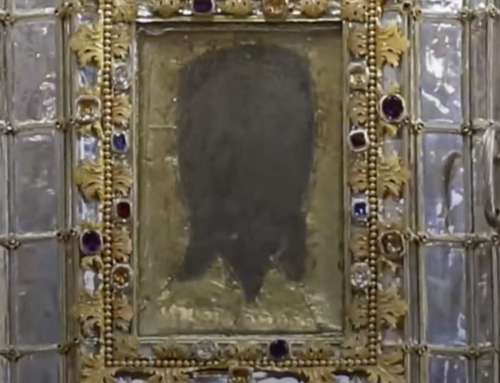
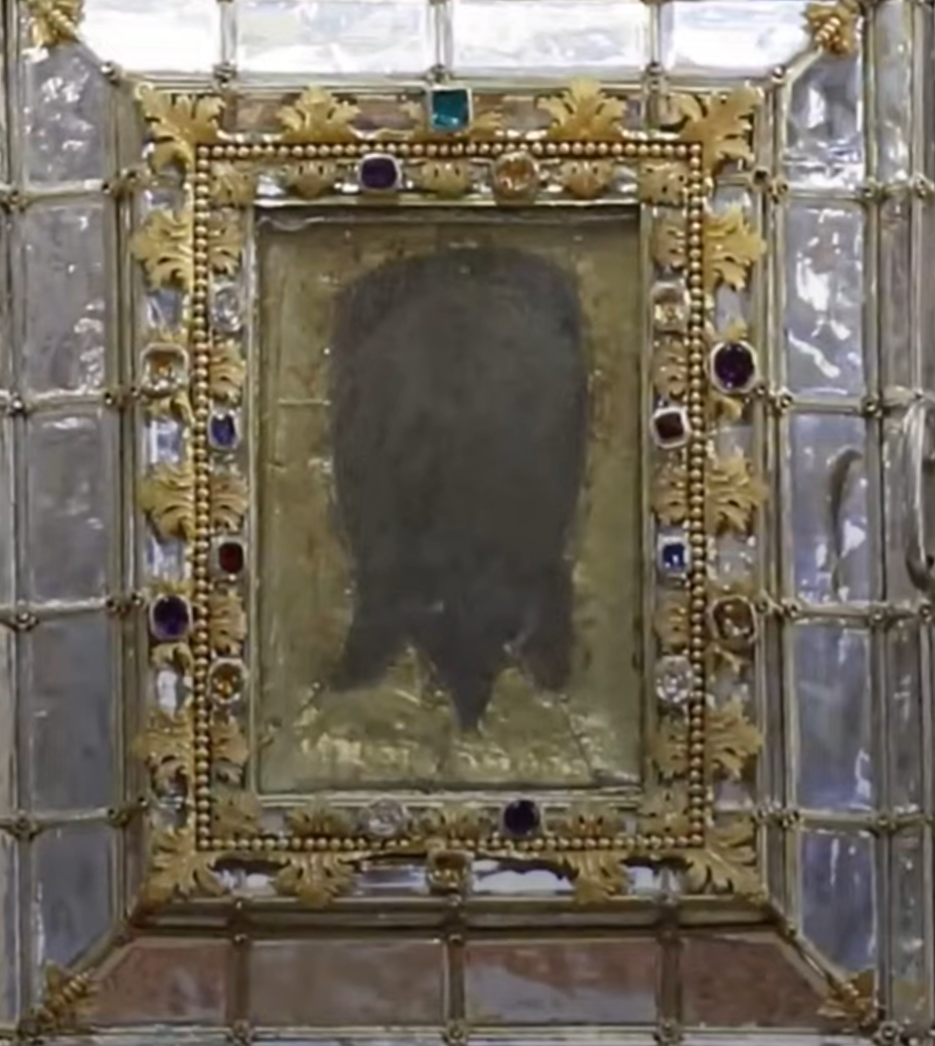
Osa de la Vega is a small town in the diocese of Cuenca, in New Castile, in the vicinity of the ancient and celebrated castle of Belmonte: It has been the cradle of illustrious families, and has always been distinguished by the faith and probity of its inhabitants. But its great privilege is that it preserves, in its parish church, as an object of pious and popular worship, a miraculous effigy of the Holy Face, of which we propose to give a summary account(1).
In the beginning of the seventeenth century, there lived at Belmonte, a town in the neighborhood of Osa de la Vega, a holy priest named John Matilla who possessed a picture of the Holy Face, representing St. Veronica holding in her hands the veil on which was impressed the sorrowful lineaments of the Redeemer. How did he obtain this treasure? It is not known, but it is probable that he had received it from Rome. He attached very great value to it, and held it in such veneration that every evening, before betaking himself to sleep, he prostrated himself on his knees before it, and remained there an hour in adoration. He left it at his death to one of his relations, Isabelle del Corral y Matilla, wife of Jerome de la Torre, who lived at Osa de la Vega. Although she was a good Christian, the heiress of this precious treasure did not seem at first to attach any great value to it. However, she took it away with her to Belmonte, and placed it in one of the rooms of her house, without being attracted to the Holy Face by any special devotion, as she herself declared later on. No one then suspected the designs of Providence in regard to it.
It was on Holy Thursday the 24th of March 1644. Towards six o’clock in the evening, at the moment when the inhabitants of Osa de la Vega had congregated together in the church in order to have the sorrowful Passion and death of the Savior explained to them, a touching and inexplicable prodigy took place in the house of Jerome de la Torre. Isabelle del Corral, his wife, had gone into the room where the holy Effigy was, of which we have spoken, in order to get a tunic for a brother of the “congregation of the Blood of Jesus Christ.”
On entering the room, she was dazzled by an extraordinary light. Filled with astonishment, she proceeded to examine more closely what it was that had struck her. Oh prodigy! she perceived that the vivid rays of light she had beheld were streaming from the holy Effigy placed in the room; she moreover saw drops of sweat running down it in abundance, as she affirmed on oath, in the inquiry which was afterwards instituted respecting the wonderful event. In her presence the adorable Face of Jesus sweated blood and water, as it had done in the garden of Olives; she distinctly beheld tears flowing from the eyes of the divine Effigy, and drops of blood running down from the head where it had been wounded by the crown of thorns.
Without, strange to say, feeling troubled at the sight, she left the room to give to a little girl the tunic she had come for. On returning, she again beheld, for the second lime, the same prodigy; only the sweat was still more abundant, whilst from the forehead and along the cheeks of the Holy Face drops of blood and water ran down upon the beard. Then, touched and overwhelmed with admiration in presence of so extraordinary an occurrence, the pious woman could no longer restrain herself; she hastened away from the room to tell to others what she had seen. The tidings spread on all sides, like an electric spark, amongst the inhabitants of the country. They hastened to the spot, and the whole multitude, filled with emotion and enthusiasm, proclaimed aloud the miracle.
Together with cries of enthusiasm were mingled tears and sighs and all the signs of deep compunction. Information was given of the event to the Rev. Father Michel Conde, a Religious of the monastery of Santa Cruz of Villaescusa de Haro. It was eight o’clock in the evening when he reached the house. Approaching the holy Picture, he examined the sweat which covered the divine Face. In order to assure himself that it was a fact, and to remove all possibility of illusion, he took a lighted taper and examined the sweat and blood attentively and leisurely. He then saw that they were drops of about the size of the seed of a pomegranate. Having taken some of these drops into his consecrated hands, he was able to convince himself that from the Holy Face was indeed flowing a real sweat of blood and water. The prudent, grave Religious also observed that from the eyes of the holy Picture two drops of blood had issued, which, in the space of one hour and a quarter, flowed down the sacred checks. He, moreover, observed that the head and the locks of hair were covered with a kind of dew of sweat, that the Face was at one moment suffused with color like that of a person in suffering, and that the next moment it became pale as though it were under the influence of some internal agony; that the eyes were sad and the lips swollen, and that from them flowed down drops of sweat. After having given an account of the miracle to the parish priest, Alonso Serrano y Guijarro, who had not been able to come to the house until after the divine office, be decided, in order to calm the extreme agitation of the faithful, that the holy Effigy should be taken to the parish church. He then had it placed in the Baptistery, and, for greater security, he himself kept the key of the chapel.
On Holy Saturday, the faithful being assembled in the church at the hour when the divine office is celebrated, the parish priest, clothed in his sacerdotal vestments and accompanied by the clergy, went to the chapel of the baptismal fonts, where the precious Effigy had been placed, that he might bless the fonts as usual. At the moment when he was repeating the first prayer, Alonso Serrano perceived that the holy Effigy was covered with a sweat which was very apparent. But he behaved as though he had not observed it, in order to moderate the enthusiasm of the assistants, who had seen the miracle, and proceeded with the blessing of the fonts. When the office was terminated, he asked for some corporals, with the object of making himself still more certain of the miracle and of giving undoubted evidence of it to the astonished crowd. Placing himself on his knees before the altar, on which was the miraculous Effigy, he called two alcades to come forward and begged them to stand upon a bench, in order that they might be able to observe more closely the miracle which had taken place. In presence of the civil authorities, the priest Alfonso wiped away numerous drops of sweat, and two of blood with which the corporals were stained and marked. He then proceeded to wipe away the other drops. The priests who were present and the faithful got up successively upon the bench, and thus they were all of them able to give testimony to the miraculous sweat, on seeing the corporals damp and stained with the blood and the water which the parish priest had wiped away until the Holy Face remained completely dry. The people then retired and the priest Alfonso closed the chapel, using the same precautions as he had done on Holy Thursday.
In order to perpetuate the remembrance of this miracle, it was resolved that the corporals should be preserved with reverence and veneration in the tabernacle of the altar of the Rosary. Since then, they have been placed in that of Our Lady of the Nativity. In 1862, by order of Mgr. the Bishop, Dom Miguel Faya y Rico, they were removed to the tabernacle of the altar of the Holy Face, where they are piously preserved in a small case.
On the afternoon of the same Holy Saturday, about two o’clock, certain persons who were grievously disappointed that they had not been able to witness the miracle which had taken place in the morning, came to the church to worship the holy Effigy. Then, for the third time, the Face of Jesus, appeared to become wet and to sweat in almost the same manner as on the previous occasions. The priest Alfonso, coming to the chapel just at this juncture, opened the door, went in, and, as before, wiped away the drops of sweat with some corporals.
A commission was then named by the Bishop of Cuenca, Mgr. Henriquez Pimentel, and commanded, to draw up a verbal process of the fact which had occurred. Judges were appointed, and a synod was held on the 23d of March 1645, in the palace and under the superintendence of Mgr. Pimentel. Enquiry having been made, it was unanimously declared, and stated in accordance with the due canonical regulations, that the sweat of blood and water of the holy Effigy was “a miracle worked by the Almighty, and that, consequently, the venerable Face of Christ our Lord was a treasure of inestimable value of which the province of Cuenca had grounds to congratulate itself, and that it ought to endeavor to put it to profit in order to the greater glory of the divine Majesty and the exaltation of the Catholic faith.”
Sharing these convictions and desirous of favoring the devotion towards this holy Picture, the Sovereign Pontiff Clement X., by a bull dated the 14th of December 1674, granted greet spiritual favors to the chapel of the Holy Face, and amongst others, the privilege of a perpetual jubilee. A confraternity in honor of the most Holy Face of Jesus was founded on the 25th of March 1676, and another bull of the same Pope granted to it numerous indulgences. A feast of the Holy Face was celebrated on the Sunday during the octave of the Nativity of the Blessed Virgin. The feast of the Immaculate Conception, the feast of the holy Name of Jesus on the second Sunday of the Epiphany, Holy Thursday, and the feast of the Precious Blood were also considered to be feasts proper to the confraternity. At the hour of death, such members of the confraternity as had been constant in wearing a scapular of the Holy Face, might gain a special plenary indulgence; numberless graces are related, wherewith God recompensed the devotion of the inhabitants of Osa de la Vega for their dear and venerable Effigy.
Nevertheless, at the present day, it appears that the pilgrimage of which it was the object is little more than a memory. But the confraternity, which had also become a thing of the past, has lately been revived, and it is said that it makes great progress in the Philippine islands. An interesting pamphlet was published at Madrid in 1874, entitled the History of the Holy Face of Osa de la Vega; it is from it that we have compiled the preceding abstract. One of the French Dominican Fathers, who have taken refuge at Belmonte, permits us to add the following details— “The miraculous Effigy is inexpressibly beautiful; it is a work of art of great value. The Face of the Christ, its eyes bathed in tears and blood, is so touching in its expression, that it is impossible to look at it without emotion. I have had the indescribable happiness of touching with my hands the sacred linen which was used to wipe away the sweat of blood. The corporals are as fresh as though they had been used but yesterday; so perfect a preservation seems to be little less than miraculous. They are kept in the tabernacle of the attar of the Holy Face, and the same homage as that paid to the most Blessed Sacrament itself is rendered, to them(2).”
(1) This recital is extracted and translated from the Historia del santissimo Rostro de Jesus que se venera en la ville de Osa de la Vega, by D. Pedro de la Torre, presbitero… Madrid, 1874. (Pamphlet of 117 pages.)
(2) Letter from the Rev. Father Brochard. Belmonte, 9th of October 1883.