THE HOLY FACE OF JAEN
Spain, a preeminently catholic nation, has at all times possessed in a superlative degree an appreciation of, and a delight in the great devotions of the Church. Spanish painters and sculptors have given expression, with striking and sometimes sublime force, to the torments of our Savior in His Passion. Pictured, or sculptured representations of the Holy Face, are very frequently to be found in churches and public museums, formed during the last thirty years from the spoils of different sacred edifices and monasteries. In addition to these works of art, Spain possesses several pictures of the Holy Face venerated with pious devotion as being reproductions of the veil of Veronica. They are styled indifferently “Santa Faz, Cara dc Dios,” or “Santo Rostro.”
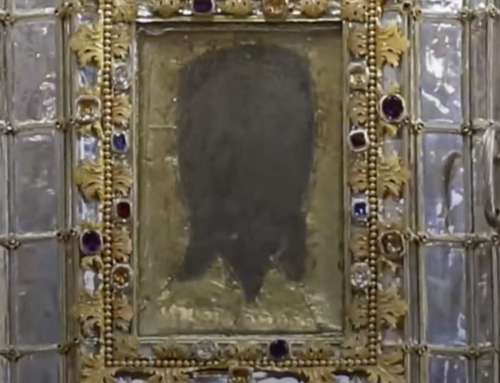
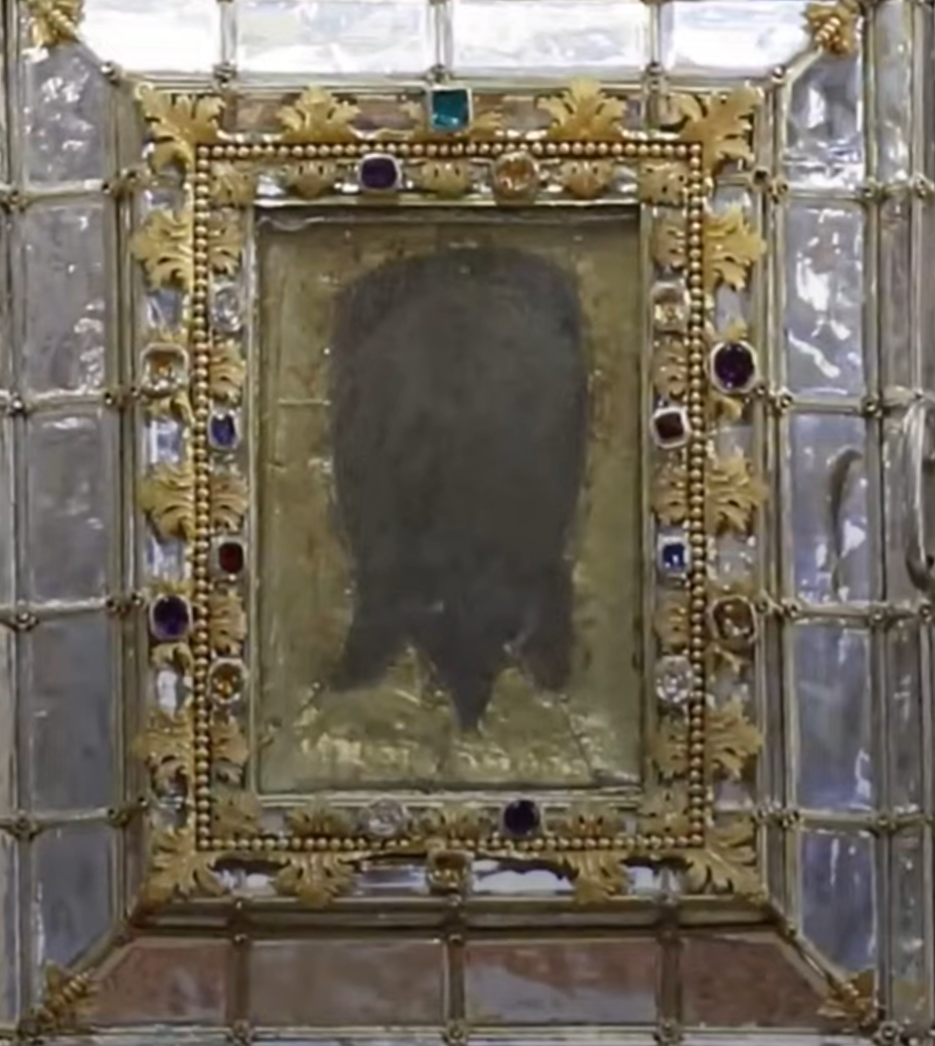
The most celebrated of them all is, unquestionably, that of Jaen(1). It has been venerated in the cathedral of the city from time immemorial. Placed in a splendid frame, enriched with emeralds, it may be easily seen, and a great number of engravings and of fac-similes of it are spread all over Spain and reverenced with great devotion by pious persons.
Spanish historians are not agreed as to the origin of this memorable picture. According to an ancient tradition, it dates from the times of the apostles, when St. Veronica herself was alive. It is believed to be one of the folds of her veil on which the Savior left His divine Effigy. Trustworthy authors are of opinion that the veil of Veronica was folded in three at the moment when the courageous Israelite presented it to the Man God, and that on each of the three folds was simultaneously impressed the ineffable lineaments of the sorrowful Face. These three several impressions, being afterwards separated from one another by Veronica, were each of them bestowed by her on different persons. The first which she gave away is the Holy Face so piously preserved in Rome in the basilica of St. Peter at the Vatican. Veronica presented the second fold to the town of Zante, when, sailing from Judea to Italy, she disembarked at the island of Zante and became its apostle. It is not known what became of it, history has not been able to trace it. The third fold is that which is venerated at Jaen. It must have been given to St. Euphrasius, the apostle and first Bishop of the city, when he was sent from Rome by St. Peter, or his successors, and received the mission of evangelizing that part of Spain.
Pope Clement VII. seems to confirm this tradition in a bull of the 20th of December 1529, by which he grunts indulgences to the Church of Jaen. “It is therein stated that a pious and venerable Effigy of our Lord and Redeemer Jesus Christ, impressed upon a handkerchief, which Effigy our Savior Himself left to Veronica at the moment when He was ascending to Calvary, is preserved there and has been venerated from time immemorial.” — “This Relic,” it is added, “is held in great honor, and numerous pilgrims flock thither to visit it on the days when it is publicly exposed.” Jules III. uses the same words in another bull which he granted to the same church in 1353. Acuna also repeats them and adds to them the litanies of the Holy Face, composed by Sancho d’Avila, “which are recited,” he says, “at the time when the holy Relic is exposed.”
Brought from Rome to Spain by St. Ephrasius, the venerable Effigy remained at Jaen, where the holy Bishop had fixed his seat, and where he suffered martyrdom at the hands of the infidels. After his death and later on, under the dominion of the Moors, it was carefully kept by the Christians, until the time when the city of Jaen was conquered and taken from the Mahomedans by the holy King Ferdinand.
It was in 1246, that this event occurred. The saintly Prince took possession of the sacred Effigy and carried it with him, as a standard in his military expeditions. One of the great historians of Spain, Marinaeus Siculus, when relating how the pious King, after he had conquered Jaen, also delivered Cordova and then Seville from the Mahomedan yoke, distinctly states that he bad with him the holy Effigy which was borne at the head of his armies. He was not able, before his death, to give back to Jaen the precious treasure which he had taken from the city, or else, if he left directions that it should be restored, his orders were not executed. The duty of making lawful restitution was reserved for Dom Nicolas de Biedna, who, being Archdeacon of Seville at the time, may have been informed of the intentions of King Ferdinand with respect to the Effigy. Having become Bishop of Jaen, be was afterwards named Vicar apostolic for the whole of Andalusia. This dignified post gave him, so the chroniclers of the period state, sufficient authority to enable him to restore to his episcopal city the venerable relic of the Holy Face which had been its glory. It was in consequence brought back from the place where it had been detained, and placed in the cathedral of Jaen, which since that time has always kept possession of it.
We are, however, bound to state that more modern historians do not accept the tradition related above. They give to the fact which has been narrated quite another interpretation. According to them, Bishop Biedna, who filled the see of Jaen from 1368 to 1376, demolished the mosque which had already been intended by the King to be converted into a cathedral. It was on: that occasion that a translation of the Holy Face occurred, giving birth to the story of the restitution of the venerable Effigy. Moreover, according to them, King Ferdinand himself received it direct from Rome, at an epoch which is not known. The Sovereign Pontiffs had, as may easily be understood, a direct interest in thus encouraging the pious Prince and the Christian armies, for which they procured in this manner the means of fighting the enemies of the faith under the eyes and before the Face of Christ. Pope Honorius III, or his predecessor, may have accordingly enriched Catholic Spain with the precious treasure at the request of its saintly King. For, in reality, say the same authors, the reliable and historical tradition does not go back further than the thirteenth century. The Effigy, as it appears at present, is of the byzantine type, and must have been painted upon the original tissue whilst the primitive impression was still visible. Unhappily it has several times been retouched by different artists; it is therefore impossible to judge of what it originally was by means of its present aspect.
However this may he, it is incontestable, according to the best Spanish authorities, that King Ferdinand held the Holy Face in profound veneration; and it appears no less unquestionable that the valiant monarch made use of it as his standard, and had it carried in battle at the bead of his armies, looking upon it as a guarantee of victory over the invaders of his country and the enemies of the Christian name. It is also certain, and moreover admirably significative in regard to Catholic Spain, that the august Face of Christ presided over the last expulsion of the Moors from the country they had so long oppressed, and that it thus became the Labarum which drove the impious Mussulman beyond the extremities of the peninsula. Need we then be astonished if the Holy Face of Jaen has enjoyed so great celebrity throughout the whole of Europe, above all in the sixteenth century?
Its reputation has not diminished at the present day in the different provinces of Spain. The inhabitants of Jaen, in particular, profess the greatest veneration for their holy Effigy and esteem it a great honor to have it in their possession. It is placed in a shrine over the high altar of the principal chapel in the Cathedral. This shrine encloses another, made of beautifully wrought silver, which contains the holy Relic itself, set in a largo golden frame, incrusted with precious stones of very considerable value(2), the whole being the gift of the Bishop of Jaen, Rodrigues Marin y Rubio.
The chapel in which the shrine is placed is locked with three keys which are kept by three Canons. There was formerly a confraternity attached to it, but it no longer exists.
The Holy Face is exposed to public veneration three times a year; on Good Friday, on the 15th of August, and on the Feast of the Assumption of the Blessed Virgin, to whom the Cathedral is dedicated; it is also exposed on the 1st of November, the festival of All Saints, in order to thank God for having preserved the city amidst the horrors of a terrible earthquake which occurred in 1755. On these occasions the Chapter chants certain passages which have relation to the Passion, and the Holy Face, with which the people are blessed in the interior of the Cathedral, is solemnly adored. This benediction is also given outside the church from four balconies, corresponding to the four cardinal points of the horizon. A great number of the faithful come to this ceremony and at the conclusion give their rosaries, medals and other objects of piety in order that they may touch the crystal which covers the sacred Effigy. When the 1st of November falls on a Saturday, which was the day of the week when the earthquake took place, the Holy Face remains exposed for the adoration of the faithful during the whole day until Compline. During the adoration, the Canons and clergy relieve each other every half hour.
In speaking of the Holy Face of Jaen, the glory of which is associated with the deliverance of Spain from the Mahomedan yoke, we may here mention an historical fact with which the annals of the Carmel of France furnish us and which is connected with the subject in question.
The Carmelites of the second convent, at Paris, possess a miraculous picture of the sorrowful Face of our Lord, which came from Spain under the following circumstances(3). This holy Picture, of very ancient date and unknown origin, had fallen into the power of the Moors, who had taken it away from the Christians. Through hatred of our divine religion, the infidels attempted to pierce it and to slash it with a knife. On doing so, blood flowed forth from it in abundance and terrified them exceedingly. In their fear and fury they threw the picture into the fire that it might be destroyed. The Holy Face, however, was proof against this fresh outrage and the flames respected it. Happily it was rescued from the impious hands of the infidels, and during a long period the Church of Toledo preserved it as one of its most precious relics.
Now, on a certain occasion, Isabella of France, daughter of Henry IV. and wife of Philip IV., King of Spain, being at Toledo, wished to see the treasure of the Cathedral, and the Cardinal Infante, who was the archbishop of the See, hastened to show her all its riches. The pious Queen was touched with only one of the pious objects shown to her. It was the impressive aspect of the ancient and miraculous picture of the Holy Face, which she immediately and urgently begged might he presented to her. The Cardinal consequently summoned the Chapter, and easily obtained its consent that the precious relic should be presented to the Queen. Isabella was delighted and never ceased to offer up before the Holy Face her homage of faith and piety. In her last moments she would not allow it to be taken down from her bedside, where she had placed it, and when she died, she left it to her daughter, Marie- Thérèse, entreating her to look upon the gill as an exceptional mark of her tenderness, seeing that she possessed nothing dearer to her in the whole world. Marie-Thérèse, having married Louis XIV., in 1660, came to France, and before her death (1683), left it as a legacy to the Convent of the Carmelites, which she bad founded, and where the holy Picture has been safely kept down to the present day.
During the Revolution, in 1792, two commissaries of the district forced the Mother Prioress, to open to them the gates of the monastery, previous to expelling her and all the sisters. Invading the chapel, they began their work of destruction by breaking the reliquaries in order to seize any thing precious which they might find and casting aside the holy relics, to the great joy of the religious. Marie-Thérèse, their royal benefactress, had enriched the effigy of the Holy Face with a golden frame ornamented with diamonds. The commissaries seized these jewels, but they gave up the divine Effigy to the Superioress Mother Nathalie de Jesus, who placed it in a more simple frame and had its authenticity guaranteed by the Father Visitor, M. de Floirac, before he emigrated. After the reign of terror, the Prioress, having assembled the remaining portion of her daughters, established herself in another house where she died in 1798, leaving to the Religious, who succeeded her, this invaluable treasure thus providentially preserved in the midst of so many vicissitudes and storms. It will be easily understood that the holy Effigy is more than ever prized at the present day by the good Carmelites, who find their happiness in venerating it within their cloister, especially during Lent, and on the different festivals of the Passion celebrated at that holy season.
The following is a description of it with which we have been furnished. It is an oil painting on linen, oblong in form, being 30 centimeters long by 21 broad, preserved under glass in a wooden frame painted and gilt in the Moorish style. The complexion is pale and gray in hue; the countenance has a touching expression of suffering and of goodness, the whole face an aspect of gentleness and of calmness which is really divine. On the bead is placed a great crown of interwoven thorns which entirely surround it. The lips are pallid; the hair and beard, of a warm chestnut color, merge gradually into the rest of the painting, which is almost completely in shade, the light being concentrated on the Face; the eyelids and the whites of the eyes are streaked with blood; the crown of thorns is of a greenish brown; the blood flows down and discolors the top of the forehead; some drops of blood stream down the face. The slashes made by the knives of the infidels, when they thrust them through it, may still be seen; the blood which miraculously flowed from it at, the time seems to be coagulated, on each side, at the bottom of the picture, and mingled with little grains of sand. But nothing that be said of it can give any idea of the merit of this inestimable Effigy, which so vividly recalls the sufferings and the love of the Man God, the sovereign Restorer.
(1) This Notice has been compiled from private letters received from Spain, extracts from the Dictionary of Madoz and a pamphlet published at Jaen, under the title of Ajuntes historicos sobre el Movimento de la seda episcopal de Jaen y series correlativas de sus Orispos, by D. Ramon Rodriguez de Galvez. (Jaen, 1873.)
(2) Madoz’ Dictionary.
(3) The details which follow are partly taken from the Vie de Mme de Soyecourt, prieure du second Carmel de Paris, rue de Vaugirard, 86 (p. LIX and 104).