THE HOLY FACE OF MONTREUIL-SOUS-LAON
We have already stated that, amongst the rare copies of the Holy Face of the Vatican approved in past centuries by the Sovereign Pontiffs, one of the most celebrated is that which is honored at the present day at Notre-Dame de Laon. We will endeavor briefly to sketch the history of it(1).
On the confines of Thiérache and of Hainault, there flourished at Montreuil-les-Dames in the thirteenth century, a Convent of Benedictine Nuns. They owed their foundation to Bartholomew de Vir, Bishop of Laon, and had received their rule from the great Abbot of Clairvaux, St. Bernard. These fervent Nuns added to prayers, fasting and many mortifications, the labor of their hands by tilling the ground with spade and hatchet. They cultivated in this way the land in their own neighborhood, cut down forests, and gave to the soil the fertility it still enjoys. Historians and chroniclers of the time praise their austerity and their virtues. They had a special love for holy relics and religious pictures, which they sought eagerly and earnestly as furnishing them with subjects of contemplation and a means of increasing their fervor. We find, for example, that, at the beginning of the thirteenth century, they possessed a piece of the true Cross, which one of their abbesses enclosed in a silver cross richly chased.
Their devotion asked for yet more than this, and, knowing the veneration which the Holy Face of our Lord impressed upon the veil of Veronica enjoyed at Rome, they cherished a lively desire to possess a faithful copy of it. This pious longing was fed in their hearts by the sight of medals which bore on them an effigy of the Holy Face, and which, at that time, pilgrims were wont to bring from Rome. At last, circumstances, arranged by Providence, permitted them to have their devotion satisfied beyond their utmost hopes.
Towards the year 1249, Montreuil had for its Abbess a Nun called Sybil, whose brother resided at Rome and later on was elected Sovereign Pontiff. He was no other than Pope Urban IV., known before his elevation by the name of Jacques Pantaléon, or Jacques de Troyes, for he was of French origin, and a native of Troyes in Champagne. His parentage was rather obscure; at first a choir boy in the Cathedral of Laon, he pursued a course of studies in the school of the chapter, studies which were accompanied with such success, that he became not only a celebrated lawyer, but a learned theologian, and, in the end, was nominated to the post of chaplain to Pope Innocent III., and to that of treasurer of St. Peter’s of the Vatican.
Sybil, his sister, was herself a woman of rare merit and of great virtue. The Nuns at Montreuil, profiting by the opportunity, begged their abbess to request her brother to obtain for them a copy of the famous veil of Veronica, the cure of which was confided to him in his character of treasurer of the Vatican Basilica, “in order,” they said, “to encourage themselves, by the contemplation of this divine object, to make further progress in the crucified life which they had embraced.” Jacques Pantaléon, after having made many urgent representations to the Sovereign Pontiff, who placed all kinds of difficulties in the way of granting his request, at last obtained permission to have a copy of the celebrated picture made. When granting this permission, the Pope added that he himself intended to be present whilst the copy was being taken, perhaps in order to give more importance to the undertaking by his presence, or from a presentiment of the miracle that our Lord was about to work in favor of his dear spouses, the Nuns of Montreuil.
Now, according to a pious legend, which has become popular and has been related by historians, the day which the Pope had fixed to have this copy made having arrived, His Holiness, accompanied by his chaplain and the officers of his court, betook himself to the church of St. Peter of the Vatican. The holy Veronica was then taken down in his presence from the elevated position where it was usually exposed, and the painter whom the Pope had selected was invited to approach it. But whilst he was attentively considering the divine Effigy, before making the first sketch of it with his pencil, he fell suddenly backwards and was seized with a kind of fainting fit, which greatly surprised the persons who where present at the spectacle. They were much more astonished, however, when the artist, having come to himself and proceeding to begin his work, they perceived that an invisible hand had painted upon the panel, during his fainting fit, an effigy which resembled the Veronica so closely, that it might have been taken for the holy veil itself(2).”
Jacques Pantaloon received this miraculous Effigy, and, with the approbation of the Pope, sent it with all due care to Montreuil, adding to it a letter for the Abbess and the Nuns, the original of which was preserved until the revolution, in the archives of the monastery.
We make from this curious document the following extracts—
“To our venerable and pious sisters, cherished in the Lord, the Abbess and Nuns of Lite Convent at Montreuil, Jacques of Troyes, Archdeacon of Laon, Chaplain to our Holy Father the Pope, sends greeting.
“May you have hereafter the full enjoyment and the clear vision of the Sovereign Good, the object of all our desires!
“We have understood, through the memorial our very dear sister has sent us, that you earnestly desire to see and possess in your monastery the Holy Face of our Savior, the guardianship of which is confided to us; that august Face which He bore upon earth when He lived amongst us, He, the most beautiful of Die Children of men. You wish to enjoy this great privilege, in order that, by the contemplation of His divine features, your devotion may become more lively, and that the light of your souls may become more pure. Desiring with our whole heart to procure for you whatever is calculated to give you the grace of God in this world, and His eternal glory in the next, and wishing to accede, as far as in us lies, to the pious desire of our dear sister, we send you a. copy of the Holy Face of which we have been speaking.
“Do not be astonished to find it discolored and blemished; those who live in a cool and mild climate have a white and delicate skin, whilst those who live in open fields have dark and bronzed complexions. It is the same with the Holy Face; the scorching sun of tribulations has discolored it, according to the expression of the Canticles, when our Savior was laboring in the field of the world for our Redemption. This is why. we beg you to receive the holy Effigy with the veneration due to Him whose divine features it represents, treat it with devotion, delicacy and reverence, in order that the contemplation of it may be profitable to your souls. Remember us in your holy prayers and meditations, and firmly believe in the God whom you contemplate, whilst honoring and venerating his august Effigy.
“The personages from whom we have received it are Saints.
“Given in the year of grace 1249, on the 3d of July, the Monday after the feast of the holy Apostles Peter and Paul.”
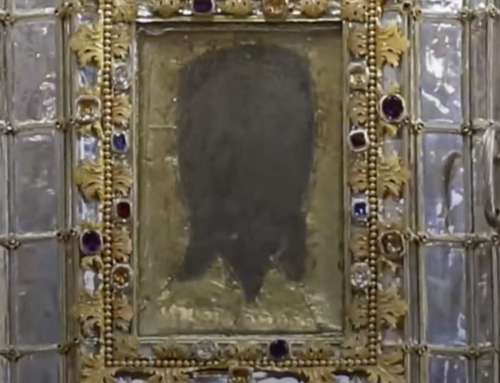
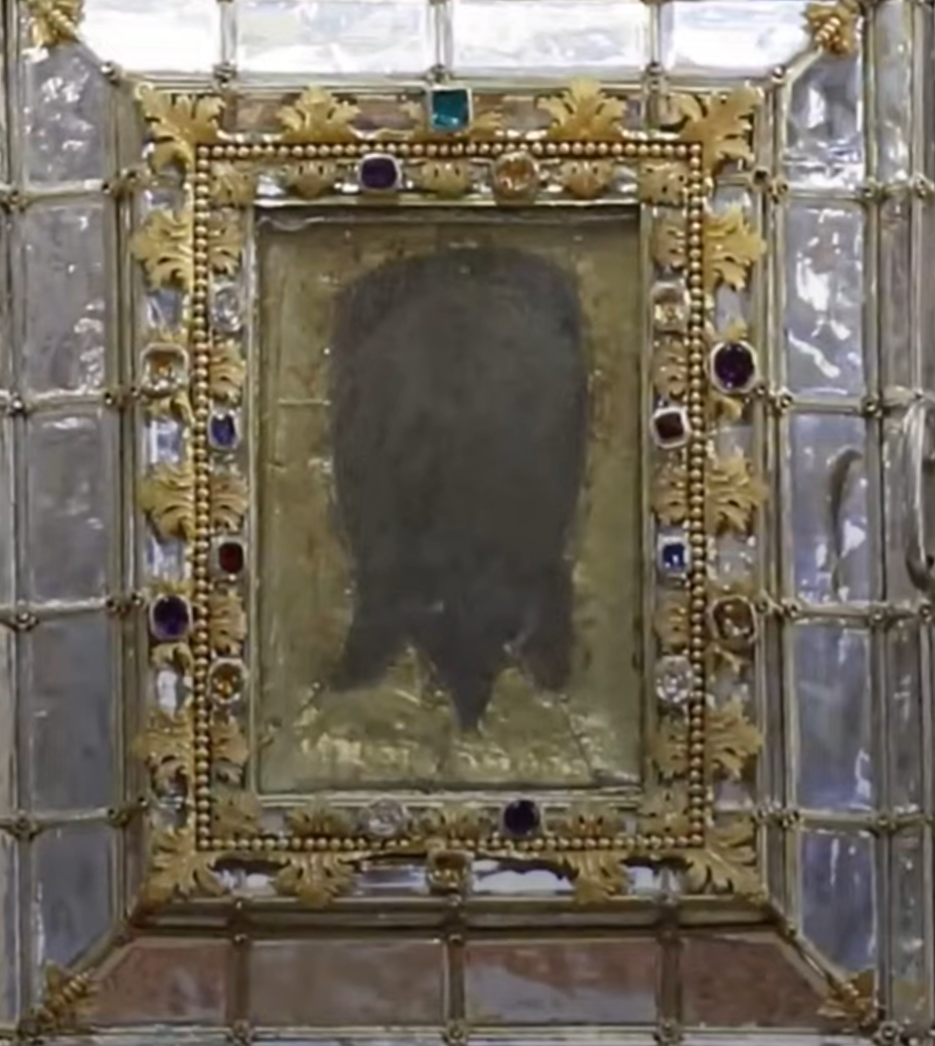
This precious picture, sent from Rome to the Nuns of Montreuil, still exists in the Cathedral of Laon.
It is portrayed in wax, upon a panel of pine wood, hollowed out like a basin and square in form.
Despite the ravages of time, the Face of the Christ astonishes and impresses the beholder; the delicate features, of an oriental type, with full lips and serious expression, the deep set eyes, the uniform coloring of the divine Face, all give to the physiognomy a calm, grave, even severe expression. If it be contemplated, for but one moment only, it is difficult not to feel profound emotion.
We can easily imagine what was the joy experienced by the Abbess and the Nuns of Montreuil on receiving the divine Effigy. In obedience to the wishes expressed in the letter which accompanied it, they treated it with “devotion and reverence,” redoubling their austerities and their love of penitence at the sight of so complete a model of charity and of expiation.
But such a treasure as this was not destined to remain hidden in the obscurity of a cloister. Providence was about to render it an object of respect to the whole country.
Dom Thierry de Brabant, the Cistercian Abbot of the monastery of the Dunes, in Flanders, having occasion to dedicate a new church, invited to the solemnity several of the neighboring bishops, and amongst others those of Thérouanne and Tournay. In order to enhance the splendor of the ceremony, he begged the abbess of Montreuil to confide the Holy Face to him, in order that it might be solemnly exposed during the festival. Upon his promising that the separation from her beloved treasure should be of short duration, the Abbess gave her consent. Soon the news was spread far and wide, and from all the neighboring country the people flocked in crowds, not so much to assist at the ceremony of the dedication, as to see and honor the Holy Face, with the miraculous origin of which they were doubtless acquainted. Heaven recompensed the faith of the multitude. “During the night which preceded the solemnity, the Holy Face appeared surrounded by a miraculous light which cast its rays upon the whole of the adjacent country, and the next day, by looking at it for only a moment, the sick and infirm were instantly cured(3).
The tidings of these marvels, being swiftly promulgated, augmented the enthusiasm of the faithful, and when the Abbot of the Dunes, after the dedication of his church, sent back the sacred Effigy according to his promise to Montreuil, the people eagerly hastened thither to contemplate it. There was, in fact, such a great concourse that, to satisfy the devotion of the pilgrims, the Nuns were obliged to expose the Holy Face in public on the high altar of their convent.
This pious movement increased with the lapse of years, and gave birth to numerous associations. Thus, several confraternities were founded in honor of the Holy Face, amongst the principal of which were those of Mons, of Avesnes, of Quesnoy, of Landrecies and of Soignies. At Montreuil, the Nuns instituted a special feast for the Holy Face, which was fixed for the Sunday after the octave of the holy Apostles Peter and Paul, it being about that time that the venerable Effigy arrived from Rome. This feast was celebrated by a mass and a proper office. The confraternities of the towns of which we have just spoken went there in procession every year, which was the reason why, in order to satisfy the piety of all, two additional Sundays were added, which were subsequently styled the “Sundays of the Processions.”
The people flocked to these annual reunions from Thiérache, Flanders and Hainault, being attracted to Montreuil both from gratitude for favors which had been received and from the desire to obtain new graces.
During the epidemics which at a certain epoch were frequent and terrible in the country, the relics of the Saints were exposed, and carried in their reliquaries through the streets, and the Holy Face of Montreuil was also borne in procession through the cities invaded by the plague. Thus, on the 2nd of September 1495, it was taken to Saint-Quentin; from Saint-Quentin it was transported, on the 4th of the same month, to Moy, where it was placed in the chapel of the chateau, and many cures were obtained. On the 5th of September it made its appearance at La Fère, and on the 28th at Crépy-en-Laonnais. In 1496, Ribemont was attacked by a terrible pestilence, and the holy Picture was taken thither to give confidence and hope to the people in the midst of their trials.
These public calamities were followed by a space of about three centuries, during which period the country was almost unceasingly a prey to another scourge which was not less dreadful than the preceding ones. It was the war which France had to sustain successively against Burgundy, England and the Low Countries. More than ten times the Nuns of Montreuil were obliged to leave their convent and to abandon it to pillage or conflagration. This is the reason why there is a complete absence of information with regard to these religious down to the seventeenth century.
We know, however, that in 1628, the feast of the Holy Face was still celebrated at the convent with great pomp. The Confraternities affiliated to the original Confraternity had each of them their banner, with which they marched in good order, accompanying the miraculous Face, which was carried in procession under a canopy held by four priests. They halted at a pavilion in the cemetery, where a sermon was preached, and the concourse of people was so great, that the officers of the Duchy of Guise were obliged to be present in order to prevent disorder(4).
During the contests waged by France against the house of Austria, and in the midst of the invasions and bloody wars which carried rapine and conflagration into the countries of the North, the Religious of Montreuil retired at first to Crépy-en-Laonnais, where they possessed a farm; then to the provostship of Chantrud, a dependency of the abbey of St. Martin of Tournay, and lastly to a hospital of a suburb of Laon, called Neuville. It was a consolation that they were able to preserve and carry away their dear Holy Face, without the precious treasure having ever been taken from them in the midst of so many other losses which they had to suffer. Their ancient abbey in Thiérache having been ruined and reduced to ashes, they called their new residence by the name of “Montreuil-sous-Laon,” the name which it still bears, but which the people substitute often by that of the “Holy Face.”
Exposed to the piety of the faithful, the Effigy of the Savior became anew the object of general veneration and the center of fresh confraternities. Nevertheless these confraternities did not come in procession to Montreuil as those of former days had done, because of the distance they had to traverse.
But the habit of making pilgrimages was still retained, and miracles were granted as in former times. These miracles, if we may believe the historians of the seventeenth and eighteenth centuries, were frequent and numerous; minutes, pictures and other pieces of documentary evidence preserved, either in the church or the abbey, furnished authentic proof of the facts adduced. Unhappily we are deprived of these documents, which were destroyed during the Revolution. Notices dating from the years 1628 and 1722 state that there were very few years in which some miraculous cures did not take place. At the same time the worship of the Holy Face was encouraged by the Sovereign Pontiffs. Thus Alexander VIII., in 1681, and Innocent XI., in 1684, granted to it numerous indulgences.
As had been the case at Montreuil-les-Dames, the offices were always celebrated with solemnity, and the faithful betook themselves to them with the same confidence, above all, on the “procession Sundays.” The mass of the Holy Face and the complete office exist, as printed at Laon in 1719. “The feast of the Holy Face,” it is stated in the preface to the book, “is celebrated on the Sunday which is nearest to the octave of the holy Apostles Peter and Paul, and on the two following Sundays when there is a plenary indulgence.” This office, written for the Religious of Montreuil-sous-Laon, is approved by the Abbot of Cìteaux; it is composed of passages taken from the Scriptures and the Fathers, and of an office of St. Veronica, which was celebrated at Saint-Eustache in Paris. The different editions of the office include the Litanies of the Holy Face, also taken from the Scriptures, and divided into three parts, probably for the use of the processions.
During the Revolution, in 1792, the Religious were driven away from their convent, and forced to abandon all which constituted its riches, the sacred ornaments, and above all, their ancient Holy Face. Transferred, at first, to the parish church of Neuville in consequence of the demand made for it by the inhabitants, the precious Effigy was sacrilegiously taken away in 1793, and conveyed to the district of Laon. Serious dangers threatened it, but a faithful and courageous administrator of the district succeeded in withdrawing it from the notice of the agents of destruction by biding it under some papers at the bottom of a cupboard where it remained until 1795, when it was transported to Notre-Dame de Laon.
An episcopal ordinance published by the Bishop of Soissons, and dated the 8th of August 1807, recognizes its authenticity, and permits it to be solemnly exposed to the veneration of the faithful. It even appears that, in conformity with the said ordinance, the office of the Holy Face was celebrated during a certain period in the cathedral of Laon. Mgr. de Villèle granted, in 1820, an indulgence of forty days to all those who should piously visit the venerable Effigy.
In 1838, the archpriest of Notre-Dame made praiseworthy efforts to withdraw it from its obscurity. It is still remembered that at Laon, in 1806, after a solemn triduum, preached with the greatest eloquence by the Rev. Father Lavigne, a question arose of reestablishing the pilgrimage and of honoring the precious Relic with special homage(5).
In 1880 and 1881, the procession, formerly made on the Sunday following the octave of the feast of St. Peter, look place in the cathedral of Laon, in the midst of a numerous assembly of the faithful. Every thing then leads one to hope that the devotion to the Holy Face will resume the ancient splendor which, during so many centuries, it enjoyed in these localities.
(1) This notice has been drawn up from a learned pamphlet on la Sainte Face de Notre-Dame de Laon (1881), which the author, M. l’abbé Ant. Lecomte, has kindly placed at our disposal.
(2) This recital is taken from a Notice published at Soissons in 1321, and which seems to be only an abridgment of a more considerable work published at Rheims in 1628, under the title of Rayons éclatants du Soleil de justice, with the approbation of MM. Porreau and Lallemand, doctors of the Faculty of that city.
(3) Dom Jean-Baptiste de Lancy: Historia Fusniacencis caenobii ordinis Cisterciensis, etc. Landuni, 1671.
(4) M. S. Claude d’Éleu.
(5) The Rev. Father Lavigne was for a long time acquainted with M. Dupont; there is no doubt that, at this period, the eloquent preacher was inspired with thoughts for which he was indebted to the holy Man of Tours.