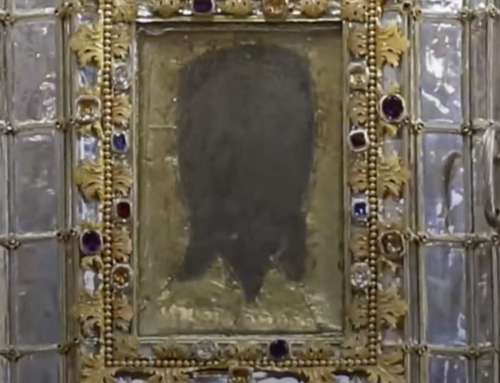
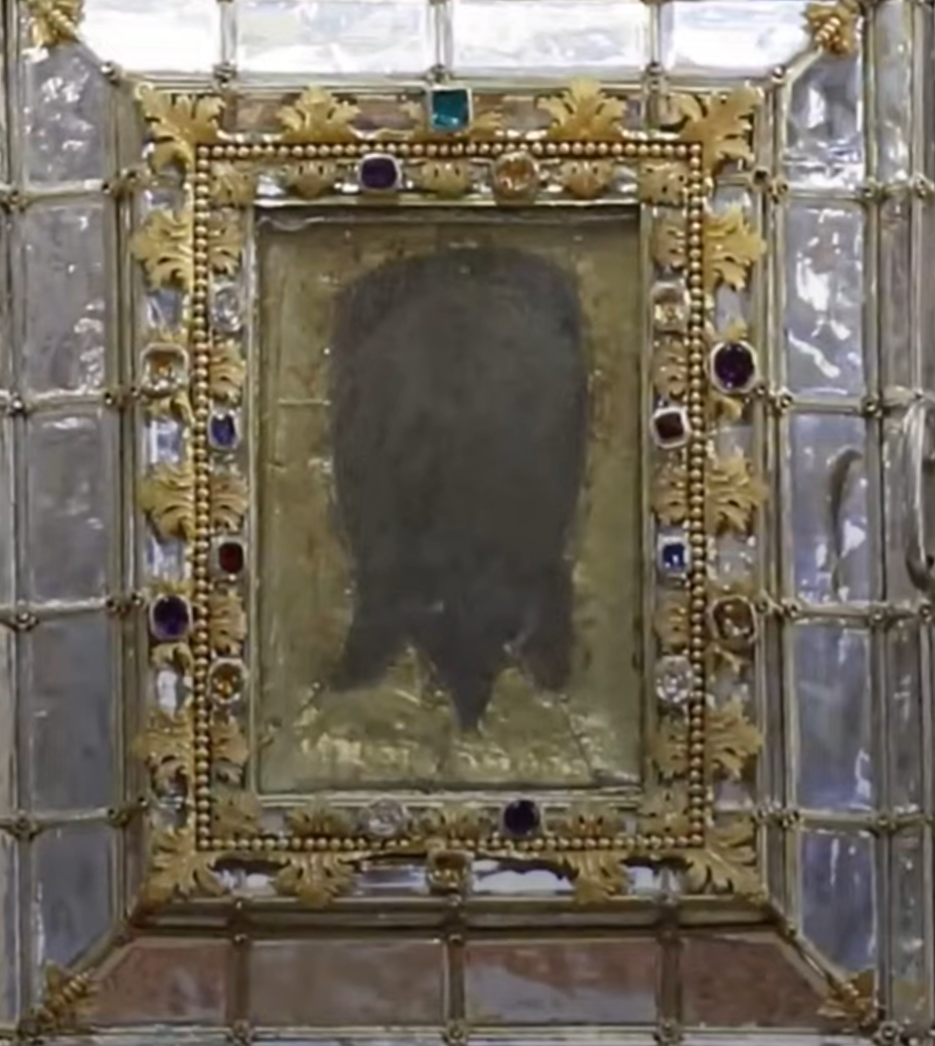
The Holy Face of the Vatican.
The worship of the Holy Face of our Lord Jesus Christ, as approved at Rome, and as practiced throughout the Church, began on Calvary. It dates from that pious woman whose remembrance has been attached, from time immemorial, to the sixth station of the Cross, and which tradition agrees to call by the name of Veronica. Before recounting the heroic act which has reordered her so celebrated and describing the worship which has for its object the miraculous imprint made upon her veil, we think that it will be useful to retrace, in a few words, the story of her life. We shall then state how the relic left by her to the Roman Pontiffs has been honored in the church of St. Peter at the Vatican, and religiously preserved down to the present day.
I
The name of Veronica is not to be found anywhere in the Gospels; but in all probability the woman so designated is no other than the one of whom St. Luke speaks (Ch. VIII., 43, 48). He represents her to us as afflicted, during twelve years, with an issue of blood which no physician had been able to heal. But “she came behind Jesus, and touched the hem of His garment,” and felt immediately that she was cured. After the question put to her by the Savior, and which gave her an opportunity to proclaim her belief in His power, she deserved to hear His divine mouth pronounce the words— “My daughter, thy faith has saved thee; depart in peace.”
Trustworthy authors affirm the identity of this fervent Israelite with Veronica. Their opinion is founded upon a document taken from three very ancient Missals— firstly that of Milan called the Ambrosian Missal, secondly the one entitled the Missal of Jaen, in Spain, and thirdly the Missal of Aosta. In this document, in the mass of the feast, which is fixed for the 4th of February, St. Veronica, who wiped the Face of our Lord, is invoked in the prayers, the divine Picture is adored in the Prose, and the Gospel is the very one in which St. Luke relates the cure of the sick woman(1).
“It is probable,” Father Ventura remarks with regard to this subject, “that she who received from the Savior the distinguished favor of wiping with her own hands the sweat and blood from His divine Face, is the same woman who touched His garment with an heroic faith, and, in so doing, rendered a most beautiful testimony to His divinity.”
Full of gratitude, the happy Israelite so miraculously cured, devoted her life to the service of her liberator. She attached herself to the footsteps of Jesus, and followed Him together with Mary Magdalen, and the other holy women of Judea who accompanied the divine Master and assisted Him in His material needs, whilst He went with His apostles from town to town, from village to village, preaching the Gospel, and announcing the Kingdom of God. She was with the Savior, it appears, on Palm Sunday, when he made His triumphal entry into Jerusalem; it is even supposed that she had the courage to appear before Pilate, and, together with several other witnesses of His miracles, to make a deposition in His favor.
It is, at any rate, incontestable that she went to meet him on the path to Calvary. A modern historian, Dr Sepp, recounts the tradition in this manner— “A woman named Berenice or Veronica draws near to Jesus with a compassionate expression on her countenance, and with a handkerchief wipes His Face covered with sweat, in such a manner that the adorable Face remains imprinted on it with its bleeding features.”
And here is a more detailed account of the same event as given by the erudite Piazza and other equally learned authors— “After Jesus had quitted the praetorium of Pilate, laden with His Cross, and covered with the blood issuing from the wounds he had received during the flagellation and from the Crown of thorns, and had proceeded four hundred and fifty steps on the path to Calvary, He approached a house which stood at the corner of the street”(2). Veronica then, perceiving Him from afar, came, full of compassion, to meet Him, and having removed the veil which she wore on her head, she presented it to Him that He might make use of it to wipe His Face, all bathed as it was with blood and sweat. Christ, having benignantly received it at her hands, gave it back to her afterwards, leaving upon it, as a gracious recompense, the impress of His holy Face. The resemblance was so complete, that it is even possible to perceive the mark made by the hand which dealt Him a sacrilegious blow. Rejoicing over the possession of so precious a treasure, the illustrious lady preserved it in her house with jealous care.
Her traditional name of “Veronica” would seem to have had its origin in this memorable action. Its meaning is “Victorious,” and it is composed of two Greek words which signify— “I obtain the victory(3).” The glorious epithet of “Veronique,” or Veronica, is frequently met with in the odes of Pindar, who, employing it in the masculine gender, applies it to the victor in the Olympian games. Certain Greek historians also use it in the feminine gender as the designation of illustrious princesses or celebrated towns. It passed from thence into the Christian history of the first centuries of the Church, where it is attributed to saints, to virgins and to martyrs of different countries. The Latins, in transferring it to their language, most probably gave it to the Jewish woman of whom we have spoken, at the time when she came to the West.
Certain learned men of the last century have endeavored to form the name in question from the Latin word vera, true, joined to the Greek word icon, image (true image)— in this way endeavoring to appropriate to a person, in the quality of a proper name, the name and the quality of the “image.”
This hybrid combination does violence to all the laws of philology and is not worthy of acceptance. On the other hand, the etymology which we have adopted is much more natural, and agrees perfectly well with the rules of language and the data of history. It is true that sometimes the name of a thing is given to a person, and that, speaking, for example, of the pictures of the Holy Race, we call them “Veronicas;” but the name itself, the personal name of Veronica, belongs to the holy woman in question, and will forever remain hers as a testimony to the everlasting and pious gratitude rendered to her, by posterity, for her heroic conduct towards the Savior on the path to Calvary.
One of our old ascetic authors, full of admiration for this sublime act of Veronica, does not hesitate to place it above even the most sublime examples of virtue which the world has ever witnessed. “Heroic woman” he exclaims, “thou art incomparable, thou hast no equal upon earth! At the very time when the whole universe conspired together against the life of its Savior; at the very moment when God the Father abandoned Him into the hands of sinners, and when the angels of peace wept bitterly over Him, without being able to give Him any succor; at the very hour when the apostles forsook, betrayed and denied Him; at the very time when His dear mother; the blessed Virgin, by fainting away had profoundly afflicted Him; at the very time when the whole of the city of Jerusalem demanded His death and crucifixion; at the very time when it was a crime and a sacrilege for the Jews to recognize in Him a holy man, thou didst revere Him as thy Messiah, thou didst adore Him as thy God, thou gavest Him refreshment and consolation in the midst of his greatest enemies. Thou didst, of a truth, merit an immortality of glory both in time and in eternity, and, therefore, the Savior made thee the most precious gift which he has ever bestowed on any earthly creature, for He gave thee His portrait impressed on thy veil. Spread it then in sight of the four portions of the globe; make all men behold the piteous and disfigured Face of a suffering God. Preach by means of the holy Effigy the passion of Jesus Christ, and make it to reach far beyond the places to which the apostles extended the knowledge of it. As for me, I promise that I will venerate thee during the whole of my life, because of this heroic act of thy charity, and, whether living or dying, I will bear in mind the remembrance and in my mouth the name of the incomparable Veronica(4).”
An author of the seventeenth century contemplates Jesus bearing His cross, and addresses Him in these words— “Why is it not permitted to me, oh Jesus, to gather, up all the blood which Thou didst shed when going to Calvary, or why could I not at least treasure in my bosom the drops which the pious Veronica collected in her veil?… Oh, happy Veronica, how richly you were recompensed for the compassion you showed for my divine Savior I Hardly had you wiped away the blood, the sweat and the tears which ran down His Face, than He left upon your veil the impress of His adorable features, to show us that He gave Himself to you in gratitude for your zeal, and to teach us that He gives Himself to those who, imitating you, assist Him in the person of the afflicted. Happy Veronica, whose ready help was not less agreeable to Jesus Christ than that of Simon, though it might have seemed less useful, but He looks only at our intention in all that we do for Him.
“How good art Thou, divine Redeemer! Thou wert willing to be assisted by a woman as well as by a man, to show us that no one is exempt from a participation in Thy Passion; and also to teach us that Thou hast regard to the delicacy and weakness of even the feeblest amongst us, and that, in order to please Thee, it is sufficient to pity Thy sufferings, and with St. Veronica to feel them in our hearts, when we cannot share them with Simon the Cyrenean, or bear the marks of them on our body like St. Paul. It was Thy love, oh my God, which impressed a semblance of Thy Face upon the veil of Veronica, that thou mightest gain her heart; it was Thy love which, to recompense and at the same time to satisfy the tenderness she had conceived for Thee, gave to her Thy heart, so to say, with Thy Face, that she might know that Thy charity was the cause of Thy sufferings, and that she might feed her love for Thee by gazing upon Thee, even during Thy absence.
“Yes, my Savior, Thou didst give Thyself to Veronica on her veil, that she might have joy in Thee spite of Thy absence, in the same manner, almost, that Thou dost give Thyself to believing souls, through faith, which, like a sacred veil, covers the eyes of reason, that by means of it they may behold Thee and consider Thee as in a figure, during this life until they possess Thee really in eternity(5).”
The place where the act performed by Veronica took place has been venerated as much as the name of the heroic woman. Bernard de Breydenbach, Dean of Mayence, states that “he traversed, on the 14th of July 1483, the long road by which Christ was led from the palace of Pilate to the place of crucifixion, and that he passed before the house of Veronica, which was five hundred and fifty steps distant from the palace of Pilate.” Adrichomius of Cologne describes the localities with still greater precision.— “The house of Veronica,” he says, “stands at the corner of a street… From the place where she met the Christ to the Judiciary gate, where He fell for the second time beneath His cross, He had traversed a space of three hundred and sixty-six steps and eleven feet.”
In a bull of the 16th of the calends of August 1561, Pius IV. “confirms and ratifies the indulgences inscribed on a very beautiful tablet kept near the Holy Sepulcher of our Lord Jesus Christ”. Sixtus V., Benedict XIII., Gregory XVI, successively recognized and published them. Now, upon this tablet, in the nomenclature of holy places to which these indulgences are attached we read— “In the house of St. Veronica there are seven years and as many quarantines”, Consequently, this station has been preserved in the exercise known by the name of “The Way of the Cross.” The Holy See, being questioned on the subject, declared that under no pretext whatever is permission given to modify the stations, and the tablet which is published thus determines the sixth in the following manner— Veronica wipes the Face of Jesus. Now, where is the church which has not its Way of the Cross, and which does not thus present Veronica before the sight of all men as a model of reparation and a powerful advocate with the sorrowful Face of Jesus?
The miraculous veil, impressed with the features of Jesus, could not be allowed to remain as private property. It was a gift of Jesus Christ to his Church, a relic destined for the center of catholicity. Therefore, Veronica took it to Rome. On account of its importance and of the curious incidents attached to it, this fact claims special study.
It is in this manner that the learned authors Philip of Bergamo and Piazza, recount the event.
“Veronica was summoned to depart from Jerusalem and to go to Rome with the Sudarium of Jesus Christ, at this epoch, by order of Caesar and by the intervention of Volusian, a valiant soldier and well known at court. The Emperor was confined to his bed with serious illness. He had been informed by Pilate of the great marvels wrought by Jesus, and he had sent ambassadors to Judea in the hope of obtaining a cure. The messengers found that Jesus had been already crucified. When the Jews sought to deceive them by relating the fable of His body having been carried away by His disciples, Veronica contradicted their falsehoods, and, showing the messengers the impression of His most Holy Face upon her veil, offered to go with them to Rome, promising that, on seeing it, the Emperor would be cured. Having then placed the precious veil in a reliquary, she embarked with the ambassadors, and arrived at Rome, where she was presented to the Emperor. As soon as he had received the holy woman, and had touched the effigy of the Christ, he was completely cured. In consequence of this miracle, Veronica was held in great esteem by the Emperor.”
Sandini gives the same recital in his History of the Holy Family, and describes the malady with which the Emperor was afflicted. It was leprosy. This miracle is also related by Ferrari in his Catalogue of the Saints of Italy.
However astonishing the fact may appear, it very clearly explains what trustworthy historians, such as Eusebius, Paul Orosius and others, say of the conduct of Tiberius with regard to Jesus Christ and His religion. Informed, they relate, by Pilate of the death, of the resurrection and of the miracles of this extraordinary man, the Emperor desired to place Him amongst his gods. The Senate, they add, irritated at not having been first informed, as was their right, by the Roman governor of his intention, and angry at not having been even consulted by the Emperor, rejected the proposition and decreed the extermination of the Christians. Tiberius revenged himself by menacing with the extremest torture whoever should denounce them, and by condemning to death or exile all the senators, with the exception of only two amongst them. He limited himself, however, to raising a statue to the Savior in the interior of his palace, in the place called the “Lararium” where the household gods styled Lares were honored. With regard to the officer in the Emperor’s service who was charged with the mission of bringing Veronica to Rome, the author of Flowers of the Saints, as well as Philip of Bergamo, call him Volusian, and the prefaces of the Ambrosian Missal, when mentioning his name, add that he also was healed of an infirmity of long standing by means of the miraculous veil. ‘’ Mention was formerly made of him, says Sualdi, in the church at Milan, on the feast of St. Veronica, which was solemnized on the 4th of February. On that day, remembrance was made of Veronica and Volusian, not only in the canonical hours, but also in the mass, which contained a special preface where Volusian was mentioned. The same personage is also represented in the pictures of modern date, it is true, which at the present day ornament the crypt of St. Peter’s at Rome. He is moreover spoken of in two ancient books contained in the library of the Vatican. In the first, written at the time of Pope Alexander III., in 1160, it is stated that Volusian was a friend of Tiberius, and that, sent by him to Jerusalem, he had brought back Veronica and the Sudarium.
Whoever may have been, however, the ambassador, he only plays a secondary part here. The main fact, that is to say the translation of the Holy Face, is attributed to Veronica by the most trustworthy authors, notably by mystical writers such as Lanspergio and Mallonius; by theologians such as Gretser and Suarez; by historians such as Stengel and Paleoti; by hagiographers and archaeologists such as Galesinus, Gervais and Biondo. Calcaginus, quoted by Sandini and reproduced by archdeacon Pamelius, gives his appreciation of the fact in the following terms— “The effigy of Christ, which tradition states to have been given to Veronica impressed upon the Sudarium, still exists, and is held in so great veneration, that not only miracles, but even the mere sight of the picture prevents any doubt from being entertained in regard to it.” Molanus strengthens this quotation by the opinion of Alberic, who, in his dictionary of the year 1350, holds the same language. “There is in the library of the Vatican, adds the Belgian author, a history of the translation of the effigy in question to Rome, under Tiberius, which is edited in a trustworthy manner, and of which the handwriting is very ancient in character. The celebrated English theologian, Thomas Stapleton, informed me that he had read the whole of it.” Baronius confirms the existence of’ this precious manuscript and he then says— “In the church of St. Mary of the Martyrs, there is preserved with the most jealous care, at the altar of the Crucifixion, the worm eaten remains of a wooden coffer which was used for the transportation of the holy Relic.” Mgr. Barbier de Montaut, copied, in the above named church, the inscription which attests how the holy Sudarium was brought in the hands of Veronica from Palestine to Rome. Struck by so general an agreement, the Bollandists formulated these two conclusions— “That the Sudarium was given to St. Veronica is accepted by orthodox Christians without hesitation. That Veronica herself conveyed the holy Picture to Rome is the unanimous opinion of all writers on the subject.”
Let us here observe with Baronius(6) that the veil used by Veronica and which she placed upon the face of the Christ covered with sweat and blood, must not be confounded with the most holy Sudarium, which is kept at Turin, and in which the adorable body of the Savior was enveloped and buried, or with the other linen cloths with which His Face and head where covered in the Holy Sepulcher.
The Latin word Sudarium signifies a handkerchief used for wiping away sweat. Such is the original meaning of the word, which Bergier thus defines in his Theological Dictionary— “A piece of linen or a handkerchief used for wiping the face.” The action of Veronica is explained by the Jewish women being accustomed to wear on their heads or necks a woolen or linen veil, which they hastened to offer to persons of their acquaintance whom they might chance to see with their faces covered with sweat or bathed in tears.
In pagan times, it was also customary to present a veil to criminals condemned to death. This was done from a feeling of compassion, or as a sign of the interest taken in them. The veil was intended to dry their tears with and to cover their heads at the moment when they were about to be executed. We read in the life of St. Paul that as he was being led out of Borne, in order to be beheaded, and had arrived at the gate of the city, accompanied by a great crowd and in the midst of the people, he saw a lady, called Plautilla, who seemed to be very sorrowful and desolate; whereupon he asked of her a veil with which to make a bandage for his eyes (as was usual in the case of those who were to be beheaded), at the same time promising that it should be returned to her. She gave it to him willingly, and the apostle, on the following night, appeared to her and restored her veil(7).
Veronica, therefore, did nothing more than conform with a custom which at that time was looked upon as usual; but is was nevertheless necessary for her to brave the fury of the soldiers and the insults of the maddened crowd. Therefore, she deserved that the Savior, touched by her devotion, should leave to her His holy Effigy as a sign of his eternal love. Her heroic action will be for ever glorified throughout all ages; and pious souls will not cease to bless her for the service and the honor rendered to Jesus in His sorrowful Passion.
It is said that Tiberius, after his cure, wished to heap favors and riches on his benefactress. But she refused all the offers of the Emperor, knowing well that she possessed a treasure compared with which everything besides was as nothing. She kept it with the utmost care and, afterwards, it became the inheritance and the treasure of the Church. All who testify to it, in fact, are agreed in saying that she gave the “veil” to St. Clement, who was at that time the assistant and the coadjutor of St. Peter and who later on was his third successor.
Did St. Veronica die at Rome? Ferrari seems to say so. Pierre Galesinus gives her a place in his martyrology as having finished her days “in the very city to which she brought from Jerusalem the Face of the Lord.” According to this opinion, it is thought that she was buried in the interior of the Vatican Basilica, not far from the august Picture itself. Nevertheless, neither her tomb nor her body is pointed out in a precise manner.
Did she die at Jerusalem? The revelations of Catherine Emmerich declare that she did, but even allowing these revelations, which after all possess but little historical value, to be true, still although the house of Veronica is shown at Jerusalem, no mention is anywhere made of her having been buried there.
Did she die in Gaul? It is so attested by a tradition, centuries old, belonging to the southern provinces of Gaul, and therefore worthy of attention for a moment. This tradition, it must be observed, rests upon the authority of the Dominican Bernard de la Guionie, Bishop of Lodève. After having referred to the apostolic mission of St. Martial, in the year 47 of our era, the historian adds that “this same St. Martial, coming from Aquitaine, had with him a man of God, called Amateur, and his wife, whose name was Veronica. Amateur, cherishing a special predilection for solitude, remained for a long time in the hollow of a rock which was afterwards known as Roc-Amadour. His body is there venerated. As to his wife Veronica, who faithfully followed the blessed Martial everywhere in his preaching, and who listened to him with as much piety as devotedness, being at last overtaken by old age, she retired to the borders of the sea in the Bordelais territory. There the holy man of God, Martial, raised and consecrated, in honor of the blessed Virgin Mary, a chapel which bears the name of Soulac, because the milk of the Blessed Virgin was the only relic placed there, the other relics of the Blessed Virgin which Martial possessed having been distributed in various places.”
This recital has been handed down to our own days as being the expression of a general belief. In 1485, Pope Martin V., declaring that the church of Roc-Amadour dates back to the foundation of Christianity, states that St. Amateur was no other than Zacchaeus, the disciple of Christ, and that Veronica was his wife. In the seventeenth century the breviaries of Limoges, of Toulouse, of Bordeaux, of Cahors, of Carcassonne, of Tulle, of Agen, of Angoulème and of Périgueux, preserved the whole substance of the ancient legends relative to the facts which we have just related.
According to Father Bonaventure, who wrote in 1680, “St. Veronica died in the year 70, A. D. and was buried at Soulac. Nevertheless, on account of wars and other disturbances, her body was translated to Bordeaux and reposes in the church of St. Scurin”. This translation took place about the ninth century, during the ravages of the Normans. For a long time the feast of the Saint, occurring on the 4th of February, was celebrated at St. Seurin. The aspect of her body indicates great antiquity. One fragment is wanting; it is the femoral bone of the upper rib; the reason of it is known and is as follows. When an inventory was made of the relics of St. Seurin, on the 40th of October 1659, this fragment was given by the chapter of Bordeaux to the parish priest of St. Eustache at Paris, who had in his parish a celebrated confraternity established under the name of St. Veronica.
Not long ago, in February 1882, Cardinal Donnet, Archbishop of Bordeaux, wishing to give a relic to his friend Mgr. Bellot des Minières, Bishop of Poitiers, ordered this ancient tomb to be opened. A commission of enquiry had been named, and a minute and careful examination was made of the bones. Their state enabled the great age of the subject to be verified, and it was calculated that, at the time of the Passion and when she received the ineffable impression of the features of the Savior, Veronica must have been about 50 years old. At the age of 64 or 65 she must have gone with the mission to Gaul, where she died on the shores of Notre-Dame de la Findes-Terres, at about the age of 87.
Such is the tradition followed by the Churches of Aquitaine. It has been ably sustained at the present day in several remarkable works(8). Nevertheless, between Rome, which asserts that Veronica died within her walls, and Bordeaux, which claims her body, we cannot pronounce any certain decision. The question, moreover, belongs only indirectly to our subject, and it suffices us to know that, according to the testimony given by the whole body of authors, the veil of Veronica remains in the eternal City. It is at Rome consequently that we may fix our starting point in order thence to follow the successive phases of the cultus rendered to the precious Effigy.
II
Pope St. Clement, the third successor of St. Peter, ruled over the Church from the year 93 to 102, A. D. The sacred Relic which Veronica desired should be given into his care, was transmitted by him to his successors who, during the era of the persecutions of the Church, kept it with the greatest secrecy(9).
With regard to specifying in what place, after peace had been secured to the Church, the Relic was at first placed, writers on the subject have not arrived at any agreement. Some think that it was deposited in the basilica of the Vatican, after it had been constructed by Constantine the Great, and consecrated by Pope St. Sylvester. Others indicate the church of St. Mary of the Martyrs, the ancient Pantheon of Agrippa, as being a place well fortified and therefore very secure, seeing that it was situated almost in the center of the inhabited portion of Rome, and at the same time was vast enough to receive the crowds of people who resorted there on certain days to honor the effigy of the Savior, whilst on the other hand the basilica of St. Peter, which for a long time was outside the walls, did not offer the same security. Those who hold the latter opinion also affirm that the Holy Face was venerated at St. Mary of the Martyrs as early as the year 610, A. D., and during the reign of Boniface IV., who officiated at the dedication of the celebrated temple. They state that it began to be exposed solemnly at that time on the high altar on the 13th of May, the anniversary of the memorable dedication, in 608, A. D., on which day the Sovereign Pontiff translated thither, upon twenty-eight funeral carts, the bodies of holy martyrs which had been taken from the catacombs.
There is still preserved, in the above named church, the remains of the coffer or reliquary in which the sacred Picture was enclosed. We have already referred to what Baronius has said respecting it. A careful examination of the remains of this coffer shows that formerly ten locks were attached to it. The keys were confided to the ten ancient Rioni, or quarters of Rome, in such a manner that the holy Relic was placed under the care of the whole city, and the reliquary could not be opened, except in presence of its representatives.
These precious remains are now enclosed in an urn and placed under a glass upon the table of the altar of the Crucifix, in a hollow of the wall; and on it is the following inscription— “The coffer in which the sacred Sudarium was taken from Palestine to Rome by St. Veronica. It shed luster on this basilica during one hundred years.”
It appears that St. Veronica, the better to preserve the Holy Face, enclosed it in two coffers or reliquaries, one of which is that of which we have just spoken. The other is venerated in the church of Saint-Éloi-des-Serruriers. Piazza Vasi, in his Itinerary, and several other authors think that this latter was the inner reliquary or coffer.
As to the preservation and the veneration of the Holy Face in the Vatican Basilica, the most trustworthy writers on the subject, and the most competent authorities prove that John VII. in the year 707, A. D., having constructed for “the Blessed Virgin of the Crib” an oratory which be desired should also be the place of his sepulcher, raised an altar there in honor of “the Holy Sudarium of Jesus Christ, called the Veronica,” and placed the Holy Face in a large and beautiful tabernacle ornamented with marble pillars; the chapel itself also received the same title and was known as “St. Mary of the Sudarium,” as is evident from a document of the year 1017, A. D., in which John VII. is styled clerk and chaplain of St. Mary of the Veronica. Torrigio, in his Holy Vatican Grottoes, speaking of the tabernacle, which contains the effigy of our Lord, is not afraid of calling it “the Holy Of Holies”. The same historian also says that under Adrian VI. “double locks were affixed to the tabernacle.” It was, moreover, surrounded by a balcony from which the Holy Face was displayed in sight of the people. Mabillon(10) speaks of a Roman Ceremonial Hook of the year 1130, A. D., in which it is said— “Then the Pontiff goes to the Sudarium of Christ, called the Veronica, and incenses it(11).” Alveri affirms, together with other authors, that, in the time of Pope Innocent II., six noble Roman families were appointed as guards of the Holy Face, and had under their charge the reliquary in which it was enclosed. In his “History of remarkable Objects belonging to the Vatican Basilica,” dedicated to Alexander III., 1159, A. D., Mallio attests the special veneration which the Holy Face enjoyed at that epoch; ten lamps being kept burning before it day and night(12).
Medals also existed and were called “Veronicas.” They bore the effigy of the Holy Face with the crossed keys of St. Peter on the obverse side; pilgrims, full of confidence in these pious objects, attached them to their hats and to their coats. So great was the veneration professed for the august Effigy, that it was often represented on Pontifical coins, which on that account were styled— Signum Veronicas(13). Scilla, in his work on Pontifical Coins, gives several specimens of them stamped with the effigy of the Holy Face.
Cancellieri, in his Memoirs respecting the Heads of the Holy Apostles Peter and Paul, relates that, in 1193, Philip Augustus, King of France, having come to Rome, Pope Celestine III. ordered them to be shown to him together with “the Veronica, that is to say the piece of linen which Jesus Christ applied to His Face, and which has so marvelously preserved the impression of it down to the present day, that it might he believed to be the very Face itself of the Savior. It is called Veronica, the writer observes, from the name of the woman to whom the linen belonged, and whose name was Veronica(14).”
Pope Innocent III., who occupied the Holy See in 1198, A. D., had a great veneration for the Holy Face; he composed prayers in its honor; prescribing that they should be recited before the august Face, and he also attached Indulgences to their recital. Matthew of Westminster attributes to the same Pope the following incident— “He had the Holy Face, called the Veronica, carried in a solemn procession, that the people might see it. On his return from the ceremony, it was put back in its place, but on the following day it was found thrown down, with the face towards the ground. Fearing that this accident was an omen of evil, the Holy Father composed a collect in honor of the Holy Face, and granted an indulgence of ten days to those who should recite it(15).” Cancellieri(16) relates, without definitely stating the date, that the Holy Face was transferred to the hospital of the Holy Ghost, and he quotes an ancient chronicle according to which the holy Picture was placed in a small chamber, entirely constructed of marble and iron, and locked with six keys which were confided to six Roman families. It was shown only once a year, and six gentlemen, who had the honor of keeping the keys, enjoyed all the franchises of Ike city and were exempt from active military service.
If to any one of them it fell by lot to be seneschal, that is to say to assist the judges at the tribunal, he was not obliged to be present. Whenever the “ostension”(17) took place it was their duty, each one of them being accompanied by twenty chosen men at arms, to surround the Holy Relic, to accompany it to the place designated and to replace it in its chamber under lock and key. It was probably on account of, and in memory of the temporary sojourn of the Holy Face at the hospital, that Innocent III. instituted, by a bull of 1208, A. D., a procession which it was customary to make every year on the first Sunday after the octave of the Epiphany, and in which the Holy Face was carried solemnly from the Vatican Basilica to the church of the Holy Ghost, accompanied by the Cardinals and in the presence of the Sovereign Pontiff, who addressed a sermon to the people. On this occasion an alms of three denarii was given to a thousand poor foreigners and to three hundred of the said hospital. The Holy Relic remained some time in the church of the Holy Ghost and was afterwards taken back to the Vatican Basilica.
A trace of these customs is to be found in one of the homilies pronounced on that day by Innocent III. The Pope, when making allusion to the marriage feast of Cana recalled to mind by the Gospel of the Sunday, said— “We also invite to this marriage feast the Son of Mary, Jesus Christ, with His disciples, seeing that His priests are today bringing here with great veneration His Holy Face in order that the faithful people, hastening hither impelled by piety and to implore mercy, may contemplate and admire its glory according to their ardent desire. Let not one of them retire from this wedding feast without being satisfied. All who have come hither to celebrate with promptitude and gladness this solemnity will receive the indulgence of one year, and the divine Spouse, Jesus Christ, who is blessed for ever and ever, will thereby change water into wine.”
Honorius III., the successor of Innocent III., mentions this procession with the privileges attached to it in a letter addressed to the Brothers of the Hospital, in 1224— “As Jesus, he says, was invited with His disciples to the wedding feast of Cana, where His Mother also went, we consider it right to decree, since this hospital is under the protection of the most Blessed Virgin, that the Canons of St. Peter’s should convey hither the Holy Face of Jesus Christ, in its reliquary of gold and silver, enriched with precious stones, in order to show it to the faithful who may resort here in crowds for the purpose of venerating it. And in order that we who exhibit and enable others to venerate this sacred treasure, should give to our neighbor an example worthy of imitation, we grant, decree and order that alms should be distributed to a thousand poor people outside the walls of the hospital and to three hundred poor within it. This alms must consist of seventeen livres of current coin, of which sum each person will receive three denarii: one for bread, one for wine, and one for meat. These alms will be paid to you every year in perpetuity by the almoner of the Sovereign Pontiff. In addition, each of the Canons who shall have borne the Holy Face in procession shall receive twelve écus and a taper weighing one pound, which he shall carry lighted. The expenses will be defrayed out of the oblations of the Confession of St. Peter. And as man does not live by bread alone, but by every word which proceeds out of the mouth of God, the Sovereign Pontiff shall assist at this procession with the Cardinals, shall celebrate the Mass and shall address an exhortation to the pilgrims on the subject of the solemnity. Moreover, that the faithful people may not have to return fasting from this sacred marriage feast, they shall receive an indulgence of one year for the remission of the temporal punishment due to their sins(18).”
The other Popes of the thirteenth century confirmed these privileges. Later on, about 1471, Sixtus IV., actuated by just motives, abolished the procession and substituted for it another which proceeds every year, on the same day, to venerate the Holy Face in the Basilica itself. The members of the Archconfraternity of “Santo Pietro in Sassia,” which already existed in 1198 and which for some time enjoyed the honor of watching over the august Relic, doubtless succeeded to the six gentlemen of Rome. At the present day, they betake themselves processionally to St. Peter’s on the first Sunday after the octave of the Epiphany, as well as on Whit-Monday; and the Holy Face is exhibited to them by privilege. Three times a year it is also shown, by special privilege, to the foundlings of both sexes and to the ecclesiastics of the hospital of the Holy Ghost, in remembrance of the sojourn that the august Relic made there in former days.
When Boniface VIII. reestablished, in 1300, the celebration of the “holy year”, he permitted the Holy Face to be shown every Friday and on all solemn feasts in the Vatican Basilica, for the consolation of pilgrims who resorted in great numbers to Rome from all parts of the world in order to gain the Jubilee Indulgence. The same Pope made the “ostension” of it to Charles II., King of Sicily, and to James II., King of Aragon.
In 1350, Clement VI., although sojourning at Avignon, caused the second universal Jubilee to be celebrated at Rome. The concourse of pilgrims to the city, on this occasion, was immense. The Pope wrote to the Canons of the Vatican in order to recommend to them the frequent “ostension” of the Holy Face, because of the great devotion of the faithful towards so precious a relic. Louis I., King of Hungary, solicited and obtained from the same Pontiff the favor of venerating it every day.
Generally speaking, it appeared that the Sovereign Pontiffs were glad to permit the “ostensions” of the veil of St. Veronica, and to institute feasts and periodical processions in its honor. Pope Sixtus IV., in a bull concerning the election of two benefices, declares that the Vatican Basilica surpasses all the other churches of Rome and of the universe, because of its possession of the “Holy Sudarium” of our Lord, by which he means the effigy of the Holy Face. Nicholas IV., in the year 1290, observes that it is “in the said Basilica that the Lord willed that the precious impression of His Holy Face, known by the name of Veronica, should be deposited, together with the body of St. Peter and those of a great number of Saints.”
Several other Popes, such as Celestine II., Clement VII., Clement VIII. and Gregory XIII., mention the relic of the Holy Face, attest to a devotion to It which never ceases to increase, and always take for granted the existence of the heroic woman to whom the Savior gave this special testimony of his love.
Benedict XIV. brings to bear upon this subject his undoubted authority in matters of science and criticism— “In the Basilica of the Vatican,” he says, “in addition to the spear and the lance, is preserved and greatly venerated the Sudarium which has perfectly kept and still keeps the impression of the face of our Lord Jesus Christ, bathed with sweat and blood.”
More than once, in the midst of the wars and bloody revolutions of which Rome was too often the theatre, the Holy Face was translated to and placed in safety in the castle of St. Angelo. Thus, according to a journal of that date, Cancellieri relates that on “the 4th of October of the year 1410, the Sudarium of St. Veronica was taken from the sacristy of St. Peter’s to the castle of St. Angelo, that it might not be exposed to the insults of the soldiers.”
In 1450, Pope Nicholas V. had three small bells cast which gave forth a silvery and harmonious sound. They were used to announce the “ostension” of the Holy Relic, as is still done at the present day. On each of the bells are the armorial bearings of the Pontiff, with these words engraved around them— “Pope Nicholas V. made me in the year of the Jubilee 1450.” The same Pope, in 1452, after having crowned Frederic III. Emperor, and created him Canon of the Vatican, as was the custom, granted to him the special favor of being able, in canonical costume, to ascend to the tabernacle of the Holy Face, there to venerate the august Relic, and to show it to the people— a favor which was not and up to the present time has never been granted except to the Canons of the Basilica.
When Pope Innocent VIII., in 1492, received as a gift from the Emperor of Turks the Holy Lance which pierced the side of the Redeemer, he preserved it in his own chamber, proposing to himself to construct a sumptuous chapel for it in the basilica of St. Peter; but finding that his end was approaching, the Pontiff ordered that the precious Relic should be placed in the chapel of the “most Holy Sudarium.”
It was Pope Urban VIII who had the Holy Face deposited in the place which he had destined for it, under the great dome, the masterpiece of Michael Angelo, in the recently constructed basilica of St. Peter. The ceremony took place on the 23rd of December of the holy year 1025. The Holy Face and the holy Lance, which had been temporary deposited in the archives of the Basilica and enclosed in an iron coffer covered with a piece of rich damask, were carried in procession and under a canopy to the great niche known as that of “St. Veronica.” The canopy was carried by the Archduke Leopold, son of the Emperor Ferdinand III., and by other illustrious personages.
In order further to increase the veneration of the faithful towards the holy Effigy, Urban VIII. decreed that on the 8th of April 1629, there should be added to the Holy Face and holy Lance a piece of the wood of the true Cross; he also ordained by a bull that the three august Relics should always be shown one after the other, granting a plenary Indulgence to all who should be present at the “ostension”. The Sovereign Pontiff himself went there at two o’clock in the afternoon, and, prostrating himself before the three holy Relics, he venerated them with great devotion; and under pain of excommunication, he forbade, by a proclamation which was affixed to the niche, that the gauze veil which covered the Holy Face should be removed without a papal authorization. The same Pope, Urban VIII., conferred upon Wladislaus, son of Sigismund III., King of Poland, on the occasion of his making him a visit, the mantle and blessed sword in recompense for his courageous devotion to the Church. Then, by a special favor, he created him Canon of St. Peter’s, so that he might, in that quality, be enabled to venerate, near at hand, the Holy Face. The prince, clad in a surplice and rochet, ascended to the tabernacle where the sacred Effigy was kept, and was authorized to show it solemnly to the people, with the assistance of the other Canons. Seven years afterwards, having become Ring of Poland under the name of Wladislaus VII., he received from the Chapter and the Canons of St. Peter’s a letter of congratulation to which he made the following gracious answer— “We have not forgotten that during our sojourn at Rome we were aggregated to your sacred College, in order that we might be permitted to contemplate the most Holy Face of our Lord.”
Como, Grand Duke of Tuscany, came to Rome, in 1700, to gain the Indulgences of the Jubilee and to venerate the holy Effigy. Pope Innocent XIII. also made him a Canon, that he might hold the precious Relic in his hands. He ascended to the loggia clad in a violet soutane, rochet, baretta and red gloves, according to the custom still observed amongst ourselves, and after having piously venerated the divine picture, he made the “ostension” of it to the people, and blessed them with it, standing between two Canons. A picture at the Vatican represents him in canonical costume.
At an epoch nearer to our own, Pope Pius VII. permitted the King of Sardinia, Emmanuel IV. and the Queen his wife, the venerable Marie-Clotilde of France, to contemplate and kiss the Holy Face of our Lord, in the vestibule of the oratory where it is kept. A similar favor was granted by the same Pope, in 1801, to the pious Archduchess Marie-Anne of Austria, who had just received the holy Eucharist in the Basilica. When she had satisfied her devotion, the Canons standing in the loggia above, blessed the persons of her suite and all the faithful present with the precious Relic.
On Easter Monday 1806, after the papal chapel, the same sovereign Pontiff, Pius VII., went to the Vatican Basilica with his noble guard; then preceded by lighted torches and assisted by two Canons, he ascended to the shrine of the Veronica. There, after having prayed for some time before the three holy Relics, he permitted all the persons of his suite to approach and venerate at their ease the glorious memorials of our redemption.
We now arrive at the memorable epoch of the reign of Pius IX. Towards the fourth year of his Pontificate, God deigned to glorify, by a touching prodigy, the Effigy venerated at the Vatican. It was during the exile of the Holy Father at Gaeta, in 1849, and at the period when the Holy Face is permitted to be publicly exposed, from Christmas to the Epiphany. Now, the third day of the exposition, the veil of Veronica became suddenly suffused with color and the Face of our Lord appeared as though animated with life in the midst of a soft light. On this occasion the divine Face appeared distinctly upon the veil, the impression on which is very slight, appearing the more so on account of it being seen through a plate of crystal which covers it, and prevents the features from being clearly visible. But, at that moment, it appeared in relief and of a cadaverous color, the eyes sunken and wearing an expression of profound severity. The Canons who were keeping guard near the holy Relic immediately caused their colleagues to be informed, as well as all the clergy of the Basilica; the two great bells were rung and the people hastened to the church. The faces of all wore an indescribable expression, many wept and all were struck with awe by the miracle. An apostolic notary was summoned and an act drawn up, affirming the fact. This astonishing miracle lasted three hours. The same evening some veils of white silk on which had been engraved the effigy of the Holy Face were touched with it and sent to France(19).
It was in consequence of this event, in the midst of the sorrowful trials of the Church, that the custom was introduced into France of asking for authentic copies of the veil of Veronica to be sent from Rome, and. of showing them special devotion.
In 1854, when the dogma of the Immaculate Conception of Mary was defined, the Cardinal Vicar in an “Invito Sagro,” announced to the city of Rome that, by order of the Holy Father, the three major Relics would he exposed upon an altar of the Vatican Basilica from the first Sunday in Advent being the 3rd of December, till the following Thursday at noon. The Holy Face and the two other precious Relies were placed on the altar of the Blessed Sacrament, below the canopy, in order that the greatest possible number of the Bishops who had come to Rome for the event might have the consolation of celebrating the august Sacrifice before the holy Relics. It was the first time that the Holy Face was exposed for so many days upon an altar in the basilica of St Peter; the Sovereign Pontiff desiring by means of this special favor to enhance the glorious promulgation of the most beautiful privilege of the Blessed Virgin, a promulgation which had been waited for during eighteen centuries, and which was calculated to excite immense gladness in heaven and on earth.
III
It is thus that the celebrated Relic, the history of which we have been tracing, has been preserved to the present day. From the time of the third successor of St. Peter, Pope St. Clement, to whom it was delivered, down to that of Leo XIII., now reigning, the divine Effigy has never ceased to be carefully preserved by the Sovereign Pontiffs; they have all of them watched over it with pious care, and have all of them been inspired with respect and with love for it.
At their voice, the faithful have always hastened to venerate it from all parts of the universe. During the different Jubilees and on the privileged days when the venerable Face was exposed, crowds filled the church of St. Peter overflowing, chanting liturgical canticles and intoning the prayer— “Hail, Holy Face of our Redeemer, wherein is reflected, as in a clear mirror, the splendor of our God. Impressed upon a veil white as snow, Thou wast given to Veronica as a token of love. Hail, ornament of the world, mirror of Saints. Purify us, Thou whom the heavenly host desire to contemplate; cleanse us from every slain and unite us to the company of the Blessed.”
The pilgrims, after having adored the Holy Face, took away with them copies of it. Towards 1333, the Prince Royal of Vienna, Humbert II., made a provision of them, as well as of many other objects which he purchased whilst visiting the churches of Rome. In the sixteenth century, Jean de Dumex was the official painter at the court of Rome who was charged with the duty of distributing these “Veronicas” throughout the Christian world. In the time of Innocent III., medals representing the Holy Face were struck, and those who sold them were called “Veronica merchants.”
St. Bridget reproaches, in the name of Jesus Christ, several of her contemporaries, because of the doubts they had expressed respecting the effigy of the Holy Face. Dante, in his immortal poem, re-echoing the belief of his epoch, meets Veronica in Paradise, holding her veil, and he exclaims with admiration— “Oh my Lord Jesus Christ, true God! it is thus then that Thy Holy Face has been preserved!” John Dorat, another poet, celebrates it as the most admirable of all paintings, because it was traced upon the veil of Veronica, not by the hand of man, but by the face of God Himself.
During a long period, it was forbidden, under pain of excommunication, to reproduce copies of the holy Effigy, and we are cognizant of only two authentic replicas made of it in past centuries; that namely of Montreuil-sous-Laon, which will form the subject of a special notice, and that granted by Gregory XV., in 1621, to a lady of the Sforza family, who made a gift of it to the House of the Society of Jesus at Rome, where it is still venerated in the chapel known as “the Chamber of St. Ignatius.”
The Sovereign Pontiffs have of late years, departed from their former strictness. They have authorized copies of the holy Effigy, printed upon linen, cotton or silk, to be made; they are then impressed with a seal and furnished with a guarantee; these faithful reproductions are permitted to he exposed in different parts of the Catholic world, in order to reanimate faith and true piety in the hearts of the people.
The “ostensions” of the Holy Face in the Vatican Basilica, are also made more frequently now than in former days. They take place as follows—
On the first Sunday after the octave of the Epiphany, and on Whit-Monday, for the associates of the Archconfraternity of the Holy Ghost;
On Wednesday in Holy Week, after the Tenebrae;
On Holy Thursday and Good Friday, several times during the day;
On Holy Saturday, after mass;
On Easter Sunday, after the papal mass, for the Pope, the Cardinals and all such persons as have taken part in the ceremony;
On Easter Monday, before and after vespers;
On Ascension day, after mass;
On the 3d of May, the feast of the Invention of the holy Cross;
On the 18th of November, the anniversary of the dedication of the Basilica;
On the 18th of January, the feast of the Chair of St. Peter at Rome;
On the 22nd of February, the feast of the Chair of St. Peter at Antioch;
Lastly, in calamities of the Church, or of the Holy See; in case of war, of earthquake, of pestilence, or of the inundation of the Tiber; on extraordinary Jubilees, or in penitential processions.
The three precious Relics, called the “Major Relics,” are kept at the present day in a niche or oratory situated in the interior of one of the four pentagonal pillars which support the great dome of St. Peter’s, on the epistle side of the papal altar.
The shrine which contains them is ornamented exteriorly with a bas-relief representing the Holy Face. Below it, placed on the basement, is the marble statue of St. Veronica, fifteen feet high, holding the Holy Face in her hands; it is due to the chisel of Mochi, an Italian sculptor of the seventeenth century. It occupies one of the lower niches, made in the great pillars which sustain the dome; an honor which it shares with St. Helena, whose statue bears a great cross, with St. Longinus, who holds a lance, and with the apostle St. Andrew, brother of St. Peter. A door, situated at the foot of the statue of St. Veronica, gives access to two passages, one of which leads to the niche above, where the holy Relics are deposited, and the other, after descending a few steps, to what are called “the Vatican Grottoes;” the name by which the subterranean space is called which is the nearest to the ancient cemetery or “Vatican Arénaire,” between the pavement of the present and a portion of the ancient basilica. In these holy grottoes repose the body of St. Peter and the tombs of a great number of Popes whose monuments are placed in the modern basilica. There also are the four subterranean chapels which, by order of Urban VIII., Bernini constructed in the interior of the pillars supporting the great cupola. He decorated them with Ionic columns of breccia, and placed above the altars very precious mosaic pictures.
We shall now describe the altar of the Holy Face.
The picture over it represents Veronica offering, her veil to the Redeemer. On the walls are depicted the Blessed Virgin and the three Maries. On the first oval of the vault, Pope Urban VIII. receives from the architect Bernini the plan of the four chapels; on the second, Pope Boniface VIII. shows the Holy Face to Charles II., King of Sicily, and to James, King of Aragon; the third recalls to mind the “ostension” made by order of Pope Nicholas V, to the Emperor Frederic III.
On the gospel side of the walls of the corridor Veronica is seen presenting her veil to the Savior, oh either side are the sisters Mary and Martha, whilst, opposite to them Veronica is seen making ready to leave Rome with the Holy Sudarium; Mary mother of James and Maria Salome are also represented, together with the Virgin Mary and Mary mother of Cleophas.
The paintings on the vault recall to remembrance the following facts— Veronica showing the holy Sudarium to the people, John VII. presenting the tabernacle raised by his piety for the preservation of the precious Relic(20), and lastly the Holy Face shown to Louis I., King of Hungary, by order of Pope Clement VI.
If, instead of descending to the grottoes, we wish to reach the niche whence the “ostension” is made, we open an iron door placed at the left, and passing through it we arrive, by means of a spiral staircase, at the sanctuary of the holy Relics. They repose on a credence table, itself enclosed in a niche secured by three locks, the keys of which are confided to the Sacristan Canons in chief, who have the charge of these precious treasures. The Holy Face is placed in a separate reliquary of magnificent crystal adorned with plates of silver, offered on the 6th of May of the Jubilee year 1350 by three Venetian nobles, whose names are preserved in a very ancient register of the benefactors of the Basilica.
By a singular coincidence, in 1838, it was another illustrious Venetian, the Sovereign Pontiff Gregory XVI., who took the wise precaution of substituting, for the thin veil which covered the Holy Face, a plate of crystal, behind which it is better preserved and venerated.
The aspect of the august Face is of itself alone sufficient to show the accuracy of its resemblance to the divine Face of our Lord, even if the innumerable miracles which it has worked, and the veneration of which it has been the object in all ages did not attest the truth of the catholic tradition. The Christ has left upon it the impress of His majestic and venerable Effigy in the lamentable state to which it was reduced when he was ascending the Mount of Calvary. Its aspect is that of overwhelming grief and so affecting is its expression that it is impossible to look at it without experiencing a profound emotion which penetrates the inmost heart with reverence and compunction(21).
Piazza, who wrote at the beginning of the last century (1713), after having recounted the history of St. Veronica in his Calendrier de Rome, on the 4th of February, gives the following description of the Holy Face, which description is confirmed by other trustworthy authors(22)—
“The head of the Christ, he says, is everywhere transpierced with thorns; the forehead is bleeding, the eyes swollen and bloodshot, the face pale and livid. Upon the right cheek the cruel mark of the blow given by Malchus(23) with his iron gauntlet sorrowfully attracts observation, in the same manner as do the spittle of the Jews and the stains left upon the left cheek. The nose is a little flattened and bleeding, the mouth open and filled with blood; the beard torn out in several places and the hair also on one side. Thus disfigured, the Holy Face, nevertheless, presents to us in its whole aspect a blending of majesty and of compassion, of love and of sadness, which at the great solemnities, when it is shown in the Vatican Basilica to the immense concourse of people attracted thither by the splendor of the ceremonial, causes this most holy Picture a living testimony, as it is, of the ingratitude of man, to inspire a salutary fear in the breasts of all who look upon it, whilst it also gives birth to a confidence mingled with sorrow and sincere repentance in the hearts of the faithful in whom it awakes, by abundant tears of penitence, an ardent love for our most sweet Redeemer.” This description of the historian exactly corresponds with the copies of the veil of Veronica as they are sent from Rome, with the seal, the certificate and the signature of a Canon of the Vatican Basilica impressed upon them. Whatever may be the opinion pronounced upon these engravings as works of art, they produce upon the attentive beholder an impression which is quite indescribable(24), and he is ready to exclaim with the Psalmist— “I have entreated Thy Face with my whole heart, have pity on me according to Thy promise” (Ps. CXXIII, 58). “Let the light of Thy countenance shine upon me, and save me in Thy mercy” (Ps. xxx, 15). In common with a certain great servant of God, M. Dupont, who died at Tours in the odor of sanctity, on the 18th of March 1876, he will also love to repeat those words of St. Edme, Archbishop of Canterbury— “May I expire panting with an ardent thirst to see the desirable Face of Jesus Christ!”
Having now reached the conclusion of this notice, we will give a short summary of what we have said respecting the Holy Face of the Vatican.
It is certain that our Lord Jesus Christ deigned to give us an effigy of Himself, and to leave to a holy woman called Veronica the miraculous impression of His Holy Face upon her veil.
It is certain that the moment chosen, in preference by Him, for representing Himself on the veil of His servant was that in which, hearing his cross and ascending the path which led to Calvary, He was about to accomplish the great work of the redemption of the human race.
It is certain that He willed to reproduce upon the veil of Veronica the features of His Holy Face, under a sorrowful aspect, such as it then bore, disfigured and worn, wounded and bleeding, covered with spittle and stains.
It is certain that He made use of Veronica herself to take her miraculous veil direct to Rome, and to place it in the hands of the third successor of St. Peter.
It is certain that He has constantly taken care that, in the midst of persecutions, disasters and wars of all kinds, the holy Effigy should be preserved and kept intact down to the present day, and that it should still be an object of public veneration, and of the most solemn homage.
It is certain that all the Sovereign Pontiffs, from century to century, guarded it with the most jealous care and that they finally deposited it in a place of honor near the tomb of the Holy Apostles, under the great dome of the Vatican Basilica, and in a special oratory, where, on certain days, it is exposed between the holy Lance and the true Cross.
Lastly, it is certain that in these latter days, it is easy to obtain the favor, formerly very rare, of obtaining authentic copies, from Rome, for the purpose of having them conveyed to and venerated in all the different parts of the world.
In presence of these providential facts, so wonderfully linked together, it is impossible not to see in them the express design of our Lord Jesus Christ, that His sorrowful Face should be the object of a special devotion in the Catholic Church. Does it not seem as though He were showing us in the veil of Veronica, and in the copies which reproduce it, a sign of salvation, a means of reparation, a symbol of mercy expressly reserved for the present generation in order to help it to become reconciled with the Divine Majesty, outraged as it is by so many crimes and blasphemies.
Oh you, who seek the most efficacious means of saving yourselves, and of saving those who are dear to you, turn your minds and hearts to the city of the Popes I Receive from her the warrant of deliverance and pardon. Render homage to the faithful and touching copy of the venerable Effigy of which she is the guardian. Look on the divine Face of your Savior, weeping, suffering, expiring through grief and love of you! At the sight of it let your hard hearts be softened and touched with compassion. Present It to the heavenly Father, saying with the accents of faith and the humility of a contrite heart— “Oh God, our Protector, behold the state to which we are reduced, look at the Face of Thy Christ, and save us.”
(1) The greater portion of the historical details which follow have been taken from the Histoire de sainte Véronique, apolre de l’Aquilaine, and from the remarkable work of Mgr Cirot de la Ville, Canon of Bordeaux, as inserted in the Petits Bollandistes (3rd of February).
(2) Others say “the house of Veronica” which was on the road to Calvary. The site was purchased by the Greek Catholics from the Turks in the year 1883.
(3) Φέρω, I obtain; νίχη, victory; φερένιχος, victorious; φίρένιχη, victorious (feminine gender).
(4) P. Parvilliers, la Dévotion des Prédestinés, ou les Stations de Jerusalem et du Calvaire.
(5) Les sentiments du vrai chrétien sur la Passion de Jésus-Christ, 1679.
(6) Annates ecclesiastiques, A. D. 34.
(7) Ribadeneira.
(8) Amongst others by Mgr.. Cirot de la Ville, in his beautiful work on the Origines chréiennes de Bordeaux.
(9) The following pages are almost entirely taken from the learned Italian Dictionary of Moroni. We have adhered faithfully to the translation made by M. d’Avrainville, the intimate friend of M. Dupont, his pious widow having recently consented to place his precious manuscript in our hands.
(10) Museum Italicum, vol. ii, p. 122.
(11) Postea vadit Pontifex ad Sudarium Christi, quod vocatur Veronica, et incensat.
(12) Ante Veronicam decem lampadae die nocteque.
(13) Signum Veronicae.
(14) Cancellieri: Veronicam, id est pannum quemdam lineum quem Jesus Christus vultui suo impressit, in quo pressura ilia ita manifeste usque in hodiernum diem apparet, ac si vultus Jesu Christi ibi esset, et dicitur Veronica, quia mulier, cujus pannus ille erat, Veronica dicebatur.
(15) Sainte Veronica, apótre de l’Aquitaine, p. 256. This collect is perhaps the prayer which the Bollandistes mention, without quoting it, and to which Innocent II. granted forty days of indulgences. They state that it is to be found in the Missal of Augsburg of 1535, and in the Missal of Mayence, printed in 1693.
(16) Setlimana Santa, p. 146.
(17) The exposition of the Holy Relics is so called.
(18) Sainte Veronica, p. 260.
(19) Vie de M. Dupont, v. II, cb. i, p. 10.
(20) In the chapel which the Pope constructed in honor of the “Virgin of the crib.”
(21) Effigies Christi, quam Veronicae in sudario dedisse traditio est, etiam nunc exstat tanta in veneratione, ut illa dubitare posthac non modo miracula non permittant, sed nec aspectus ipse, “the portrait of Jesus Christ, which tradition states to have been given to Veronica upon her Sudarium, is now the object of such great veneration that not only miracles but even the mere view of the Sudarium does not allow any doubt to be entertained of the fact.” (Pamelius, in his annotations upon the twelfth chapter of Tertullian’s Apology.)
(22) Especially Gio Gregorio in his book Du Prétoire de Pilate (Uv. XVII).
(23) John Lanspergius, hom. 19, De Passione, writes— Quod Christi Facies in eodem impressa sudario digitorum vestigia retineat, et aspicientibus monstrat, quod annata manu Christo Domino inflixere.
(24) This is especially the case with regard to the authentic copy which was received by M. Dupont in 1851, and which he venerated with such great faith during twenty-five years of his life. The city of Tours has now the happiness of possessing it at the Oratory of the Holy face.