Meditation XXIV
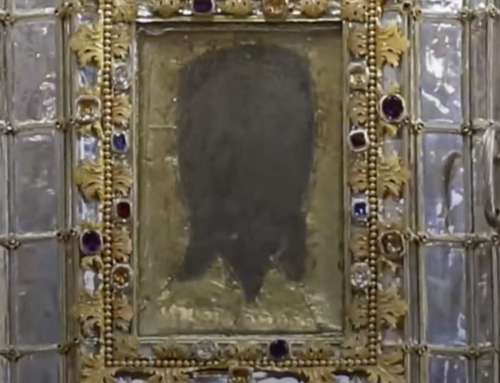
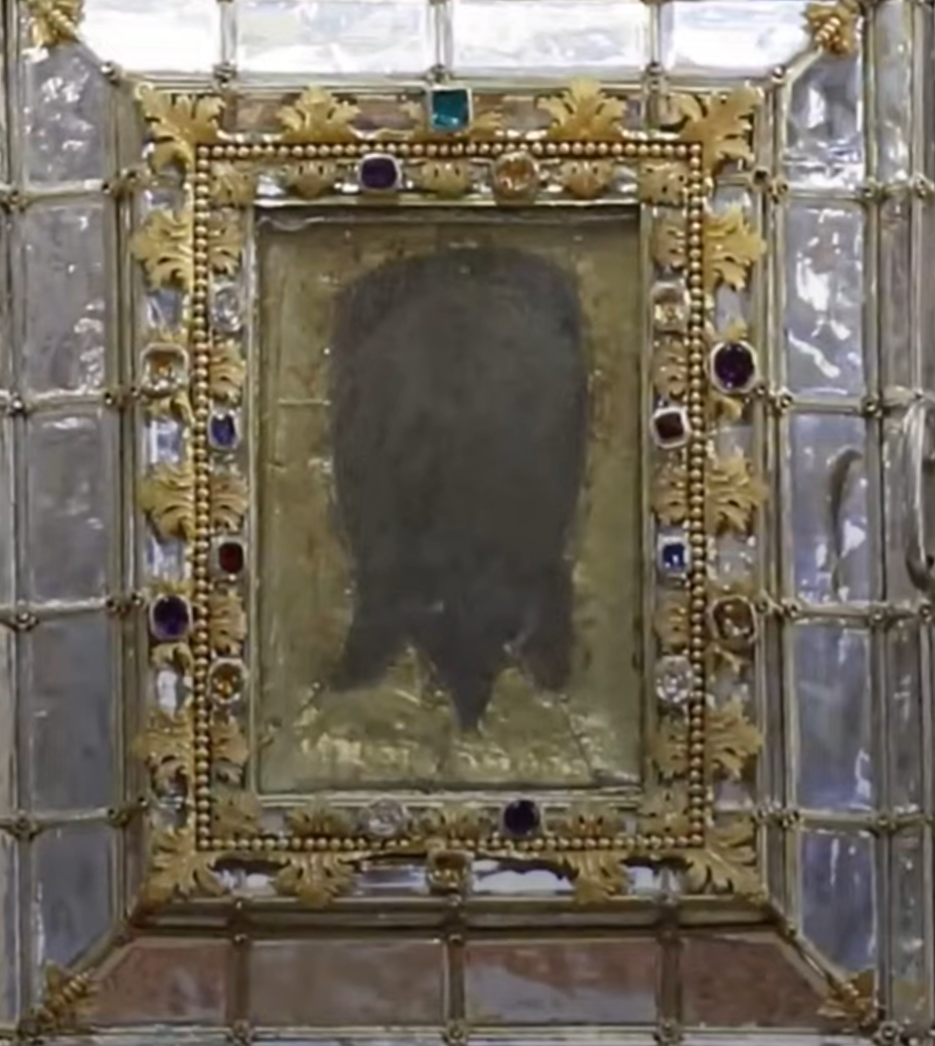
THE HOLY FACE AND OUR LADY OF THE SEVEN DOLORS.
Oh adorable Face, become like to that of a leper, have pity on us.
Let us transport ourselves in spirit near Mary at the foot of the cross. Let us hail the Mother of sorrows, let us endeavor to understand the torture her soul endured, when contemplating the Face of her divine Son on the cross. She exclaimed— “Call me not Noemi, which is beautiful, but call me Mary, which is bitter; for the Almighty hath quite filled me with bitterness(1).”
1st POINT. — SUFFERINGS OF MARY AT THE FOOT OF THE CROSS.
The tortures which martyrs have endured are nothing in comparison with the anguish which Mary suffered. In Mary, it is the soul which is pierced with the sword of suffering. And what suffering! It is suffering which nature and grace elevate to the very highest degree. Nature shows us in Jesus the most perfect of sons, the most beautiful of the children of men, and now his Face is more disfigured than that of a leper; it is that of a man of sorrows who has tasted every kind of suffering. Grace reveals to her in her son, God infinitely good, infinitely powerful, the Creator of the universe and the Savior of the human race. And she sees him upon the cross, placed amongst criminals, mocked at and maltreated by his people, steeped in outrages by menials and executioners. Do you recognize, oh Mary, the gracious Face which you adored with such profound respect in the stable of Bethlehem; the Face which wounded with a dart of love, in the Temple, the heart of the holy old man and that of Anna the prophetess; which filled with admiration the doctors of the law? Behold if now, upon the cross, and since a mother always recognizes her son, recognize your Jesus and your God, but recognize also my work and the work of sin, and let me weep for a moment from grief and regret at the sight of his sufferings and of yours.
2nd POINT. — THE WORDS SPOKEN BY JESUS TO MARY.
But the eyes of Jesus have met those of Mary; he also sees, standing near her, the beloved apostle, and his dying lips part that he may let his sacred testament fall from them. “Woman, he said, behold thy son; Son, behold thy mother(2).” What an exchange! exclaims St Augustine, instead of the most amiable of sons, of the God man, Mary receives guilty humanity. And she accepts the exchange. Ah! if I could but at least resemble St John! If I could, like him, unite myself inseparably to my august mother, follow her steps, live her life, love and suffer with her! Mary is my mother, Jesus said it on the cross. I will therefore say with the Church — “Oh mother, source of love, grant me to feel the violence of your sorrow, and also to weep with you. Holy mother of my Savior, impress deeply on my heart the wounds of my crucified Jesus. Let me weep with you, let me compassionate the sufferings of the divine crucified as long as I live in this land of exile and suffering(3).”
SPIRITUAL BOUQUET
Ecce Mater tua.
Behold thy mother. (John, xix, 26.)
CURE OF A YOUNG GOVERNESS.
The following fact was related before the ecclesiastical tribunal, in the cause of M. Dupont, by three witnesses— the person on whom the miracle had been worked; her brother, who is a Cure at the present moment, and their sister, from whom we borrow the following more detailed account.
“In the month of August of the year 1863, my sister, who was then a governess, and about twenty years of age, was suddenly attacked with a very serious affection of the brain. The tidings which were received by her family were so devoid of all hope, that I put on mourning, and my father made all the necessary preparations for the bringing home of the corpse. The doctor, with the aid of nitrate of silver, succeeded however in saving her when all hope of his being able to do so seemed at an end; but he did not succeed in restoring her to health. When my father brought her home to us, she was suffering so much from her head and from brain exhaustion, that her ideas were in a state of confusion. Added to this, she was not able to take anything, or hardly anything to eat. She had terrible palpitations, which were so strong, that they raised the bedclothes. She could not, so to speak, walk, still less get up stairs. This state of things, which lasted about three months, left no hope of any cure being possible.
“In the summer of 1867, one of our friends, a lady, proposed to take my sister with her to Tours to see M. Dupont. My parents looked upon this journey as being almost impossible; but fearing nevertheless to disappoint the patient, they permitted her to undertake it, and she was able to travel, certainly with difficulty, but without any accident. My sister told us that when she reached the house of the servant of God, she experienced a quite indefinable impression. After prayers had been offered and unctions made, Dupont told her to go up stairs. She obeyed, but she ascended the steps very slowly. The servant of God told her to mount them a second time, and more quickly; she did so, and she then understood that she was cured.
“She was able to walk from M. Dupont’s house to the hotel, not only without fatigue, but feeling such pangs of hunger that she was obliged to eat a piece of bread, though during four years she had not had the slightest appetite.
“The return home was accomplished quite easily. When we saw her that same evening, her complexion had recovered its rosy hue, and had lost the olive tint which it had had for three years. At table, she ate with an excellent appetite, she walked and went upstairs without the least difficulty. Her palpitations had disappeared. Her cure was instantaneous and complete.”
INVOCATION.
Oh adorable Face of Jesus, which dost lovingly bend over the sick, the objects of thy paternal tenderness, look favorably also on those who have recourse to thy power and thy goodness. Deliver us, above all, from sin, and grant that our foreheads and our hearts may be always pure and turned towards thee, the source of all grace and of all holiness.
(1) Ne vocetis me Noemi, id est pulchram; sed vocate me Maria, id est amaram. (Ruth i, 20.)
(2) Mulier, ecce filius tuus. Ecce mater tua. (Joan., xxvii, 26.)
(3) Prose Stabat.