Meditation XXII
THE FACE OF JESUS, VERONICA, AND THE HOLY WOMEN.
Oh adorable Face, wiped with a veil by pious woman on the road to Calvary, have pity on us.
WE are about to meditate on the subject which friends of the Holy Face specially love. Veronica and the holy women will teach us how to console, and to rejoice the adorable Face of Jesus. Oh! that we might participate in the feelings of these pious women, and with them follow the Savior along the path of reparation, and offer to the suffering Jesus the pious homage which he awaits from his most faithful disciples.
1st POINT. — VERONICA WIPES THE FACE OF JESUS.
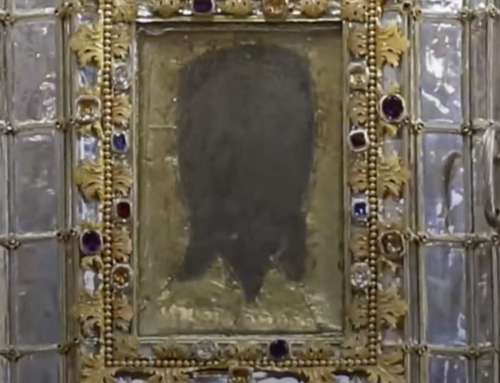
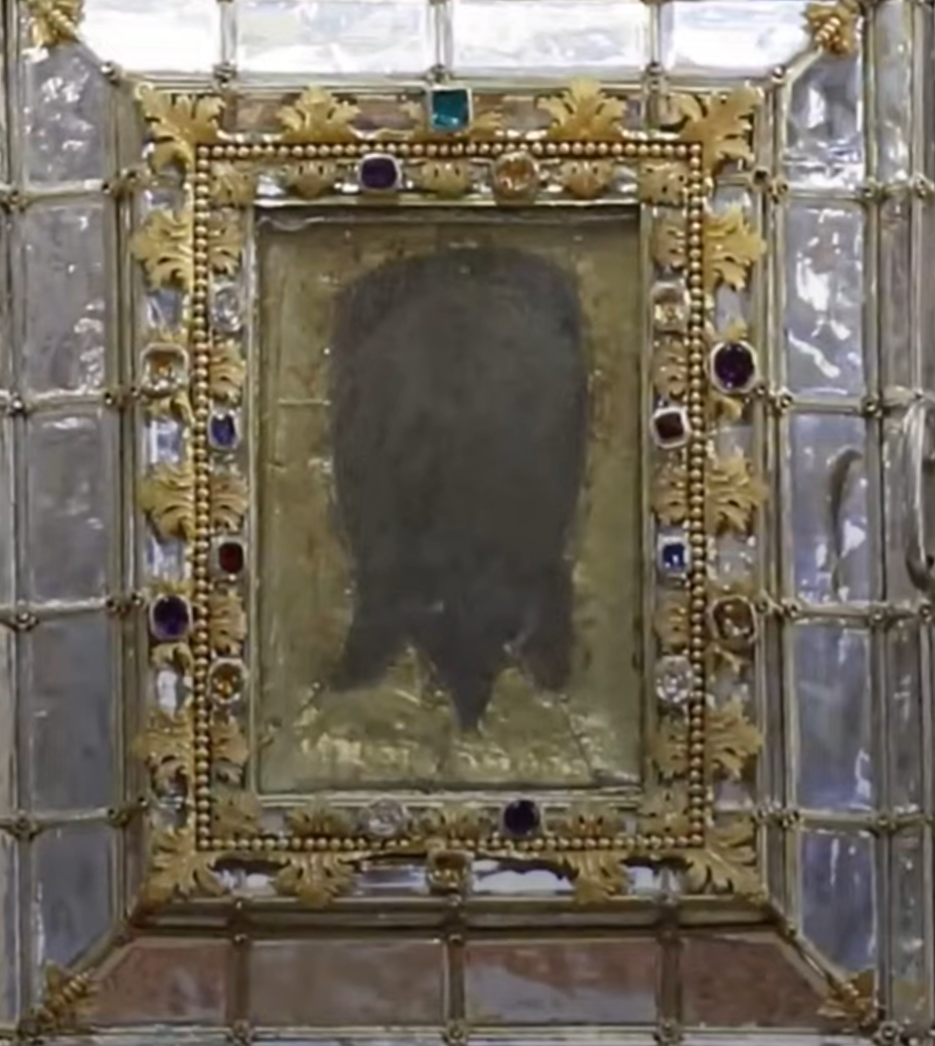
Hardly had the Savior risen from his first fall than a pious Israelite, who had followed him and who was filled with pity for his sufferings, could not restrain the impulse of her generous and faithful love. She passed through the ranks of the soldiers, she despised the sarcasms of the crowd, and at last she reached her master. He had no longer the appearance of a man, he had become a worm, as it were, and as the dregs of humanity. Under these disguises she adores her God, voluntarily disfigured for our sins, and detaching the precious veil which covers her brow, she presents it on her knees with reverence to the Savior. He takes the veil of Veronica, he applies it to his divine Face, he shows to the pious woman the real relief which her act of charity has afforded him, and he leaves her the miraculous proof of it, and the lasting recompense in the precious relic which the whole world venerates at St Peter’s in Rome, and which keeps for ever preserved on it the features of the Man God suffering for his creatures in testimony of his love.
Oh Jesus, permit me to repair, in union with Veronica, the sacrileges, the impiety, the indifference and the coldness of which thou art every day the object. Impress thy Face on my heart, and by this token recognize me to be thy child and thy disciple.
2nd POINT. — THE HOLY FACE AND THE HOLY WOMEN.
Veronica was not alone. There was a crowd of people and of women who wept and lamented over Jesus(1). They also have their recompense. The Savior halts, he turns his Holy Face towards them, and lets fall from his lips these consoling words— “Daughters of Jerusalem, weep not for me, but weep for yourselves and for your children.” And these words of the Savior have resounded through the centuries in the ears of pious mothers, of wives, of all Christian women, who have set themselves to meditate on the passion of Christ, to follow the sorrowful way of the cross, and also to express the feelings of sorrow with which the lamentable state to which their master has been reduced inspires them, and the instruction which they receive is always the same. Before pitying the sufferings of your God, try to put a stop to the torrent of iniquities which is swollen by the impieties and the blasphemies of your children, of your husbands and of your fathers. It is for you and for them that you ought to weep, rather than for the sufferings of the Savior.
Oh Jesus, give me grace to lay to heart this pious duty, and by my expiations, my sighs and my tears, to gain hearts for thee.
SPIRITUAL BOUQUET
Nolite flere super me, sed super vos ipsas flete et super filios vestros.
Weep not over me, but weep for yourselves and for your children. (Luke, xxiii, 28.)
THE PRESENTATION OF THE BANNER OF THE SACRED HEART BY M. DUPONT TO GENERAL CHARETTE.
The facts are known which are the occasion of this episode in the national history of France during the year l871. Our readers will, however, permit me to recall them to memory.
It was during the most bitter days of our misfortunes. Our armies had suffered several sanguinary defeats; the shame of capitulation had been added to the tortures inflicted on the country; the capital was about to be besieged by an army twenty times superior to that of its defenders. All hope seemed to be lost.
During the month of October 1870, M. de Montagu, a gentleman attacked by dropsy of the heart, and M. l’abbé de Musy, a young priest who was paralytic and almost blind, but who was destined later on to be one of those privileged to receive graces at the hand of Our Lady of Lourdes, were conversing together respecting the misfortunes of France and seeking for means whereby to remedy them. Already eminent laymen, natives of Poitiers, had made a vow to raise a sanctuary to the Sacred Heart in the midst of Paris. All at once the old man said to his interlocutor— “Blessed Margaret Mary wrote these consoling words— The Sacred Heart will save France. Let us endeavor to put into the hands of our soldiers the true Christian banner bearing embroidered on it folds, the picture of the Sacred Heart. Let us send this banner to Paris, and let it float as a testimony of the faith of France upon the walls of the besieged capital.”
The abbé de Musy adopted the idea and immediately wrote to the Superioress of the Visitation at Paray-le-Monial. In a few days the banner was embroidered. There then remained the difficulty of making it reach the hands of General Trochu, Commander of Paris. All communication with the capital had been broken off, and the Government of the National Defense installed at Tours. M. l’abbé de Musy possessed in that town a devoted friend, namely M. Dupont. He sent the banner of the Sacred Heart to him with these words— “If you can, you must send it to General Trochu. If not, then confide it to one of our heroic crusaders, Charette or Cathelineau.”
By a providential coincidence, Charette had just arrived at Tours, to organize his battalion of volunteers of the West. M. Dupont called upon him at the hotel de Londres, and a meeting was arranged for the next morning before the Holy Face. There, in presence of a little group of friends, the case containing the banner was opened. This banner, the authentic fac-simile of which may be seen in the Orator of the Holy Face, represents the Sacred Heart, and has the following legend or it— Heart of Jesus, save France.”
Prayers were offered for the salvation of France, and it was decided that the banner should be placed by the Rev Father Rey until the next day on the tomb of St Martin, and that on the reverse side of the flag should be added these words— “St Martin, protect France.” The embroidery, designed by the ladies who were present, was executed by the Carmelites.
Charette then received, at the hands of the holy Man of Tours, and amidst the emotion of all who were present, the labarum which was destined to distinguish itself on the fields of Patay and of Loigny. This touching scene has been represented on a glass window of the sanctuary of Notre-Dame de Graçay (diocese of Bourges).
M. Dupont is there seen standing before the Holy Face, with one hand raised to heaven, as in the attitude of the accomplishment of a solemn act; with the other hand, he holds the banner of the Sacred Heart, which Colonel Charette, kneeling on one knee, receives with faith and reverence.
The pilgrims who visit this sanctuary, and who will admire this work of art, will not fail to make the reflection that the devotion to the Sacred Heart and the devotion to the Holy Face are inseparably united. God has raised up both the one and the other to be in these latter days a powerful means of regeneration and of salvation.
INVOCATION.
Oh Lord Jesus, who has said— Learn of me for I am meek and humble of heart, and who didst manifest upon thy august Face the sentiments of the divine Heart, grant that we may love often to come and meditate upon the divine features, that we may read there thy gentleness and thy humility, and learn how to form our hearts to the practice of these two virtues which thou desirest to see shine forth in thy servants.
(1) Sequebatur autem illum multa turba populi et mulierum quae plangebant et lamentabantur eum. (Luc. xxiii, 27.)